


Announce

Calls for Papers and Contributions

CfP: Pedagogy and the Premodern
Posted: Sunday, December 29, 2019 - 15:57

A symposium hosted by Duke Center for Medieval and Renaissance Studies

March 6–7, 2020 Duke University

Scholars of the premodern face an increasingly difficult challenge in the modern academy: presenting medieval and early modern texts, materials, ideas, and histories in classrooms and institutions preoccupied to an unprecedented extent with the new and the now. In addition to perennial questions of the (allegedly) declining relevance and appeal of premodern study to postmodern undergraduates, we face in our classrooms potential barriers to student engagement and learning—difficulties of language; problems of unfamiliarity; questions of relatability—that are specific to our fields and require considered approaches. More troublingly, the premodern past has become in recent years a particularly explosive site of contestation as insidious and racist attempts to co-opt this past have been made ever more visible, both inside and outside the academy.

In light of these contemporary concerns, what does it mean, today, to teach the premodern past responsibly and ethically? How might we effectively engage students in the unfamiliar past in a way that connects with a rapidly changing present? How can we help students to attend seriously to medieval and early modern voices, concerns, and ideas? How does the medieval and early modern classroom remain a vital and vibrant force in the modern university?

This symposium, hosted by Duke's Center for Medieval and Renaissance Studies, seeks to open out conversations about pedagogical theory and practice in medieval and early modern studies that stem not from anxiety about the relevance of these areas of study, but from assurance of their value. We hope to create a space for robust and practical thinking about the pedagogical challenges and opportunities of teaching the premodern world within the postmodern classroom. To that end, we invite teachers and scholars working in any discipline to propose panel sessions, workshops, roundtables, and individual papers on any aspect of medieval and early modern pedagogy within the contemporary university.

Presentations, in whatever form, should be geared towards sparking discussion and encouraging interchange among participants. Lines of inquiry might encompass (but are certainly not limited to):

Questions of "relevance" and appeal

Diversifying and/or decolonizing the premodern syllabus

Creative and/or performance-based pedagogy in the premodern classroom

Digital pedagogies and premodern materials

Teaching the premodern through popular culture

Anti-racist pedagogies and the premodern classroom

Balancing the alterity and continuity of the premodern past

Interdisciplinary pedagogy

Exemplary models and strategies for teaching premodern material

We welcome participation from scholars working in any discipline in premodern study, broadly conceived, and particularly encourage early-career scholars and advanced graduate students to submit proposals for papers, panels, and workshop sessions that engage deeply with pedagogies of the premodern from any angle and at any scale, from the systemic to the individual assignment.

Proposals for individual papers, panel sessions, or workshops should be submitted by January 15, 2020. For individual papers, please submit a 150-word abstract and a current CV. For panel sessions, organizers should submit a brief overview of the proposed panel, and the names, contact information, and CVs of all participants. Workshop proposals should include a brief overview of the content and aims of the workshop, a current CV, as well as details regarding format, number of participants accommodated, and any space/equipment/special requirements.

We encourage interested scholars to reach out with any questions. Proposals and queries should be sent to: Grace Hamman (grace.hamman@duke.edu) and Lindsey Larre (lindsey.larre@duke.edu).
CfP: 2020 TACMRS International Conference: Food: Sacrifical, Spiritual, and Secular
Posted: Sunday, December 29, 2019 - 15:55

Food, whether secular or spiritual, physical or metaphysical, human or nonhuman, has been an important issue throughout the history of this planet. Human history is a long story of appetitive contest with nature and the environment, while consumption is an empowering practice that involves struggle and sacrifice. The matter of food may illuminate or complicate histories of labor, leisure, science, production, ethical considerations, religious discourse and practices, and environmental concerns.

Eating and drinking are not only biological behaviors but also acts filled with deeper significance. In the Book of Genesis, God endows humans with ascendancy over the natural world, just as Noah is instructed that every living thing is a potential meal for humankind. The rules for the edible and nonedible in the Bible concern the establishment of a communal identity. In Greek mythology, the change of the seasons is caused by Persephone’s eating of the seeds of a pomegranate in Hades. In the Iliad, Achilles’s refusal to eat indicates both his super- and sub-human status. Eating and drinking in many religions also serve as fundamental metaphors for human connectedness with the divine. For Christians, the Eucharistic bread and wine denote the continuing presence of Jesus in the world, whether in sign or reality, as is graphically portrayed by the Ugolino episode in Dante’s Inferno.

Food, drink, and modes of consumption have been crucial topics in many fields and periods. Plato and Xenophon, for example, considered a symposium the perfect place and time for philosophical inquisitions, where the banquet of wisdom could be consumed. In medieval English romances, banquets and feasts are not only social occasions but also venues where miracles and mysteries happen. In Thomas More’s Utopia, the moral meanings and ethical implications of diet are treated in the context of the design of the farms and dietary treatises. Shakespeare’s The Taming of the Shrew shows how food intakes were thought to influence the balance of the four bodily humors when Petruchio denies Katherine meat in an attempt to quench her feisty temper. Lady Mary Wroth’s 1621 prose romance Urania reflects the social changes around banqueting with particular reference to the court of King James I. In Ben Jonson’s Volpone, the protagonist’s excessive desire, social abnormality, and moral degeneration is demonstrated by the consumption of parrots, nightingales, peacocks, and ostriches. In the visual arts, food and drink also serve as important cultural repositories of numerous allegories and symbols. While Cornucopias celebrate abundance and thanksgiving, apples in devotional paintings frequently symbolize redemption. Furthermore, in material culture, importation of exotic food bore witness to the burgeoning globalization evidenced by frequent international trade and cultural exchange. Oranges stood for wealth in regions such as Flanders after being imported from Spain, while pineapples with their crown-like bracts made their way to European furniture and paintings as images of power after being imported from South America.

To explore the important issues of food/drink/consumption, this conference welcomes papers from scholars working in all fields such as anthropology, geography, history, literature, art, politics, sociology, religion, and cultural studies from the pre-modern to the early modern periods. Topics for consideration might include (but are not limited to):

Art and Visualization of food/drink/consumption

Boundaries of the edible and nonedible

Critical explorations of food/drink/consumption

Culinary writings

Politics of food/drink/consumption

Religion, Heresy, or the Sacred Forms of food/drink/consumption

Food/drink/consumption and Fasting, Festivity, or Medicine

Food/drink/consumption and Emotions, Obsessions, or Language

Food/drink/consumption and Gender, Racial Identity, or Society

Food/drink/consumption and the Moralistic/Legislative

Food/drink/consumption and Ecology, Philosophy, or Theology

Food/drink/consumption and Medievalism or Technology

TACMRS warmly invites papers either in English or Chinese that reach beyond the traditional chronological and disciplinary borders of Classical, Medieval, and Early Modern Studies. This conference will comprise Paper sessions and a Roundtable discussion for pedagogy. Paper proposals and sponsored panel proposals (with individual paper abstracts) are welcomed. To ensure the quality of the papers presented, the presenters should submit drafts of full papers by the end of August 2020. Selected full papers will be peer-reviewed and published in a special issue of Ex-position.

Please submit proposals (250 words for English, 500 words for Chinese) along with a one-page CV to tacmrs.ntu@gmail.com by 6 January 2020. The Conference will take place on 23–24 October 2020 at National Taiwan University in Taipei, Taiwan. There is no registration fee for the conference. Please note, presenters should be members of TACMRS if they reside in Taiwan. Membership application forms can be downloaded from the TACMRS website or via email upon request. For more information, please visit the 2020 TACMRS Conference website at https://2020tacmrs.wordpress.com/ and the TACMRS website at http://tacmrs.org.tw/main.php.

CfP: Tenth Annual RefoRC Conference on Early Modern Christianity
Posted: Sunday, December 29, 2019 - 15:48

On 27–29 May 2020, the Tenth Annual RefoRC Conference on Early Modern Christianity will take place in Aarhus, hosted by the University of Aarhus.

Find the full Call for Papers at: https://www.reforc.com/tenth-annual-reforc-conference-on-early-modern-christianity/

Submission deadline: 1 March 2020.

Call for contributions: Women and History, c. 1500-Present
Posted: Sunday, December 29, 2019 - 15:37

Themed Issue of History: Journal of the Historical Association

Deadline for completed manuscripts: 30 June 2020

Guest Editors: Madeleine Pelling (Paul Mellon Centre for Studies in British Art) and Lilian Tabois (University of York).

The last decade has seen women, as the subjects and writers of history, increasingly positioned at the forefront of our cultural and scholarly discussions. From international events like Women’s History Month and social media campaigns including #WomenAlsoKnowHistory to the National Trust’s Women and Power programme, women’s contributions to personal, local and national histories are beginning to be recognised. More often than not, however, focus has remained on women as the subjects of historical narrative, rather than as its authors or makers. This themed issue of History will cover a period from c. 1500 – the present to explore women’s roles as historians, genealogists, antiquarians, archaeologists and activists, asking how they accessed, created and professionalised history across five centuries. Articles should be 6000-7000 words, and should be submitted by 30 June 2020.

https://gallery.mailchimp.com/ae053a7fde1b4b8eb1b5f99ca/files/31b83d0e-0e2f-488f-b0da-aa66584277b5/Women_and_History_CFP.pdf

CFP: Canadian Society for Renaissance Studies / Société canadienne d’études de la Renaissance
Posted: Sunday, December 29, 2019 - 15:25

(Le français suit.)

The 2020 conference of the Canadian Society for Renaissance Studies / Société canadienne d’études de la Renaissance (CSRS/SCÉR) will be hosted by Western University (London, ON) from May 30 to June 1st, as a part of the Canadian Federation for the Humanities and Social Sciences’ annual Congress of the Humanities and Social Sciences. The theme for this year is  “Bridging Divides: Confronting Colonialism and Anti-Black Racism”

The CSRS/SCÉR invites members to submit proposals that address the 2020 Congress theme in relation to the Renaissance and/or early modern period (approximately 1400-1700).

In addition, we welcome proposals on any topic relevant to this period in a full range of disciplines, such as art history, bibliography, book history, cultural studies, digital humanities, history, literature, medicine, music, or philosophy. Crossdisciplinary and interdisciplinary approaches are particularly welcome. Proposals can be submitted in either English or French, and should fall into one of the following categories:

a) an individual proposal (maximum 300 words) for a 20-minute paper;

b)  a panel of three proposed 20-minute papers that address a defined theme (to be submitted in one file listing the names and institutional affiliations of the organizer(s) and participants, the proposed title of the session, a brief description (of 100 to 300 words) of the theme, and 300-word abstracts of each of the three proposed papers);

c) a workshop or roundtable discussion (to be submitted in one file including the names and institutional affiliations of the organizer and proposed speakers, the proposed title of the session, a 300- word paragraph outlining the focus and goals of the session, as well as the anticipated contributions of all of the participants).

Please submit your proposal (a) or proposed session (b or c) together with a brief (100-word) bio for each participant indicating presenter or speaker’s name, institutional affiliation, position (graduate student, faculty member, independent scholar, etc.) and full contact information to Program Chair Kenneth Graham, no later  than 15 January 2020 at: k2graham@uwaterloo.ca

Please note: acceptance of successful submissions will be sent out by the end of February 2020. To participate in the conference, you must be a member in good standing of the CSRS-SCÉR for the year 2020.

APPEL DE COMMUNICATIONS, SOCIÉTÉ CANADIENNE D’ÉTUDES DE LA RENAISSANCE, CONGRÈS 2020

Le prochain congrès de la Société canadienne d’études de la Renaissance (SCÉR) se tiendra du 30 mai au 1er juin 2020, à l’Université Western (London, ON), dans le cadre du Congrès annuel de la Fédération canadienne des sciences humaines (FCSHS).

Le congrès de cette année a pour thème « Bâtir des passerelles : combattre le colonialisme et le racisme anti-Noirs ». La SCÉR invite ses membres à soumettre des propositions de communication qui abordent ce thème en rapport avec la Première Modernité (1400-1700) ou tout autre sujet relatif à la Renaissance dans les disciplines qui les intéressent : littérature, histoire, philosophie, musique, histoire de l’art, histoire du livre, bibliographie, études religieuses, médecine, études culturelles, humanités numériques, etc.

Les propositions de communication interdisciplinaires ou pluridisciplinaires sont aussi les bienvenues. Les communications peuvent être soumises et présentées aussi bien en anglais qu’en français et ressortir à l’une ou l’autre des trois catégories suivantes :

a) une proposition de communication individuelle de vingt minutes sur un sujet librement choisi (maximum 300 mots);

b) une séance de trois communications de vingt minutes chacune sur un thème commun (à soumettre en un seul dossier incluant le nom de l’organisateur ainsi que les noms des participants et leurs affiliations institutionnelles, de même que le titre de la séance proposée, une brève description du sujet (de 100 à 300 mots), les trois propositions de communication (maximum 300 mots chacune) et l’ordre de présentation souhaité des conférenciers;

c) un atelier ou une table ronde (à soumettre en un seul dossier incluant le nom de l’organisateur ainsi que les noms des participants et leurs affiliations institutionnelles, de même que le titre de l’atelier ou de la table ronde, et un paragraphe (maximum 300 mots) décrivant le sujet et les objectifs de même que la contribution attendue de la part de chaque participant).

Merci d’envoyer vos propositions de communication (a), de séance, d’atelier ou de table ronde (b ou c) accompagnées d’une brève notice (100 mots) indiquant le nom du conférencier, son affiliation institutionnelle, son statut (étudiant au cycle supérieur, professeur, chercheur indépendant, etc.) et ses coordonnées complètes (adresse postale et adresse courriel), au responsable du programme à Kenneth Graham (k2graham@uwaterloo.ca ) au plus tard le 15 janvier 2020.

Veuillez noter que l’annonce des propositions qui auront été retenues sera envoyée aux participants à la fin du mois de février 2020. Afin de participer au congrès, vous devez être un membre en règle de la SCÉR pour l’année 2020.

Jobs

University of South Carolina-Columbia, MLA, Langs, Lits, & Cultures, Assistant Professor of French Cultural Studies (tenure-track)
Posted 24 Nov 2014 - 14:19

The Department of Languages, Literatures, and Cultures (http://artsandsciences.sc.edu/dllc/) at the University of South Carolina announces a tenure-track assistant professor position in pre-19th century cultural studies (broadly conceived), with a strong interest in interdisciplinary studies and/or Business French. The successful candidate must be able to teach French language, literature and culture at all levels, and will be expected to have an active research agenda. Native or near-native French language skills required. Teaching responsibilities include two courses per semester and offer the opportunity to teach in the nationally-ranked Comparative Literature Program. A Ph.D. is required, in hand, by August 1, 2015. A record of teaching experience at the collegiate level is also required. 

Applicants should submit a letter of application, current CV, and three signed letters of recommendation to:

For full consideration by the search committee, complete applications should be received through the Interfolio website no later than November 1, 2014.

The Department of Languages, Literatures, and Cultures is proud to be home to the tenth ranked public PhD in Comparative Literature in the nation (NRC 2010). We are also home to internationally known scholars in language acquisition and literary studies, Chinese, Classics, French, German, Russian, and Spanish. The department provides instruction in 12 languages and offers undergraduate majors in seven different programs, teacher certification in 4 language programs, and Masters degrees in Comparative Literature, French, German, and Spanish. It also works as an active partner with the PhD in Linguistics. Languages, Literatures, and Cultures is a campus leader in the study and use of instructional technology, and the home of innovative programs that move learning beyond the traditional classroom.

The University of South Carolina's main campus is located in the state capital, close to the mountains and the coast. The Carnegie Foundation for the Advancement of Teaching has designated the University of South Carolina as one of only 73 public and 35 private academic institutions with "very high research activity" and also lists USC as having strong focus on community engagement. The University has over 31,000 students on the main campus (and over 46,000 students system-wide), more than 350 degree programs, and a nationally-ranked library system that includes one of the nation's largest public film archives. Columbia, the capital of South Carolina, is the center of a greater metropolitan area which has a population over 750,000.

The University of South Carolina is an affirmative action, equal opportunity employer. Minorities and women are encouraged to apply. The University of South Carolina does not discriminate in educational and employment opportunities or decisions for qualified persons on the basis of race, color, religion, sex, national origin, age, disability, sexual orientation, or veteran status. 

 
University of North Carolina Wilmington, tenure-track, French Media / Cultural Studies
Posted 24 Nov 2014 - 14:17

The Department of Foreign Languages and Literatures at the University of North Carolina Wilmington invites applications for a full-time, tenure-track position in French Media and/or Cultural Studies beginning August 2015.

The teaching load is 3/3 and includes language, literature, and culture courses at all levels of the undergraduate curriculum in a dynamic and growing French Section. Applicants must have an active research agenda, successful college-level teaching experience, and a strong interest in curricular development. An interest in participating in Applied Learning initiatives is crucial and contributions to university service are expected. The position requires native or near-native proficiency in French and English. A Ph.D. in French or an equivalent foreign degree must be in hand by August 2015.

To apply, please complete the online application at http://consensus.uncw.edu. A letter of application, addressed to Professor PJ Lapaire, Department of Foreign Languages & Literatures, and a curriculum vitae, must be attached to the online application in Microsoft Word or PDF format. Three letters of recommendation must be sent directly to Professor PJ Lapaire, Department of Foreign Languages and Literatures, University of North Carolina Wilmington, 601 S. College Rd. Wilmington, NC 28403-5954.Priority consideration will be given to application materials uploaded or postmarked by December 20, 2014, however applications will be accepted until the position is filled.

Initial interviews will be held via Skype in early 2015.

UNC Wilmington actively fosters a diverse and inclusive working and learning environment and is an equal-opportunity employer. Qualified men and women from all racial, ethnic or other minority groups, protected veterans, and individuals with disabilities are strongly encouraged to apply.

 
University of California, Santa Barbara, tenure-track, "Long French Enlightenment"
Posted 24 Nov 2014 - 14:13

RECRUITMENT PERIOD

Open Sep 15, 2014 through Dec 12, 2014

DESCRIPTION

The Department of French and Italian, University of California, Santa Barbara, invites applications for a tenure-track position at the rank of Assistant Professor in French Literature, beginning July 1, 2015. We seek a candidate whose research and teaching focus on aspects of the “long” French Enlightenment (ca. 1670-1815), with a strong background in the literature, philosophy, and culture of this period. The successful candidate will bring a comparative perspective to bear on the study of literature and will be able to contribute to existing initiatives such as the Graduate Center for Literary Research, the French track in Comparative Literature, and the Interdisciplinary Humanities Center. Preference will be given to candidates with a strong background in French and at least one other European literary tradition. Secondary specializations in a cognate field (e.g. history, political science, science and technology, translation studies, cultural studies) are welcome although not required. The successful candidate will teach in both the French and Comparative Literature programs, including large humanities courses on European literary culture, smaller courses for the French major, and graduate seminars. The ability to conduct courses at all levels in French and English is essential, as is evidence of outstanding research (or research potential). Ph.D. is expected by the time of appointment.

All application materials, including letters of reference, should be uploaded onto the UCSB Academic Job Board athttps://recruit.ap.ucsb.edu/apply/JPF00384. Application packets should include the following: cover letter, detailed curriculum vitae, short writing sample, teaching statement, transcript, and at least three letters of recommendation. The Department will begin reviewing materials on November 15, 2014. To ensure full consideration, all application materials should have arrived by that date. Inquiries may be addressed to the search committee at frenchlitsearch2014@frit.ucsb.edu. Interviews will be conducted at the Modern Language Association Convention in Vancouver (Canada), January 8-11, 2015.

The Department of French and Italian at the University of California at Santa Barbara is deeply committed to both research and teaching, with nationally and internationally recognized faculty in French, Francophone, and Italian studies from the medieval period to the present. Our Department is strongly committed to interdisciplinary work and maintains close affiliations with other departments across campus, as well as strong integration with the Interdisciplinary Humanities Center (IHC), the Graduate Center for Literary Research (GCLR), the Comparative Literature Program, and Programs in Medieval Studies, Translation Studies, and Feminist Studies. We offer undergraduate programs leading to the B.A. in French and in Italian Studies and an M.A./Ph.D. track administered through the Department of Comparative Literature. For more information, please visit our web page at: http://www.frit.ucsb.edu.

The Department is especially interested in candidates who can contribute to the diversity and excellence of the academic community through research, teaching, and service. The University of California is an Equal Opportunity/Affirmative Action Employer. All qualified applicants will receive consideration for employment without regard to race, color, religion, sex, national origin, or any other characteristic protected by law including protected Veterans and individuals with disabilities.

REQUIREMENTS

DOCUMENTS

  • Curriculum Vitae - Your most recently updated C.V.

  • Cover Letter

  • Statement of Teaching

  • Transcript

  • Writing Sample

  • Statement of Contributions to Diversity - Statement addressing past and/or potential contributions to diversity through research, teaching, and/or service.

     (Optional)

  • Statement of Research

     (Optional)

REFERENCES

3-5 letters of reference required

HOW TO APPLY

  1. Create an ApplicantID
  2. Provide required information and documents
  3. If any, provide required reference information
  4.  
Professeur ou Professeure en littérature d'expression française (littérature des femmes), Université Laval (Québec)
Posted 24 Nov 2014 - 14:11
Professeur ou professeure en littérature d'expression française (Littérature des femmes) Période d'affichage 10-09-2014  au  09-01-2015 Département Département des littératures Faculté Faculté des lettres et des sciences humaines

Information générale sur la faculté / département

Milieu de vie privilégié au cœur de la ville de Québec, l’Université Laval est une grande université complète reconnue pour sa culture de l’excellence en enseignement et en recherche.

Description du poste

La personne titulaire de ce poste devra :

• Enseigner aux trois cycles en littérature d’expression française, notamment dans le domaine de la littérature des femmes ; • Encadrer des étudiants aux trois cycles et diriger des mémoires de maîtrise et des thèses de doctorat ; • Mener des activités de recherche dans le domaine de la littérature d’expression française, en particulier de la littérature des femmes ; • Participer au bon fonctionnement des programmes d’études littéraires ; • Prendre part aux activités départementales et universitaires.

Critères de sélection

• Doctorat (ou l’équivalent) ou doctorat en voie d’achèvement en littérature d’expression française (Québec, France ou francophonie) avec thèse sur la littérature des femmes ; • Expérience de l’enseignement de la littérature d’expression française au niveau universitaire ; • Publications pertinentes et participation à des colloques ou congrès dans le domaine ; • Aptitude à travailler en équipe ; • Une spécialisation en études culturelles sera considérée comme un atout.

Conditions d'engagement et de traitement

Salaire selon la convention collective en vigueur.

Candidature

Date limite de dépôt de candidatures 9 janvier 2015 Date d'entrée en fonction 1 juillet 2015

Faire parvenir sa candidature accompagnée d’un curriculum vitæ, de trois lettres de recommandation et d’un exemplaire des textes publiés et, le cas échéant, des évaluations d’enseignement, avant le 9 janvier 2015, à l'attention de : Madame Chantal Hébert Directrice Département des littératures Pavillon Charles-De Koninck 1030, avenue des Sciences-Humaines Université Laval Québec (Québec)  G1V 0A6

Aucune candidature par courrier électronique ne sera acceptée. Tous les documents doivent être envoyés à la date indiquée ; tout dossier incomplet sera éliminé.

Valorisant la diversité, l'Université Laval invite toutes les personnes qualifiées à présenter leur candidature, en particulier les femmes, les membres de minorités visibles et ethniques, les autochtones et les personnes handicapées. La priorité sera toutefois accordée aux personnes ayant le statut de citoyen canadien ou de résident permanent
Salisbury University, tenure-track, Generalist: open until filled
Posted 24 Nov 2014 - 14:08
The Department of Modern Languages at Salisbury University is accepting applications for a tenure-track position in French.

Area of Specialization: A generalist with demonstrated excellence in undergraduate teaching who will support our ongoing study abroad initiatives. Training in the francophone literatures and cultures of the Caribbean and Africa desired, but not essential.

Primary Job Duties: Teaching load is 3-3. Salisbury University faculty members are expected to demonstrate appropriate levels of scholarly activity and service.

Minimum Qualifications: A Ph.D. in French or related field is required at the time of hire. Native or near-native fluency required.

Applications will be accepted via Salisbury University's Online Employment Application System. Please visit our websitehttp://www.salisbury.edu/HR/Jobs/ to apply online. See the FAQs of the Online Employment Application System for more information and instructions.

To be considered an applicant, you must apply online and submit the following: 1). A letter of interest, 2). curriculum vitae, 3). a statement of teaching philosophy, and 4) the names, addresses, telephone numbers and email addresses of at least three (3) professional references. For questions about the position, please contact the search chair, Claire Kew at cfkew@salisbury.edu.

Applications received by November 15, 2014 will be given first consideration. The position will remain open until filled. Salary is competitive and commensurate with qualifications and experience. Appointment will be contingent upon verification of eligibility to work in the U.S. and is expected to begin August 2015.

This position is based in Salisbury, Maryland. Founded in 1925, Salisbury University is one of 13 institutions that compose the University System of Maryland. Salisbury University is a selective undergraduate institution with the University System of Maryland. The University is close to ocean beaches and the Chesapeake Bay and 2-3 hours from the metropolitan areas of Washington, Baltimore, Philadelphia, and Norfolk. SU has been cited nationally as one of the top ten public regional universities in the North according to the U.S. News and World Report, and has also been recognized by the Princeton Review and Kiplinger's magazine. SU has 388 full-time faculty members serving a student population of approximately 8,600.


New Publications

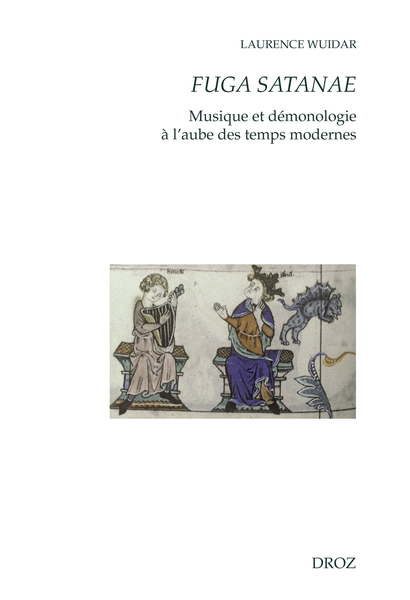
Fuga Satanae. Musique et démonologie à l'aube des temps modernes (Laurence WUIDAR)
Posted: 4 May 2023 - 10:00

Laurence WUIDAR, Fuga Satanae. Musique et démonologie à l'aube des temps modernes, Genève, Droz, 2023.
Dès le texte biblique, libérer l’individu possédé par le diable est une question épineuse qui reçoit une réponse musicale : David soigne Saul grâce au pouvoir de son instrument. Si la théorie musicale et la glose médiévale véhiculent cette action de la musique sur le malin, c’est au XVe siècle que naît un genre littéraire particulier à la diffusion et au succès européens : le manuel d'exorcisme où les théologiens établissent une science des signes pour distinguer la possession démoniaque des maladies naturelles et discourent des remèdes spirituels et corporels. La musique y est signe de la présence du diable et son langage participe des altérations du possédé, mais elle est aussi antidote et rétablit l'harmonie du corps aliéné. L’analyse de la musique dans les manuels d’exorcisme, au cœur de cet ouvrage qui inclut également la littérature de sorcellerie et de nécromancie, dévoile un rôle et un statut de la musique méconnus jusqu’à aujourd’hui que celle-ci ne perdra pourtant qu’à la mise à l’Index des manuels les plus célèbres au début du XVIIIe siècle.

Plus d'informations ici.

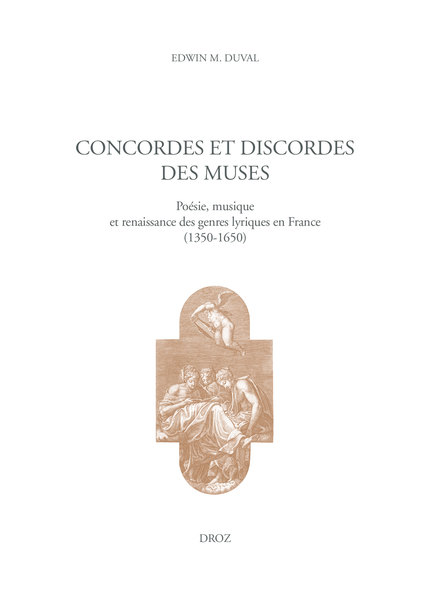
Concordes et discordes des muses. Poésie, musique et renaissance des genres lyriques en France (1350-1650) (Edwin M. DUVAL)
Posted: 4 May 2023 - 09:46

Edwin M. DUVAL, Concordes et discordes des muses. Poésie, musique et renaissance des genres lyriques en France (1350-1650), Genève, Droz, 2023.
De la fin du Moyen Âge jusqu’à l’aube de l’Âge classique, la musique ne cesse d’exercer une influence profonde sur les diverses formes de la poésie lyrique française – tantôt de manière positive, en imposant certaines contraintes formelles au texte, tantôt de manière plus négative, en présupposant des structures musicales que les poètes s’évertuent à « dé-lyriser ». En examinant dans le détail les concordances et les discordances entre forme poétique et forme musicale dans l’œuvre des poètes les plus importants depuis Guillaume de Machaut jusqu’à Tristan L’Hermite en passant par Clément Marot, Maurice Scève et la Pléiade, cette étude offre une nouvelle perspective sur l’essence même des genres dits « lyriques » – ballade, rondeau, virelai, sonnet, ode, stances. Elle découvre dans l’évolution de ces genres des moments de rupture et de continuité tout autres que ceux que l’histoire littéraire nous a habitués à y voir.

Plus d'informations ici.

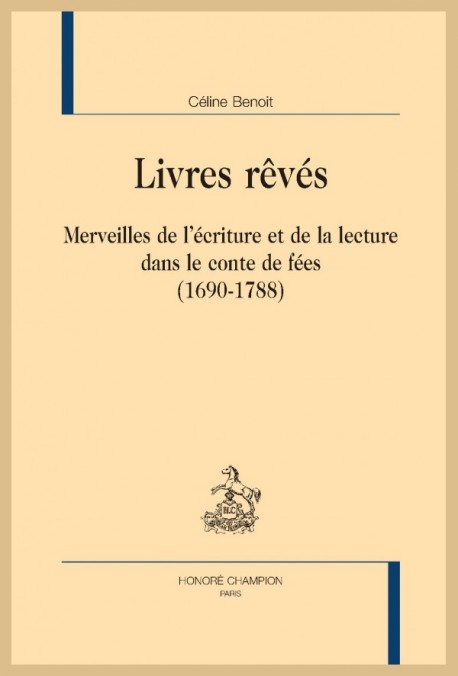
Livres rêvés. Merveilles de l'écriture et de la lecture dans le conte de fées (1690-1788) (Céline Benoît)
Posted: 4 May 2023 - 09:39

Céline Benoît, Livres rêvés. Merveilles de l'écriture et de la lecture dans le conte de fées (1690-1788), Paris, Honoré Champion, 2023.
Si la fée est aujourd’hui toujours représentée avec une baguette magique, cet objet n’est pourtant pas son apanage dans le conte de fées classique dans lequel l’écrit sous toutes ses formes – inscriptions, livres, bibliothèques – est largement prédominant comme le montre cette vaste étude.

Elle englobe toute la période de la mode du genre en France, soit de la fin du XVIIe à la fin du XVIIIe siècle, par des recensements exhaustifs et montre que la matière merveilleuse se nourrit dès ses débuts de l’essor de l’alphabétisation, du développement de l’imprimé ou encore des débuts de la bibliothéconomie. Un aspect inédit de l’histoire culturelle et le charme de ces représentations tout à la fois nostalgiques et modernes, aristocratiques et féministes sont ainsi dévoilés.

Cette enquête permet de mesurer l’originalité de ce genre littéraire dans son accueil du livre et de l’écrit, comme dans son évolution qui accompagne le mouvement des Lumières.

Céline Benoit est docteur en littérature et civilisations françaises de l’université Sorbonne Nouvelle-Paris 3. Elle dirige actuellement la bibliothèque Mathématiques Informatique Recherche d’Université Paris Cité.

Plus d'informations ici.

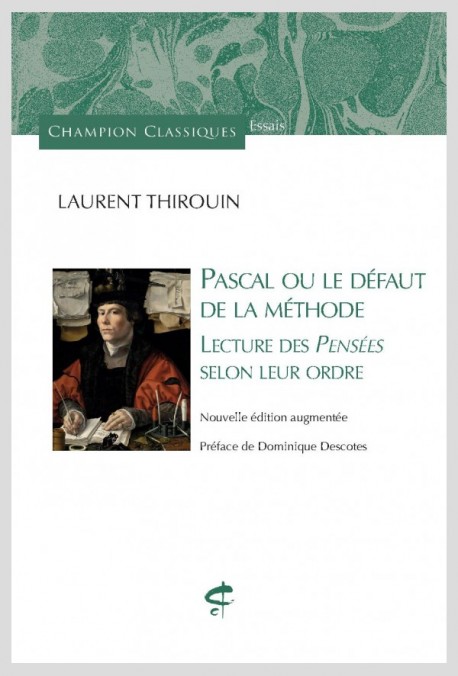
Pascal ou le défaut de la méthode (Laurent Thirouin) -réédition
Posted: 4 May 2023 - 09:35

Laurent Thirouin, Pascal ou le défaut de la méthode. Lecture des "pensées" selon leur ordre, nouvelle édition augmentée, préface de Dominique Descotes, Paris, Honoré Champion, 2023.
Redoutable dialecticien, Pascal reste conscient de la faiblesse de tout argument, de l’insignifiance des énoncés, de la stérilité des méthodes. Il ne prétend pas, dans ses Pensées avoir rien dit d’inouï, mais avoir mieux placé la balle dont tout le monde joue, avoir inventé une disposition nouvelle. Il importe donc de s’interroger sur cette disposition, c’est-à-dire de considérer enfin comme essentielle l’étrange répartition en liasses que restituent aujourd’hui les éditions des Pensées. L’ordre de Pascal est à la fois une rhétorique singulière et un rapport original à la vérité. Mais l’examen doit être inductif et méticuleux. Quelle logique exacte préside à la répartition des pensées entre une liasse « vanité » et une liasse « misère » ? Comment la raison des effets marque-t-elle la grandeur de l’homme ? Pourquoi Pascal a-t-il disséminé les fragments traitant du divertissement, au lieu de les réunir dans le dossier qui semble consacré à la question ? Quelle espèce de transition désigne-t-il sous le titre « Transition de la connaissance de l’homme à Dieu » ? Telles sont les questions, et d’autres similaires, proposées à la réflexion dans ce volume. Le commentaire d’une pensée ne devrait plus s’envisager en dehors de sa situation dans le singulier dispositif que forment les liasses.

Plus d'informations ici.

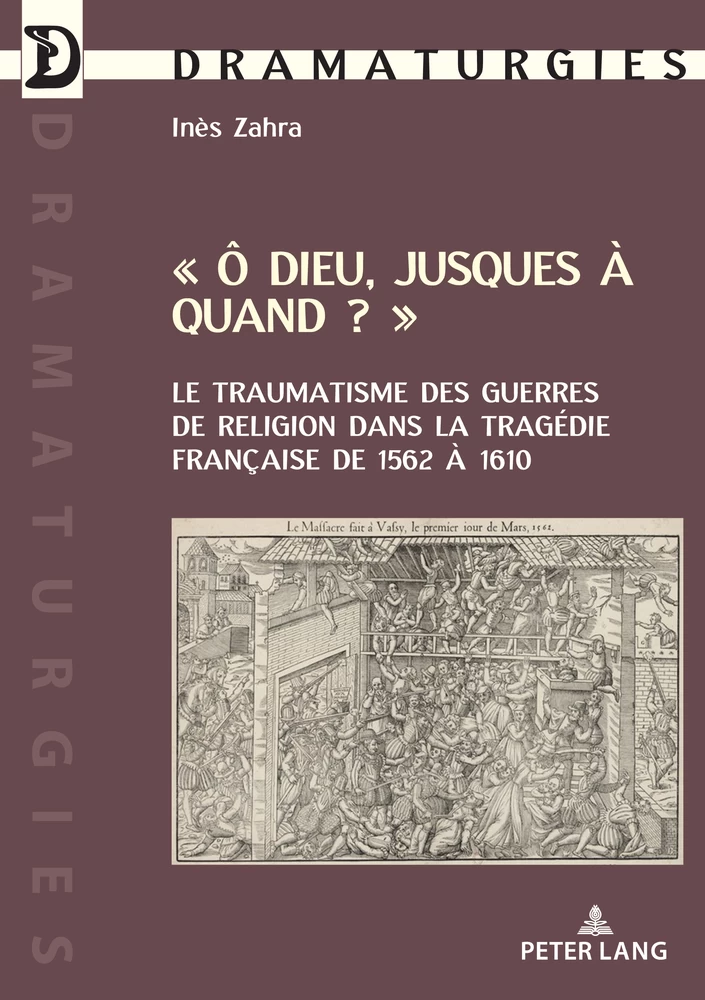
Ô Dieu jusques à quand ? Le traumatisme des guerres de Religion dans la tragédie française de 1562 à 1610 (Agnès Zahra)
Posted: 4 May 2023 - 09:25

Agnès Zahra, Ô Dieu jusques à quand ?  Le traumatisme des guerres de Religion dans la tragédie française de 1562 à 1610, Peter Lang, 2023.

Le traumatisme est aujourd’hui un paradigme essentiel dans la lecture et l’écriture de l’Histoire. Depuis la Deuxième Guerre mondiale et les procès de Nuremberg, qui débouchèrent sur la notion d’imprescriptibilité des crimes, notre rapport au temps s’est transformé. Le passé s’est imposé au présent, et la mémoire, jadis décrié e, s’est peu à peu hissée au rang de véritable devoir. Or, si aujourd’hui, dans les contextes d’après-catastrophe, l’oubli est ce contre quoi il convient de lutter, il n’en a pas toujours été ainsi. Dans la France des guerres de Religion, celui-ci n’était en effet pas le mal, mais la thérapeutique politique. Face à la rupture de l’unité religieuse qui engendra un déferlement de violence inouï , confrontant pour la première fois la conscience chrétienne à la mort de masse, la monarchie tentera, quarante ans durant, d’abolir la mémoire des exactions commises pendant les guerres. Mais le théâtre tragique, qui renaît en France précisément au moment où éclatent les conflits civils, semble hanté par l’actualité terrible. Quelle place ce théâtre fait-il à la mémoire des troubles ? Comment celle-ci s’y exprime-t-elle, s’y élabore-t-elle ? Que font les dramaturges de la violence juste passée et à quelles fins ? Dans ce livre, Inès Zahra examine, à l’aune des Trauma studies, courant théorique qui questionne la manière dont le passé violent affecte le présent, les rapports qu’entretiennent la tragédie franç aise de la fin du XVIe et du début du XVIIe siècles et la mémoire des guerres civiles.

Plus d'informations ici.

Conferences and Colloquia

The Clandestine and Heterodox Underground of Early Modern European Philosophy, 17th–18th Centuries
Posted: 10 Feb 2016 - 12:19

UCLA Center for 17th- & 18th-Century Studies

A conference organized by Margaret Jacob, University of California, Los Angeles; Gianni Paganini, Università del Piemonte Orientale; and John Christian Laursen, University of California, Riverside, co-sponsored by the UCLA Department of History; Università del Piemonte Orientale, Vercelli; and Centro di Ricerca della Accademia dei Lincei, Rome.

Friday & Saturday, March 4–5, 2016, 9:00 a.m.

314 Royce Hall, UCLA

This conference explores philosophical writings that circulated clandestinely in the early modern era—a corpus of some 250 texts in some 2,000 manuscript copies. At its most radical, the clandestine philosophical tract remained rigorously anonymous. These tracts offered a rationalist criticism of philosophy and religion, drawing on classical and Renaissance alternative traditions while providing critical readings of mainstream texts to bring out their errors and ideological slight of hand. Many of the ideas expressed in the manuscripts emerged in print in the works of Voltaire, Hume, d’Holbach, and Diderot. The conference examines how these manuscripts enable a reading of European intellectual history beyond the official professions of faith promoted by the schools and established authors. 

Speakers

Jeffrey D. Burson, Georgia Southern University

Sabrina Ebbersmeyer, Københavns Universitet

Karen Hollewand, University of Oxford

Jonathan Israel, Institute for Advanced Study

John Christian Laursen, University of California, Riverside

Inger Leemans, Vrije Universiteit Amsterdam

Whitney Mannies, University of California, Riverside

John Marshall, Johns Hopkins University

Gianni Paganini, Università del Piemonte Orientale

Winfried Schröder, Philipps-Universität Marburg

Maria Susana Seguin, Université Paul-Valery Montpelier III


Rienk Vermij, University of Oklahoma


To register, day 1: http://www.1718.ucla.edu/events/heterodox-underground/

To register, day 2: http://www.1718.ucla.edu/events/heterodox-underground-2/

UCLA campus parking information: https://main.transportation.ucla.edu/campus-parking/visitors/


Source: Steve Fleck


Îles et Insulaires (XVIe-XVIIIe s.)
Posted: 6 Feb 2016 - 20:57

Du 17 mars 2016 au 18 mars 2016

Maison de la Recherche   28, rue Serpente, Paris 6e   Salle D 035 

Jeudi 17 mars 2016

                                               ______________

                                                     09 h 00

                     Accueil des participants et Ouverture du colloque par

                                           Frank LESTRINGANT


                                                    09 h 30

                                            Georges TOLIAS

  Isolement, connectivité, singularité : le moment des îles, XVe-XVIe siècle.


                                                 09 h 55

                                       Burghart SCHMIDT

Les îles dans les descriptions cartographiques, iconographiques et historiques de l’époque moderne : une tentative d’interprétation interdisciplinaire.


                                         10 h 15-11 h : Discussion et Pause.


                                               11 h 00

                                     Cornelia KLETTKE

La cartographie des îles et l’imaginaire géographique dans le Roland furieux de l’Arioste.


                                              11 h 25

                                    Phillip John USHER

             La Crète épique. La Franciade et la tradition des isolarii.


                                              11 h 50

                                         Amy GRAVES

Souverainetés intermittentes :  l’Isle des Faisans et la frontière perméable franco-espagnole.


                                          12 h 15-12 h 30 : Discussion.

                                             14 h 30

                                   Laurence PLAZENET

 Îles romanesques au XVIIe siècle : exotisme et territoire de la morale.


                                            14 h 55

                              Marie-Christine PIOFFET

Archipels à la dérive : résurgence du mythe des îles flottantes dans la fiction romanesque du XVIIe siècle.


                                          15 h 20

                                Frédéric TINGUELY

L’île est un piège : les aventures de François Leguat et de Geoffroy Atkinson.


                                       15 h 45-16 h 15 : Discussion et Pause.


                                          16 h 15

                       Marie-Christine GOMEZ-GÉRAUD

                     Îles lointaines : le Japon des jésuites.


                                          16 h 40

                             Jean-Michel RACAULT

Naissance de la robinsonnade. Fonctions et significations de l’île dans Le Solitaire anglais (The Hermit) de Peter Longueville.


                                        17 h 05

                                Richard COOPER

     Le Portulan rimé de Jehan Maillart, escripvain du Roy.


                                        17 h 30-17 h 45 : Discussion.


                                       Vendredi 18 mars 2016

                                             ______________


                                                    09 h 00

                                              Tom CONLEY

                                L’île-sonnet : lire Du Bellay en 1558.


                                                   09 h 25

                                         Thomas HUNKELER

                            « Barbare à moy » : Scève et l’île-Barbe.


                                                   09 h 50

                                          Julien GOEURY

                                 Les îles chez Mage de Fiefmelin.


                                        10 h 15-11 h : Discussion et Pause.


                                                  11 h 00

                                 Dominique de COURCELLES 

  À la poursuite d’archipels « mas al Sur »: l’histoire des îles Diego Ramirez.


                                                11 h 25

                                 Jean-Claude TERNAUX

Les îles les plus fameuses du monde chez Du Bartas et ses commentateurs.


                                               11 h 50

                                       Kirsten KRAMER

Insularité et globalisation dans les Soledades de Góngora et les Novelas ejemplaresde Cervantès.


                                             12 h 15-12 h 30 : Discussion.


                                               14 h 30

                                       Wes WILLIAMS

                   « Ce n'est point une isle » : Montaigne, insulaire ?


                                             14 h 55

                         Edith MAZEAUD-KARAGIANNIS

Les îles grecques du Grand Insulaire d’André Thevet : refuges, retraites, exils.


                                            15 h 20

                                Alexandre TARRÊTE

                  L’insularité d’Utopia chez Thomas More.


                                          15 h 45-16 h 15 : Discussion et Pause.


                                          16 h 15

                                Carmen BERNAND

L’île de la Chaconne (XVIe-XVIIe siècle) : Le pays de Cocagne à Jauja, Pérou.


                                           16 h 40

                           Thibaut MAUS de ROLLEY

L’île des griffons : variations d’un motif, du Roman d’Alexandre à La Terre australe connue de Gabriel de Foigny.


                                         17 h 05

                                 Vincent MASSE

Le rôle des îles dans le système cosmo-eschatologique de Guillaume Postel.


                                       17 h 30-17 h 45 : Discussion.


                                         17 h 45-17 h 55 :

                               Conclusion et remerciements.


La Vraisemblance ou les enjeux de la représentation : Le théâtre et la peinture dans les discours Académiques (1630-1730)
Posted: 6 Feb 2016 - 20:38

Du 9 février 2016 au 11 février 2016

Centre allemand d'histoire de l'art / Deutsches Forum Für Kunstgeschichte

Hôtel Lully - 45, rue des Petits Champs, 75001 Paris


Organisation : Markus A. Castor et Kirsten Dickhaut 
 

« Si par les règles du théâtre, il est permis aux poètes de joindre ensemble plusieurs événements arrivés en divers temps pour en faire une seule action, pourvu qu'il n’y ait rien qui se contrarie et que la vraisemblance y soit exactement observée, il est encore bien plus juste que les peintres prennent cette licence, puisque sans cela leurs ouvrages demeureraient privés de ce qui en rend la composition plus admirable et fait connaître davantage la beauté du génie de leur auteur. »

Charles Le Brun, « Conférences de l’Académie Royale de Peinture et de Sculpture », Tome I, Vol. 1, 1648-1681, éd. par Jacqueline Lichtenstein et Christian Michel, Paris, 2006, p. 173.


Mardi 9 février 2016, 17h00

Thomas Kirchner, DFK Paris

Ouverture

Markus A. Castor, DFK Paris, Kirsten Dickhaut, Univ. Koblenz-Landau

Introduction

Jacqueline Lichtenstein, Université Paris-Sorbonne :

Le peintre a-t-il comme le poète, le droit de tout oser ? Vérité et vraisemblance dans les conférences académiques

Apéritif


Mercredi 10 février 2016

Présidence de séance : Kirsten Dickhaut & Markus A. Castor

09h-9h45 : Joachim Küpper, Freie Universität Berlin

Le concept de vraisemblance chez Aristote

09h45-10h30 : Andreas Kablitz, Universität zu Köln

À propos de la transformation du concept aristotélicien de la vraisemblance dans la poétologie du XVIIe siècle

10h30-11h15 : Hannah Williams, Queen Mary University of London

Entre théâtre et académie : l'art religieux dans les églises parisiennes

Pause midi

Présidence de séance : Markus A. Castor & Kirsten Dickhaut

14h-14h45 : Florence Ferran, Université de Cergy-Pontoise

La Vraisemblance du théâtre

14h45-15h30 : Anne-Elisabeth Spica, Université de Metz

Paradoxes et points aveugles du paragone

Pause Café

16h00-16h45 : Élodie Ripoll, Université Koblenz-Landau

Rougir sur la scène classique. Enjeux scéniques et théoriques

16h45-17h30 : Christophe Henry, Académie de Versailles

Manières, plasticité, analogies : La vraisemblance académique à l’épreuve des scories ataviques et culturelles

17h30-18h15 : Kirsten Dickhaut, Université Koblenz-Landau

La vraisemblance merveilleuse - une catégorie chère à Corneille et aux Académiciens


Jeudi 11 février 2016

Présidence de séance : Élodie Ripoll & Kirsten Dickhaut

09h00-09h45 : Susanne Friede, Alpen-Adria Universität Klagenfurt

Les règles de la vraisemblance et du genre : L'art de la représentation dans quelques comédies de Corneille

09h45-10h30 : Emmanuelle Hénin, Université de Reims

Vraisemblance et illusion : un discours en trompe-l’œil

Pause Café

11h00-11h45 : Laëtitia Pierre, Université Panthéon-Sorbonne

Tullia ou la violence représentée (1667-1735)

Présidence de séance : Laëtitia Pierre & Élodie Ripoll

11h45-12h30 : Markus A. Castor, DFK Paris

La volonté n’est pas toujours la maîtresse de nos productions – La vraisemblance dans le discours académique et dans la pratique artistique 1667-1740

Pause midi

13h30-14h15 : Lauren Cannady, Clark-Institute, Mass.

La question de la vraisemblance dans la peinture selon l’abbé Dubos : une reprise de Roger de Piles ?

14h15-15h45 : Alain Viala, University of Oxford

Il faut bien des bergers, pour la vraisemblance : de Molière à Watteau

15h45-16h30 : Theodora Psychoyou, Université Paris-Sorbonne

« Représenter en musique » et « bruit poétique » : de quelques paradoxes de la vraisemblance musicale


Source: Fabula
À la recherche du style de Tristan L’Hermite : des fils d’Ariane dans le labyrinthe tristanien
Posted: 1 Feb 2016 - 17:47

Cette Journée d'études aura lieu le vendredi 12 février 2016 de 10H30 à 17H00, à l’Université Paris-Est Créteil, Campus Centre, Bâtiment P, salle des thèses, 61, avenue du Général de Gaulle, 94000 Créteil, France (Métro ligne 8 – Créteil-Université. Elle est organisée par Claire Fourquet-Gracieux (U.Paris-Est Créteil Val de Marne) pour l’association des Amis de Tristan L’Hermite et l’équipe d’accueil LIS (Lettres, Idées, Savoirs) et portera sur la langue de Tristan.

« L’œuvre entière de Tristan figure [un] labyrinthe, et il convient de s’y promener sans tenir compte des distinctions de genres ou peut-être des dates » (F. Graziani, 1992). Relevons le défi implicite, qui consiste à sortir d’une approche poétique au profit d’une étude transversale, trans-générique, et plus précisément stylistique. Tristan est un polygraphe accompli. Poète, dramaturge, romancier, épistolier, il n’hésite pas à faire usage de la « polygraphie intégrée » (S. Berrégard, 2006) c’est-à-dire à pratiquer la polygraphie à l’intérieur d’un même opus. De la sorte, il serait en partie artificiel de séparer le Tristan poète du Tristan dramaturge, du Tristan épistolier ou du Tristan romancier. Tout nous invite plutôt à embrasser l’œuvre intégrale, dont l’unité paraît concertée : aucune de ses pièces de jeunesse n’a été reniée et la dimension diachronique de sa publication est lissée par Tristan lui-même dans les Vers héroïques.

Or, aujourd’hui, lorsqu’on attribue un manuscrit à Tristan l’Hermite, c’est avant tout la signature et la parenté thématique de ces pages avec les pièces tristaniennes qui sont invoquées. L’argument du style d’auteur est certes avancé, mais avec une charge d’implicite que cette journée d’études souhaiterait expliciter : les manuscrits « ont le style de Tristan, parfois le même vocabulaire et sont souvent signés par la mention ‘Trist.’ ou ‘Tristan’ » (L. Grove, 1997).

Tour à tour qualifié de maniériste, mariniste, malherbien, le polygraphe semble pourtant se dérober à toute recherche de singularité stylistique, ce que S. Boutet justifie en le qualifiant de poète de l’inventio plus que de l’elocutio. Parallèlement, en partie à cause de cette multiplicité d’étiquettes, Tristan échappe en permanence au statut de disciple ou encore à l’idée qu’il représenterait le style Louis XIII. Il présente donc un profil stylistique singulier, que nous nous proposons d’étudier, entre sincérité et ingéniosité portée au plus haut degré, selon la logique d’un détournement perpétuel. Peut-on repérer un faisceau de stylèmes qui sous-tendrait l’idée d’un style d’auteur, par-delà la variété stylistique ?

Cette journée d’études se propose donc de partir à la recherche de l’écriture tristanienne. À cet effet, le dialogue entre les spécialistes de Tristan L’Hermite et les lecteurs spécialistes d’autres domaines promet d’être enrichissant pour faire le départ entre stylèmes, sociolecte et idiolecte. Gageons que le savoir des spécialistes des genres pratiqués par Tristan, l’œil entraîné des dix-septiémistes familiers du style Louis XIII et l’expertise des linguistes de la période préclassique et classique donneront à saisir le style de Tristan.

Au-delà de l’étude monographique, poser la question du style de Tristan L’Hermite vise à nourrir la réflexion sur les deux notions théoriques de style d’auteur et de littérarité. La notion de style d’auteur apparaît généralement peu pertinente pour l’Ancien Régime, prise entre style d’époque et style de genre. Elle mérite cependant d’être interrogée et réhabilitée, à l’épreuve de la production de ce polygraphe. L’interrogation sur la littérarité trouve à son tour matière à s’exercer, dans une œuvre qui associe traductions, lettres réelles et genres littéraires. Entre fiction et réalité, ses Lettres mêlées suivent-elles ainsi « l’oblique du style » (A. Jaubert, 2006) ?

Programme

10h30-11h – Accueil et ouverture de la journée
Tristan et les autres
Présidence de séance : Véronique ADAM
11h-11h30 – Françoise GRAZIANI (Université de Corse)
« Concetto et pensée ingénieuse »
11h30-12h – Melaine FOLLIARD (Université Aix-Marseille)
« Le déterminant démonstratif, péché de jeunesse ou fait de style chez le premier
Tristan L’Hermite ? »
12h-14h – Discussion et déjeuner
être poète en tout et partout
Présidence de séance : Alain GENETIOT
14h-14h30 – Sophie TONOLO (service du Dictionnaire, Académie Française/ DYPAC)
« Un style chez le poète ? »
14h30-15h – Suzanne DUVAL (Université de Strasbourg/STIH)
« Entre prose et poésie : le style gracieux du Page disgracié »
15h-15h30 – Discussion
Maîtriser la diversité
Présidence de séance : Sandrine BERREGARD
15h30-16h – Françoise POULET (Université Bordeaux-Montaigne/TELEM)
« Une savante folie : discours (pseudo-)savant et écriture comique dans Le Page
disgracié et La Folie du sage ».
16h-16h30 – Claire FOURQUET-GRACIEUX (Université Paris-Est Créteil/LIS)
« Le Page disgracié, miroir grossissant. Critique et auto-pastiche ».
16h30-17h – Discussion et clôture de la journée

L'affiche est aussi disponible ici: http://www.lesamisdetristan.org/?page_id=332


RESPONSABLE :

Claire Fourquet-Gracieux

Source: Fabula

Versailles in the World, 1689-1789
Posted: 25 Jan 2016 - 10:49

If you're in New York on Friday January 29 -- NYU, Jurow Hall, Silver Center, Washington Square Campus

Versailles is often seen as the epitome of “Frenchness,” yet the palace and its contents were profoundly shaped by encounters with people and objects from around the world. This symposium builds upon recent colloquia and exhibitions such as La Chine à Versailles: art et diplomatie au XVIIIe siècle (2014) and Voyageurs étrangers à la cour de France, 1589-1789 (2014) to emphasize the international character of Versailles between the reigns of Louis XIV and Louis XVI and to situate its art and architecture in a global context.

The day-long public event at the Washington Square Campus of NYU brings together an international group of scholars to explore connections between Versailles and a wide variety of geographical regions and cultures, from Thailand to Tunisia to Dutch Brazil. Papers focus on a range of visual and material culture that relates to cross-cultural exchanges at Versailles in the late seventeenth and eighteenth centuries, including the depiction of ambassadorial visits to the palace; gifts to and from the French Court; objects and images made for Versailles and its inhabitants that depict non-European cultures or reveal cross-cultural resonances; exoticism and fashion; and examples of art and architecture made outside of Europe that were inspired by Versailles.

Versailles in the World, 1660-1789 is timed to coincide with the preparation of a major exhibition on the foreign visitor at Versailles that will open at the Metropolitan Museum of Art in May 2017. It has been made possible through the generous support of New York University, Bard Graduate Center, and The Metropolitan Museum of Art.

Program: http://versaillesintheworld.com/program-schedule/4591189406


Co - Organizers:

Jeffrey Collins, Bard Graduate Center

Meredith Martin, New York University & The Institute of Fine Arts

Robert Wellington, Australian National University