



Announce

Calls for Papers and Contributions

CfP: Les sources de la violence. Mesures de la cruauté et de la méchanceté dans le discours littéraire.
Posted: Sunday, September 9, 2018 - 01:05

York University, 19-20 mai 2019.

Toronto, Canada

PRÉSENTATION

La méchanceté et la cruauté se mesurent-elles? Ces formes de violences décrivent des comportements qui prennent leur source chez une personnalité déviante, dangereuse. Interroger ces perversions c’est comprendre les motivations qui initient l’attitude, les amonts de la violence, étant entendu qu’elle peut demeurer à l’état de projet.

Le Dictionnaire de la méchanceté nous apprend qu’au Moyen Âge le méchant (du verbe mescheoir) était un malchanceux, moins à craindre qu’à plaindre. Après le XVIe siècle, le terme commence à désigner une inclination au mal. L’appréciation de la méchanceté « demeure à la fois personnelle, conjoncturelle et collective, liée aux figures de l’altérité et aux représentations préexistantes […] de l’acte moralement répréhensible »[1], il ne faut donc pas négliger la dimension stéréotypique et fantasmatique de la représentation de la méchanceté.

Le discours légal a ses degrés de gravité, et tout un spectre pour évaluer la préméditation. Que retient la littérature de cet examen ?

La littérature accueille volontiers l’illégitime, de sorte que le partage de l’acceptable s’y effectue difficilement. Quels codes du potentiel dangereux s’appliquent alors à l’esthétique littéraire ?

La méchanceté, dit Simon Harel, « n’est pas une notion, encore moins un concept », mais plutôt un « inventaire émotionnel […] disparate », une « notion fugitive » [2]. La dimension communicationnelle semble particulièrement importante pour définir la méchanceté, car la relation engage un éthos maléfique qui compose sur les modes de la menace.

Alors que l’époque donne plus volontiers son attention aux « bons sentiments », à la bienveillance et au Care, cette rencontre met en lumière les voix de la violence. Pourtant, envisagée comme une forme essentielle de la subjectivité collective, la méchanceté participe à la définition et à l’affirmation d’un « moi social » qu’il nous semble essentiel d’éclairer. Décrivant un objet textuel marginal dans la littérature canonique comme dans le discours civique, ce colloque contribue à une définition originale et novatrice de la communication établie entre le discours social et le discours littéraire.

Ce colloque veut se pencher sur ces fictions littéraires malveillantes  qui reposent sur un projet esthétique cruel ou méchant. Traquant le romancier malin, soit celui dont la méchanceté est aussi astucieuse, les participants à ce colloque privilégieront les dimensions tant esthétiques que sociocritiques afin de comprendre les nuances du maléfique. Cas sinistres, situations inquiétantes, narration torves, il est attendu que les intervenants se risquent à quantifier la perversion littéraire, sinon à en déterminer la valeur et les critères de la réception manipulée.


COMMUNICATIONS

Date limite de dépôt des propositions de communication  (résumé de 250 mots accompagné d’une courte notice bio-bibliographique) : 10 octobre 2018.

Soumettre à mlarochelle@glendon.yorku.ca (indiquer comme titre du message « Soumission colloque méchanceté »)

Comité organisateur : Marie-Hélène Larochelle, Université York, Catherine Mavrikakis, Université de Montréal.


NOTES

[1] Dictionnaire de la méchanceté, Sous la direction de Lucien Faggion et Christophe Regina, Paris, Éditions Max Milo, 2012, p. 13.

[2] Simon Harel, Attention écrivains méchants, Québec, PUL, 2011, p. 3.
CfP: The Orléans Collection: Tastemaking, Networks and Legacy
Posted: Sunday, September 9, 2018 - 00:25

The Orléans Collection: Tastemaking, Networks and Legacy

New Orleans Museum of Art, January 11-13, 2019

Proposals: September 30, 2018

The New Orleans Museum of Art and the Frick Center for the History of Collecting will host a 

symposium in conjunction with 'The Orléans Collection' exhibition dedicated to the collecting 

and collection of Philippe II duc d'Orléans (1674–1723) on view at the New Orleans Museum of 

Art October 26, 2018 through January 27, 2019 


Collecting over just over two decades, Philippe II d'Orléans amassed one of the most important 

collections of European paintings in the history of art, which he displayed in his Palais-Royal in 

Paris. This celebrated collection assembled over 500 masterpieces of European Art and this

landmark exhibition reunites a representative group of forty works to tell the complex story of

the collection's formation and character and the impact of the sales of the collection in London

during the French revolution, a watershed event in the history of collecting. 


The Orléans Collectionexhibition catalogue essays offer an overview of the collection, Philippe's 

relationship with his court painter Antoine Coypel, the refurbishment of the Palais-Royal during 

the regency, his collecting of Venetian, Dutch and Flemish and Bolognese Art, contemporary 

artists studying the collection, and a review of the circumstances of the collection's dispersal.

The catalogue's extensive Appendix transcribes the earliest 1727 publication of the collection 

tracing picture to their current locations. 


The symposium seeks to expand beyond the scope of the catalogue and consider a 

wider range of relationships concerning Philippe d'Orléans's taste and the impact the collection 

had for generations of collectors and artists, and an increasingly wider public throughout the 

eighteenth century. Subjects of interest might include: Philippe II's patronage network; fellow

collectors and trends in collecting in Paris; dealers and the art market in eighteenth century

Paris; connections with contemporary collections in the German principalities; the 'Orléans 

Effect' in Great Britain and later entrance in public collections.  


Travel can be provided to a limited number of applicants. 

To propose a paper, please submit a message of interest and 300 word abstract by September 30, 2018to: nomasymposium@noma.org

CfP: NEGOTIATIONS AND NEGOTIATING IN HISTORICAL PERSPECTIVE: A CONVERSATION IN EARLY MODERN STUDIES
Posted: Sunday, September 9, 2018 - 00:23

KINGS COLLEGE LONDON

3 June 2019

Proposals: 1 March 2019

The ability to publicly negotiate, to have conversation and to utilise political language appears to be in crisis. The politics of now is a politics dened by our inability to speak to one another|Donald Trump, Brexit and Migration have exposed the ssures in our communities and the inability for civil and political leaders to nd common ground. Yet, it has never been so easy to talk to one another: the use of Twitter by movements such as Black Lives Matter and #metoo shows the benets and limitations of a new public sphere. This is not the first time that civil discourse has expanded or broken down. The early modern period saw a dramatic increase in people talking, debating and arguing with each other; religion, colonialism, nationalism and political ideology separated people from each other as much as they brought them together. This was a period dened by debate, conversation, misunderstanding and caricature.


This conference aims to bring together scholars from across the humanities to facilitate greater interdisciplinary work, to discuss how the study of the early modern era is entwined with our understanding of the current world, and how such work may impact the present. We aim to inspire thought on structures of empowerment and disempowerment in settings of law, politics and institutions, and also within trade and writing. We want to address the question of what it means to negotiate, to converse, and to foster productive political debate. We invite papers that focus specically on negotiations within the period, and also papers that address the themes of negotiation and conversation more theoretically or broadly. Perspectives on gender, class, race and religion are particularly encouraged|especially those that utilise academic training to engage with these questions more expansively.


Topics may include, but should not be limited to:

The Negotiation of Space

Religious Negotiations

Race, Religion, Gender, Class and other

Identity Categories

Ways to utilise humanities research

Negotiation of and within Print Culture

Negotiations in Theatre, Fiction and the Arts

Habits and Methods of Coping with the

Early Modern Experience

The Physicality of Negotiations

Diplomatic and Political Negotiations

The Negotiation of the Early Modern World as lived Experience

Systems of Empowerment and Disempowerment

Negotiations across and within institutions


The conference will take place on 3 June 2019, in the Strand Building, King's College London.

In addition to the panels, a keynote address will be given by Professor Andy Wood. Please

send abstracts of no longer than 300 words to dominic.birch@kcl.ac.uk by 1 March 2019.

Registration will be free, and we will be able to cover some travel costs for postgraduates and early career researchers.

CfP: ACLA seminar on performativity
Posted: Saturday, September 8, 2018 - 00:14
Dear colleagues,
I am organizing the following session at next year's ACLA in Washington D.C. (March 7-10, 2019) with a colleague working on Haitian literature. Our goal is to put early modern and modern scholars working on polemic / performativity into dialogue, and with that, I would like to invite any interested colleagues to kindly submit a proposal via the ACLA portal between this coming Thursday, August 30 and September 20, 2018. Details on the call can be found through the following link:


For those who haven't yet attended an ACLA conference, the seminar format works really well for engaging ideas more deeply over several days, and for creating an environment in which to develop and "test out" new projects.
 
Please feel free to reach out with any questions: kal397@nyu.edu.
 
With all good wishes for the coming academic year,
Katie
 
Kathrina LaPorta


CfP: Transnational Opera Studies Conference
Posted: Friday, September 7, 2018 - 23:59
An updated version of the CFP of tosc@paris.2019 (3rd edition of the Transnational Opera Studies Conference, 27-29 June 2019) is now available.
 
The third Transnational Opera Studies Conference will be organized by the Université Paris 8, hosted by the Opéra de Paris and the Institut national d'histoire de l'art, partners of tosc@paris.2019, with the Bibliothèque nationale de France, the Musée du Louvre, the Opéra-Comique and the Centre Pompidou-Metz.
 
Proposals are now welcome not only for individual papers, but also for themed sessions and roundtables, on any subject related to opera and other forms of musical and music theatre.
 
Full details and more information available at: http://www.scenes-monde.univ-paris8.fr/spip.php?article1432
 
Proposals must be submitted as attachments by email (“.doc” or “.docx” format – not “.pdf”) to paristosc - at - gmail.com by 30 September 2018.

New Publications

La Vertu féminine, de la cour de Sceaux à la guillotine - Gladu (Kim), Krief (Huguette), Bernier (Marc André)
Posted: 8 Apr 2022 - 07:22

La Vertu féminine, de la cour de Sceaux à la guillotine, dir.  Gladu (Kim), Krief (Huguette), Bernier (Marc André), Paris, Classiques Garnier, 2022.
L’ouvrage envisage les Lumières au prisme inédit de la vertu féminine. Il présente les figures qui incarnent leur projet d’émancipation. Sur fond de polygénèse, il montre en quoi les exempla virtutis, socles de l’imaginaire des Lumières, sont héritières de l’humanisme ou de la culture galante, entre autres.

Nombre de pages: 273
Parution: 16/03/2022
Collection: Masculin/féminin dans l’Europe moderne, n° 34
Série: xviiie siècle, n° 15
ISBN: 978-2-406-12582-2
ISSN: 2111-6970
DOI: 10.48611/isbn.978-2-406-12584-6

Plus d'informations ici.

Le Temps des « écriveuses » L’œuvre pionnière des épistolières au xviie siècle (Nathalie Freidel)
Posted: 8 Apr 2022 - 07:17

Nathalie Freidel, Le Temps des « écriveuses » L’œuvre pionnière des épistolières au xviie siècle, Paris, Classiques Garnier, 2022.
L’épistolaire permet aux femmes du xviie siècle d’accéder à l’écriture et d’exercer une influence sur la scène culturelle et littéraire. Le temps des écriveuses voit s’épanouir les réseaux épistolaires féminins, dans le cadre de la famille, des relations amicales ou de l’exercice de la sociabilité.

Nombre de pages: 290
Parution: 23/03/2022
Collection: Masculin/féminin dans l’Europe moderne, n° 35
Série: xviie siècle, n° 3
ISBN: 978-2-406-12823-6
ISSN: 2111-6970
DOI: 10.48611/isbn.978-2-406-12825-0

Molière and After. Aspects of the Theatrical Enterprise in 17th- and 18th-Century France (dir. Sabine Chaouche et Jan Clarke)
Posted: 8 Apr 2022 - 07:14

"Molière and After. Aspects of the Theatrical Enterprise in 17th- and 18th-Century France", European Drama and Performance Studies 2022 – 1, n° 18
Numéro dirigé par Sabine Chaouche et Jan Clarke

In 2022, the 400th anniversary of Molière’s birth will be celebrated by means of conferences, exhibitions and publications worldwide. The enthusiasm with which this event is being greeted demonstrates the dramatist’s continued significance for multiple audiences – in theatres, universities, and among the general public. The present volume seeks to contribute to this commemoration of the man who (after Shakespeare) was undoubtedly one of the greatest actor-dramatists and all round ‘men of the theatre’ the world has ever known through an examination of his legacy with regard to the specific field of entrepreneurship. For, while Molière’s outstanding talents as a playwright, actor and stage-director have been praised and analysed by generations of scholars in the fields of literary and performance studies, his work as a company director
and entrepreneur, and the economic context in which he and his troupe operated, has all too often been overlooked.

Plus d'informations ici.

abbé Jean Paulmier, Memoires touchant l’etablissement d’une mission chrestienne (éd. Margaret Sankey)
Posted: 8 Apr 2022 - 07:10

abbé Jean Paulmier, Memoires touchant l’etablissement d’une mission chrestienne dans le troisième monde Autrement appelé, la Terre australe, meridionale, antartique, & inconnuë, éd. Margaret Sankey, Paris, Classiques Garnier, (2006) 2022.
Les Mémoires de l'abbé Paulmier occupent une place importante dans l'histoire européenne du concept de Terra australis. Cette édition critique, la première depuis 1664, est enrichie de documents inédits ainsi que d’une préface replaçant l'ouvrage dans son contexte historique et cartographique.

Nombre de pages: 400
Parution: 23/03/2022
Réimpression de l’édition de: 2006
Collection: Géographies du monde, n° 7
ISBN: 978-2-406-12984-4
ISSN: 1279-8428
DOI: 10.15122/isbn.978-2-37312-289-3

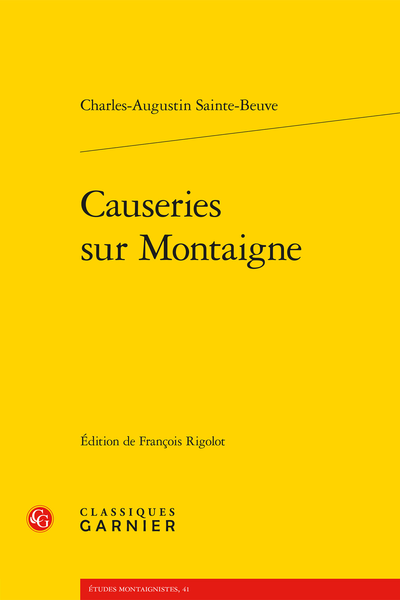
Sainte-Beuve, Causeries sur Montaigne (éd. François Rigolot)
Posted: 8 Apr 2022 - 07:07

Sainte-Beuve, Causeries sur Montaigne, éd. François Rigolot, Paris, Classiques Garnier, (2003) 2022.

Sainte-Beuve parsème ses œuvres de références à Montaigne. Les affinités entre ces « deux cerveaux congénères » sont indéniables et s'étendent de l'homme à l'écrivain. Cette édition donne un aperçu de la réception de Montaigne au xixe siècle et révèle la richesse des analyses du critique littéraire.

Nombre de pages: 239
Parution: 16/03/2022
Réimpression de l’édition de: 2003
Collection: Études montaignistes, n° 41
ISBN: 978-2-406-12952-3
ISSN: 0986-492X
DOI: 10.15122/isbn.978-2-37312-812-3