


Announce

Calls for Papers and Contributions

CfP: True Warriors? Negotiating Dissent in the Intellectual Debate (C. 1100–1700)
Posted: Thursday, February 28, 2019 - 10:42

Lectio International Conference – 11–13 December 2019 – University Of Leuven (Belgium)

Dissent, polemics, and rivalry have always been at the center of intellectual development. The scholarly Streitkultur was given a fresh impetus by the newly founded universities in the High Middle Ages and later turned into a quintessential part of early modern intellectual life. It was not only mirrored in various well-known intellectual debates and controversies – e.g. between Aristotelians and Augustinians, scholastics and humanists, Catholics and Protestants – but also embodied in numerous literary genres and non-literary modes of expression – e.g. disputationes, invectives, consilia, images, carnivalesque parades, music, etc. – and discursive or political strategies – patronage, networks and alliances. Moreover, the harsh debates notwithstanding, consensus was also actively searched for, both within particular disciplines and within society as a whole.

The aforementioned genres and strategies are all modes of negotiating dissent, which raises several important questions regarding these intellectual ‘warriors’. What were the most important issues at stake and how were they debated? Did the debates in the public sphere reflect the private opinions of the scholars involved? What access do we have to those private opinions? Can we approach such controversies in terms of authenticity and truthfulness, or consistency and coherence? Is there a contrast between ego-documents and the published part of an author’s oeuvre? Starting from these questions, the aim of this conference is to study the polemical strategies and the modes of rivalry and alliance in scholarly debate from the twelfth through the seventeenth centuries. Topics of interest may include, but are not limited to:

  • the role of alliances and polemics in establishing intellectual networks;
  • the presentation of rivaling views and the depiction of adversaries;
  • the discrepancy or congruency between private and public persona;
  • hitherto neglected disputes or new perspectives on well-known controversies;
  • non-literary modes of negotiating dissent;
  • the relation and connections between various literary and non-literary genres, also across different semiotic modes (literature, visual arts, performative arts...);
  • the role of socio-cultural and economic background in polemics;
  • the role of language (e.g.: vernacular vs. Latin);
  • similarities and differences across disciplines (philosophy, civil and canon law, theology, medicine...) with regard to polemization and the negotiation of dissent.

We actively invite papers from a variety of perspectives and disciplines (civil and canon law, philosophy, theology and religious studies, literary studies, historiography, art history, etc.) and aim to study texts in Latin, Greek and the vernacular, as well as pictorial and performative traditions. We do not only welcome specific case studies, but also (strongly) encourage broader (meta)perspectives, e.g. of a diachronic or transdisciplinary nature.

The conference will span the period from the twelfth until the seventeenth centuries. The conference will be organized by the Leuven Centre for the Study of the Transmission of Texts and Ideas in Antiquity, the Middle Ages and the Renaissance (LECTIO). It follows upon last year’s conference on polemics, rivalry and networking in Greco-Roman Antiquity.

Confirmed keynote speakers:

  • Leen Spruit (Radboud Universiteit – Nijmegen)
  • Anita Traninger (Freie Universität – Berlin)

We invite submissions for paper proposals in English, French, German and Italian. Proposals should consist of a (provisional) title, an abstract of 300–400 words, and information concerning the applicant’s name, current position, academic affiliation, contact details and (if applicable) related publications on the topic. Applicants who intend to speak in French, German or Italian, are expected to include an English abstract as well. Accepted papers will be awarded a 30 minutes slot (20 minutes presentation, 10 minutes for discussion).

Please submit your proposal via email (lectio@kuleuven.be) by April 15, 2019. Applicants will be notified by email within 5 weeks from this date. Successful applicants are expected to submit their paper for inclusion in a thematic volume to be published in the LECTIO series (Brepols Publishers). All submitted papers will be subject to a process of blind peer-review. For any further queries, please mail to lectio@kuleuven.be.

On behalf of the organizing committee, Guy Claessens – Wim Decock – Jeroen De Keyser – Fabio Della Schiava – Wouter Druwé – Wim François – Erika Gielen

http://www.kuleuven.be/lectio http://lectio.ghum.kuleuven.be/lectio/conferences

Source: RSA

CfP: Gendered Environments
Posted: Tuesday, February 26, 2019 - 10:42

Baltimore (21-23 mai 2020), avant le 17 mars 2019

2020 Berkshire Conference on the History of Women, Genders, and Sexualities

Baltimore, Maryland

Deadline: Sunday, March 17, 2019

Gendered Environments: Exploring Histories of Women, Genders, and Sexualities in Social, Political and “Natural” Worlds

Program Chairs: Cathleen Cahill (Penn State) and Martha Few (Penn State)

Call for Papers: the 18th Berkshire Conference on the History of Women, Genders, and Sexualities May 21-23, 2020 at Johns Hopkins University in Baltimore, Maryland. (Download 2020 CFP)

The theme for the 2020 Berkshire Conference on the History of Women, Genders, and Sexualities will be Gendered Environments: Exploring Histories of Women, Genders, and Sexualities in Social, Political, and “Natural” Worlds. The conference will be held May 21-23, 2020 at Johns Hopkins University in Baltimore, Maryland.

The 2020 “Big Berks” focuses on the histories of women, genders, and sexualities, and this year devotes special attention to a pressing theme of our current moment: the role of environment(s), ecologies, and natural systems broadly defined in the histories of women, genders, and sexualities. As we plan our meeting at the edge of the Chesapeake Bay, a profoundly vibrant ecosystem where humans have gathered for millennia, we are reminded of the many ways in which the natural world has shaped human society. Its history also highlights the local and global connections of all places. This place is the homeland of the Piscataway Conoy Tribe, and was home to Henrietta Lacks; it is the site of the Baltimore Fish market and a part of the Chesapeake Bay Watershed, a node in the Atlantic Flyway, and at the edge of the Atlantic World.

Our aim is to hold conversations that think through the intricate interplays among gender and sexuality, social and legal systems of power and political representation, and the material realities of an interconnected world continually shaped by physical nature, the human and nonhuman animals, plants, and other beings that inhabit that nature. If Earth’s history has indeed entered a new geological epoch termed the Anthropocene, where do the historical knowledges and experiences of women, people of diverse genders and sexualities, and people of color, along with environmental justice efforts in the historical past, enter into our efforts to understand, theorize, contextualize, and meet these existential problems?

While the notion of environments invokes important thinking about Earth, our theme extends to a capacious definition of social, cultural, and political surrounds. The histories of women’s lives, intellectualism, and activism unfold across a range of environmental contexts that are simultaneously material, political, economic, and cultural. We interpret this overarching theme broadly, inviting submissions for an array of engaging and interactive presentations intended to generate conversations across time, fields, methodologies, and geographic borders; across races, classes, sexualities and gender  identities; among academic and public historians, activists, artists and performers. We are especially keen to attract participants from around the globe and scholars of time periods and geographic fields that typically have been underrepresented at the Berkshire Conference.

We hope these conversations will highlight fresh perspectives and create new networks for intellectual collaboration and activism among scholars, public historians, artists, activists, teachers, and those interested in history, the environment, climate change, social movements, and social justice. Such interaction has dynamic potential to move the history of women, genders, and sexualities in particularly innovative directions that generate new theories and methodologies, bringing these histories into new spaces – not only in our universities and liberal arts colleges but also in community colleges, neighborhood centers, K-12 schools, prisons, NGOs and other activist groups in the United States and abroad. Such an approach is critical as we are experiencing the effects of pressing environmental issues, even as the value of research from climate science to the humanities is being questioned.

Reviving connections between communities and institutions, historians are increasingly joining forces — inside and outside the academy – with an eye toward affecting social change and social justice. New forms of cooperation have raised important historical questions: What can we learn from internationalizing the discussion of women, communities, and the environment? How can we use multi-sited histories of human and non-human animals as well as the relationships of communities to local and distant ecologies to rewrite gendered histories from long distance trade and exchange to the rise of global capitalism? How can scholars and activists collaborate to transform the pedagogical landscape in our ‘classrooms’ around environmental issues in the past and present? This conference is a call for collaboration and cooperation across many lines of difference.

The 2020 Berkshire Conference will be a venue for difficult conversations about these and other crucial questions. In the hope of promoting a greater range of conversations and interactions, this “Big Berks” seeks to intentionally diversify the way we present and discuss history. In addition to traditional modes of presentation, we encourage the submission of conference presentations that feature different kinds of voices. We strongly encourage submissions that include scholars, public historians and/or activists, artists, and/or performers. We also encourage submissions that include multiple styles — such as digital technologies, formal papers, performance, and/or the arts — along with varied formats from e-posters, pop-up talks to lightning sessions.

We invite submissions broadly themed on the histories of women, genders, and sexualities, including but not limited to those with a special interest in environment(s), ecologies, and natural systems.

The deadline for all submissions is March 17, 2019.

CfP: Women and Gender in the Premodern Mediterranean
Posted: Tuesday, February 26, 2019 - 10:40

Baltimore (21-23 May 2020), proposals due 10 March 2019

18th Berkshire Conference on the History of Women, Genders & Sexuality


The Mediterranean has been acknowledged as a distinct environment since at least the work of Fernand Braudel, yet despite this fact, many of the broader studies on the Mediterranean have paid little attention to women and gender. This is particularly the case for studies of the premodern past. For next year’s conference in Baltimore, Berks organizers have invited us to think about gendered environments « through the intricate interplays among gender and sexuality, social and legal systems of power and political representation, and the material realities of an interconnected world continually shaped by physical nature, the human and nonhuman animals, plants, and other beings that inhabit that nature. » With that in mind, we are planning a workshop to explore the Mediterranean as a gendered environment.

We invite proposals from scholars whose work considers the above themes in relation to any location in the Mediterranean in the medieval and early modern periods. Our workshop aims to facilitate a comparative discussion on women from different social, religious, and geographical contexts of the Mediterranean world. In particular, we would like to bring together scholars whose work focuses on Christian, Jewish, or Muslim women, across social hierarchies, and geographical locations. If you are interested, send a 250-word abstract and contact information to Alexandra Guerson (alexandra.guerson@utoronto.ca) and Dana Wessell Lightfoot (lightfoot@unbc.ca ) by March 10th, 2019.

CfP: RACINE’S BRITANNICUS
Posted: Tuesday, February 19, 2019 - 13:45

A one-day symposium to mark the 350th anniversary of the first performance.

Proposals are invited for papers of 20 to 30 minutes on any aspect of the play and its cultural contexts.  Contributions may be in English or French.  Participants who wish to attend but do not wish to offer a paper are warmly welcome, but should book their places as accommodation is limited.

Date: Friday 6 September 2019, from 11 a.m. to 5 p.m.

Venue:The British Academy, 10-11 Carlton House Terrace, London

Cost: £30, including a buffet lunch.

Proposals for papers, and indications of a wish to attend by those not offering papers, should be sent to Professor Paul Hammond, School of English, University of Leeds, LS2 9JT (p.f.hammond@leeds.ac.uk) by 1 April 2019.

CfP: Motion, Rhythm, Shifts
Posted: Monday, February 18, 2019 - 13:03

An interdisciplinary conference. 5 October 2019. Rhode Island School of Design

In 2019, the New England Renaissance Conference will be hosted for the first time at the Rhode Island School of Design (RISD, pronounced “RIZ-dee”), a private, nonprofit college founded in Providence in 1877, which has currently circa 2,400 students from around the world. RISD offers liberal arts studies and 19 studio majors in the fine arts, architecture, design or art education (bachelor’s or master’s degrees).

We invite papers that explore the notion of rhythm in the period of ca. 1400-1700. Scholars from disciplines as varied as history, art history, literature and poetry, religion, theatre, music, environment, studio art and design are welcomed. The idea of motion, rhythm, and shifts is rich in significance for the Early Modern period as it touches upon global concepts, material culture, ritual, performance, and identity.

Paper topics include, but are not limited to:

  • temporal aspects (codification of time, recurrence of a specific phenomenon, the timing of a performance, stages in the production of art, series, metamorphoses)
  • movements and crossings (body movements, dance, inter-arts, transportation / re-location of people, things, images, or relics)
  • mobilities (migrations, trade patterns, traveling artists, scansion of narratives or poetry, translations)
  • ritual and ceremonies (processions, parades, ceremonial entries, relics transfers, etc.)

DATE: Saturday 5th October 2019, 9:00 a.m. – 6:00 p.m.

LOCATION: Chace Auditorium, Rhode Island School of Design Museum, Providence

The conference will be free to all. A dinner and accommodation on 4th October are planned for the speakers.

We invite abstracts no longer than 300 words accompanied by a title and a brief CV to be sent by May 1, 2019, to:   prihouet@risd.edu. For further questions, feel free to contact conference organizer Prof. Pascale Rihouet at that email address.

See also: http://www.new-england-renaissance-conference.org/

Source: H-France

New Publications

Laura Nicolì, Les Philosophes et les Dieux. Le Polythéisme en débat dans la France des Lumières (1704-1770)
Posted: 15 Jun 2022 - 04:55

Laura Nicolì, Les Philosophes et les Dieux. Le Polythéisme en débat dans la France des Lumières (1704-1770), Paris, Honoré Champion, 2022.
L’idolâtrie, le polythéisme, les cultes des païens, la religion « autre » par excellence : le thème est omniprésent dans la réflexion  religieuse et antireligieuse du siècle des Lumières. Les philosophes comme les théologiens, les savants comme les artistes, les orthodoxes et les idéologues, les académiciens et les salonniers se mêlent au débat. À la rencontre de ces différentes voix prennent naissance un regard de plus en plus historique et un intérêt véritablement philosophique envers l’univers religieux des païens, qu’on ne considérait auparavant que du point de vue exégétique et théologique. S’ensuit un renversement de paradigme : l’idée traditionnelle selon laquelle le monothéisme serait la religion
originelle et le paganisme sa corruption est graduellement mise en doute. Le nouveau modèle du polythéisme primitif, qui s’impose à
partir de la moitié du siècle, ne représente pas simplement une 
réponse inédite à la question de l’origine des divinités païennes. 
C’est le statut même du problème qui change, se chargeant d’une signification bien plus large et d’enjeux plus décisifs : s’interroger sur l’origine et la nature des dieux et des déesses signifie désormais s’interroger sur l’origine et la nature de la religion tout court. 

Laura Nicolì est chercheuse post-doctorante à la Sorbonne Université
(LabEx OBVIL) et à la Voltaire Foundation d’Oxford. Elle a obtenu son doctorat en histoire de la philosophie et histoire des idées à « La
Sapienza » de Rome et à l’EPHE de Paris. Ses travaux portent sur les débats philosophiques sur l’origine et la nature de la religion  dans l’Europe des Lumières.

Plus d'informations ici.

Les Actes du Consistoire de l'Église française de Berlin (1672-1694) (éd. Fiametta Palladini)
Posted: 15 Jun 2022 - 04:53

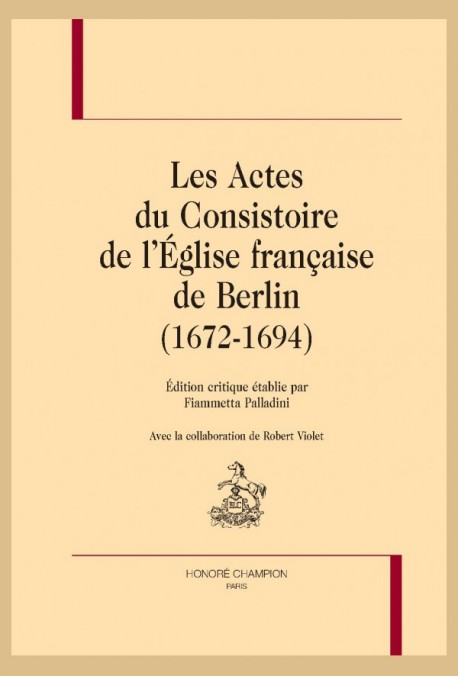
Les Actes du Consistoire de l'Église française de Berlin  (1672-1694), éd. Fiametta Palladini avec la collaboration de Robert Violet, Paris, Honoré Champion, 2022.
Cette édition rend accessible à un large public l’une des sources principales de l’histoire du Refuge de Brandebourg-Prusse au cours des années de la révocation de l’édit de Nantes. Le principal protagoniste du livre est le Consistoire de l’Église française de Berlin, qui fait des efforts herculéens pour assurer la survie physique et l’intégrité morale et religieuse des réfugiés. La communauté est constituée de plusieurs centaines de personnes pour la plupart inconnues. Lorsque cela a été possible, les membres de la communauté ont été identifiés dans notre annotation, qui croise et commente les événements décrits dans les Actes au moyen de documents relatifs à la « Colonie française » conservés aux Archives secrètes prussiennes (Geheimes Staatsarchiv) à Berlin.

Le livre intéressera les historiens, les théologiens et les sociologues, mais sera également utile pour la recherche généalogique et peut fasciner même ceux qui sont simplement curieux de savoir comment vivaient les Huguenots de Berlin à la fin du XVIIe siècle.

Fiammetta Palladini, diplômée en philosophie à l’Université de Rome La Sapienza en 1965. Jusqu’à sa retraite, elle était Primo ricercatore à l’Institut ILIESI (Istituto per il Lessico Intellettuale Europeo e la Storia delle Idee, Rome) du Conseil National de la Recherche (CNR). Elle est l’auteur de plusieurs livres et de nombreux articles sur Samuel Pufendorf, Jean Barbeyrac et la philosophie morale et politique du XVIIe siècle, entre autres : Discussioni seicentesche su Samuel Pufendorf (1978), Samuel Pufendorf Discepolo di Hobbes (1990, traduction anglaise 2019), Die Berliner Hugenotten und der Fall Barbeyrac (2011).

Plus d'informations ici.

Sébastien Douchet - Une réception du Moyen Âge au XVIIe siècle
Posted: 15 Jun 2022 - 04:50

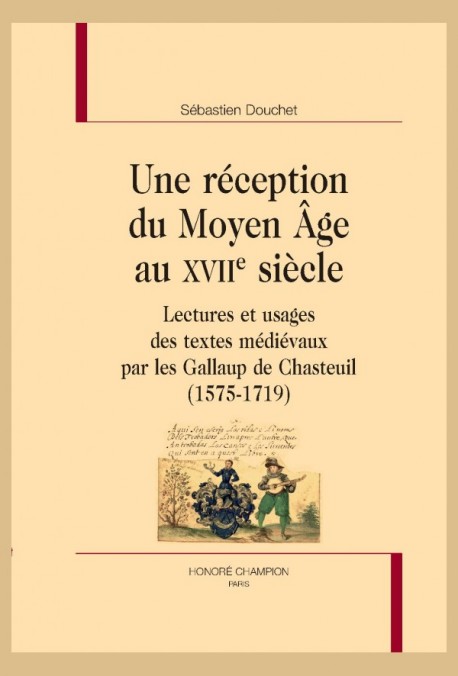
Sébastien Douchet, Une réception du Moyen Âge au XVIIe siècle. Lectures et usages des textes médiévaux par les Gallaup de Chasteuil (1575-1719), Paris, Honoré Champion, 2022.
Les Gallaup de Chasteuil, parlementaires et lettrés aixois, ont produit au XVIIe siècle un travail méconnu de mise en recueil, d'édition et de commentaires de textes médiévaux. Le patrimoine littéraire du Moyen Âge ainsi diffusé servit à la contestation de la Justice royale et à la consolidation de la modernité galante et féminine de leur temps.

Plus d'informations ici.

Autour de Montaigne (Emile Faguet)
Posted: 15 Jun 2022 - 04:47

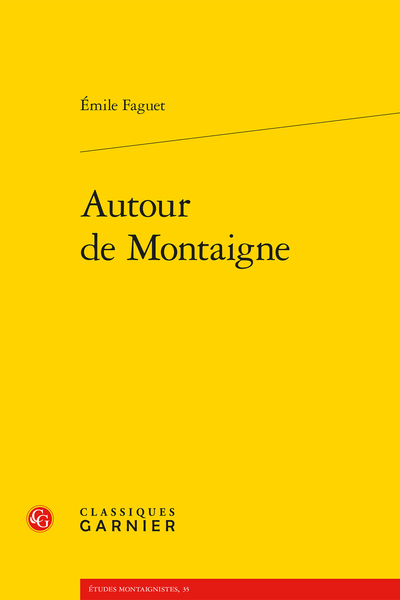
Emile Faguet, Autour de Montaigne, préfce Antoine Compagnon, Paris, Classiques Garnier, (1999) 2022.
 

Les essais d’Émile Faguet, alors critique très influent, illustrent bien l'instabilité de la réception de Montaigne au début du xxe siècle. Il défend l'idée d'un Montaigne « polychrome », dont la pensée est toujours en mouvement. Ces études éclairent également l’histoire de la critique littéraire.

Nombre de pages: 290
Parution: 18/05/2022
Réimpression de l’édition de: 1999
Collection: Études montaignistes, n° 35

Plus d'informations ici.

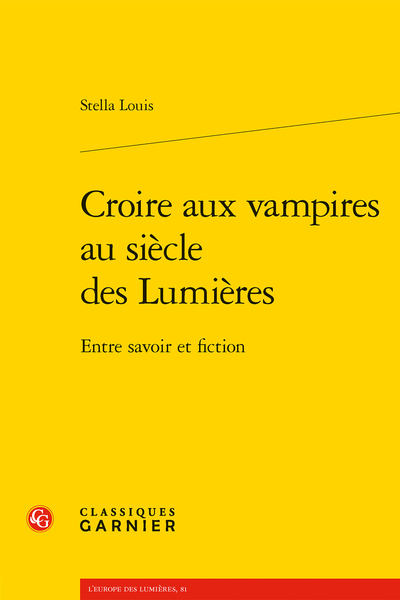
Croire aux vampires au siècle des Lumières Entre savoir et fiction (Stella Louis)
Posted: 15 Jun 2022 - 04:44

Stella Louis, Croire aux vampires au siècle des Lumières. Entre savoir et fiction, Paris, Classiques Garnier, 2022.

Cet ouvrage étudie la façon dont s’est construite une écriture de la croyance aux vampires à un moment précis de l’Histoire de la pensée humaine, et comment cette écriture a permis de définir, de fixer et de faire circuler le vampirisme et le vampire, entre savoir et fiction.

Nombre de pages: 268

Parution: 18/05/2022

Collection: L'Europe des Lumières, n° 81

ISBN: 978-2-406-11897-8

ISSN: 2104-6395

Plus d'informations ici.