



Announce

Calls for Papers and Contributions

Le Mercure confiné
Posted: Tuesday, March 31, 2020 - 12:41

Le Mercure confiné - expérimentation scientifique, artistique et ludique en période d’isolement (Anne Piéjus)

Chères et chers amis, étudiants, amateurs et amatrices du XVIIe siècle,

Je suis confinée, tu es confiné, vous êtes confinées…

Nous sommes au spectacle, et pourtant partie prenante, de la reconfiguration accélérée des liens sociaux et politiques en temps d’épidémie. Parmi les multiples sollicitations de toute nature dont nous sommes abreuvés, peut-être regardez-vous vous aussi avec un certain intérêt fleurir les initiatives citoyennes, scientifiques, culturelles ou artistiques en ligne. Sans doute êtes-vous contraints d’organiser votre temps autrement. Peut-être même le goût des autres est-il aussi pour vous celui de leur voix… ? Cette expérience est faite pour vous !

Recréer un salon virtuel

Après quelques années de travail en équipe sur le Mercure galant (périodique créé par J. Donneau de Visé, qui a paru de 1672 à 1710) et partageant avec des collègues, des amis, des étudiantes et étudiants venus travailler dans l’équipe, un certain goût pour les jeux littéraires et musicaux, est née l’idée d’une plateforme collaborative qui permette de recréer, ou de réinventer, des formes de sociabilité inspirées de ce périodique. Sans prétendre transposer les salons du XVIIe siècle à l’ère numérique, il semble qu’il y ait là matière à expérience, à commencer par une toute simple, adaptée aux circonstances : redonner à ces textes et à ces musiques une épaisseur sensible, en leur donnant de la voix ; c’est-à-dire les lire, les faire sonner entre nos murs, les enregistrer, et les partager. Ce crowdsourcing sera associé, lorsque nous le pourrons, à un espace contributif scientifique (de critique et d’enrichissement des ressources publiées par l’équipe) que nous élaborons en équipe ; et, pourquoi pas, étendu à toutes sortes de créations, bouts-rimés, énigmes, expériences de poésie collective, etc.

Je vous propose donc aujourd’hui de lire à haute voix des textes et de chanter des airs publiés dans le Mercure galant, de vous enregistrer, et de réunir vos contributions.

Comment contribuer

Toutes les bonnes volontés sont bienvenues, de tout âge, de toute nationalité et avec l’accent qui est le sien. Nul besoin d’être musicien professionnel ou spécialiste de la déclamation historiquement informée pour participer.

Les arrangements ont toute leur place eux aussi, et vous pouvez vous lancer dans la variation, la réponse fictive, le double orné, le trope, ainsi bien entendu qu’à l’interprétation instrumentale des airs. Il s’agit à ce stade d’une simple expérience collaborative.

Choisir un texte à lire ou un air à chanter parmi les lettres, fables, histoires galantes, « aventures », madrigaux, rondeaux, sonnets, airs en musique, …

Si vous préférez des suggestions, écrivez à anne.piejus@cnrs.fr en indiquant vos goûts (longueur approximative du texte ; prose ou vers ; type de sujet qui vous intéresse ; tessiture vocale et instruments à disposition, le cas échéant)

Informez-moi de votre choix (on évite autant que faire se peut les doublons)

Préparer votre interprétation, puis enregistrez-vous avec les moyens du bord, idéalement en privilégiant le format WAV (audio non compressé), de préférence 44100 Hz (ou 96000 Hz), 24 bits.

Préparez votre envoi :

Indiquez les références du texte que vous trouverez en tête de l’article (par ex. : « [Avanture du Bain], Mercure galant, juillet 1679 [tome 7], p. 147-153. »

Précisez si vous souhaitez partager votre contribution de manière anonyme, sous votre identité réelle, ou sous un pseudo[1], et précisez de quel lieu (réel ou fictif) vous vous êtes enregistrés. Joignez une photo de ce lieu ou des alentours.

Envoyez-moi votre fichier par email, WeTransfer ou autre.

Vous trouverez en ligne :

Une édition numérique des textes, avec fac similés des musiques notées (cliquer sur le lien au bas de chaque article « air nouveau »),

Une édition moderne numérique des airs, en cours. On en a un aperçu ici, dans une version non relue. On peut vous envoyer en format PDF

  • les fac similés (regroupés pour une lecture musicale plus facile)
  • les transcriptions modernes (corrigées), y compris des airs non encore mis en ligne.

Nous avons aussi établi la collection virtuelle qui a servi à la mise en ligne sur Gallica, soit l’édition parisienne de ce journal.

S’y ajouteront à brève ou moyenne échéance d’autres ressources : les estampes parues dans ce journal seront bientôt accessibles en ligne ; nous indexons tous les articles sur la musique et les spectacles, et vous pourrez bientôt trouver en deux clics ce qui vous intéresse. Cette indexation s’appuiera sur un vaste ‘référentiel’ de l’Ancien Régime lui aussi interopérable, que préparent deux collègues. Pour l’instant, la fouille du texte en accès libre est limitée, mais elles et moi pouvons vous aider.

Que vont devenir vos enregistrements ?

Dans un premier temps, les enregistrements seront publiés en ligne. Vous pouvez écouter les premiers ici : https://soundcloud.com/user-459148113

Rien ne vous empêche de vous auto-publier par ailleurs.

Nous prévoyons une séance d’enregistrement pour tous ceux qui souhaiteront ré-enregistrer dans de meilleures conditions.

Sous réserve de votre accord, les voix du « Mercure confiné » seront par la suite associées à l’ensemble des ressources dédiées au Mercure galant produite par l’équipe de l’IReMus, regroupées sur une plateforme hébergée par Huma-Num, en cours de construction. Grâce à vous, on pourra, conformément à leur nature, écouter certains airs et certains textes du Mercure galant prévus pour la lecture à haute voix.

Merci à vous de votre participation !


[1] L’imagination vous fait défaut ? En voici quelques-uns utilisés par les contributeurs au Mercure galant : Les trois aimables Sœurs de la Ruë Pavée ; L’Amoureux oisif des bords de la Marne ; La charmante Bibi ; L’Amant patient de Dieppe ; L’Ombre des Tuileries ; La plus aimable de la Rue Sainte Marguerite ; Le Solitaire de Pontoise ; Le Sauvage d’Arbouville du Havre ; Une Belle de Thouars ; L’Œdipe Boulonnois ; une belle Suissesse ; Télamire, de Troyes ; Mademoiselle la Fileuse ; L’agréable Demoiselle de la Rue de Moussy ; La Belle Angélique ; La Belle Solitaire… et pour des collectifs : La Société spirituelle du Marais ; La Société des jeunes Belles de Caen ; Les deux Inséparables de la Rue de Moussy ; Les Pensionnaires du Cloître de Lyon ; Les Beaux esprits du Canton de Lille ; Les Dames de Richelieu ; La Société Cloîtrée de Paris ; l’Académie des Beaux Esprits, etc.

[2] Les Extraordinaires sont à chercher séparément.

Appel à contributions: Gender Fluidity in Early-Modern to Post-Modern Children’s Literature and Culture
Posted: Monday, March 30, 2020 - 16:58

Special Volume of 10-12 Research Articles Introduced and Edited by Sophie Raynard (Stony-Brook University) and Charlotte Trinquet du Lys (UCF)

Open Cultural Studies (ISSN 2451-3474).

Publisher: De Gruyter Poland.

Contract date: 2/20/2020 Publication date: 1/15/2021

CALL FOR CONTRIBUTIONS:

Manuscripts should not be longer than 8,000 words including bibliography.

The concepts of non-binary, transgender, gender fluid, polygender, etc., in today’s conversations on sexual politics seem to be understood as new concepts as though the realities behind these neologisms do not necessarily encompass all of human history. Scholars in Children’s Literature and Culture Studies or Fairy Tales and Folklore studies, have always come across these representations of non-traditional gender expressions in early-modern literature as well as in historical accounts. Cross-dressing in particular is pervasive in that type of literature, and we know that cross-dressing characters abounded on the early-modern stage and were objects of fascination for their contemporaries. Today’s critics, especially feminists, have been capitalizing on the current interest in gender and sexuality studies and have successfully applied these new definitions to early-modern representations, thus bringing these texts to the forefront of the conversation on gender identity. With such provoking titles as “Gender Trouble,” “The Theatricality of Transformation,” “Erotic and Alien,” “New Bodies, Old Sins”, these studies have encouraged us to perceive and receive early-modern cross-dressing representations, no longer as individual aberrations or expressions of deviancy, but rather as part of a long cultural tradition of non-traditional gender identity and political transgression. By contrast some modern and post-modern popular culture productions dealing with the same issues of gender expression might not always be as progressive as they claim to be. Disney films in particular have consciously tackled the gender issue ever since they faced bitter criticism from feminist scholars, but the question remains whether they have been successful at addressing those biases. Just as early-modern specialists are bringing their own expertise to the table and illustrating the progressivism that always existed in old texts, it would also be opportune to reflect on contemporary productions. In this special issue, we invite scholars of children’s literature and films, and scholars of popular culture from the early-modern to the post-modern eras to explore the topics of gender roles and identity, showing in what ways and to what extent they can be viewed as socio-historical constructs, thus adding new perspectives to the ongoing discussions on sexual politics.

ABOUT THE ACADEMIC JOURNAL: Open Cultural Studies is a peer-reviewed, scholarly journal that explores the fields of Humanities, Social Sciences and Arts. It interprets culture in an inclusive sense, in different theoretical, geographical and historical contexts. As an Open Access journal, Open Cultural Studies is committed to increasing public access to scholarship that covers an entire range of social and cultural phenomena both within and beyond the academy. It aims, in particular, to enhance international collaboration among scholars by bringing together researchers from the Global North and the Global South. By bringing together experienced/high-profile and emerging and Third- and First-World scholars, the journal aims to contribute to a wider understanding of culture and promote both innovation and inclusion. The number of downloads in the year 2019 was more than 18 000. Keeping with the trend, next volume should double that number. The independent academic publisher De Gruyter has a history spanning back 270 years. De Gruyter group publishes over 1,300 new titles each year in the humanities, social sciences, STM and law, more than 700 subscription based or Open Access journals, and a variety of digital products.

HOW TO SUBMIT

1) Authors are kindly invited to send an abstract to the Guest Editors at the following email addresses: sophie.raynard@stonybrook.edu; ctrinquet@gmail.com

2) After acceptance of abstracts by editors, authors are kindly invited to register at De Gruyter’s paper processing system at: https://www.editorialmanager.com/culture/default.aspx and submit their contribution.

- Every manuscript should be clearly marked as intended for this special issue and include the title: Gender Fluidity in Early-Modern to Post-Modern Children’s Literature and Culture.

- All papers will go through the Open Cultural Studies’ high standards, quick, fair and comprehensive peer-review procedure. Instructions for authors are available here. In case of any questions, please contact Guest Editors (sophie.raynard@stonybrook.edu; ctrinquet@gmail.com) or Managing Editor (katarzyna.grzegorek@degruyter.com).

3) As an author of Open Cultural Studies you will benefit from:

- transparent, comprehensive and fast peer review managed by our esteemed Guest Editor;

- efficient route to fast-track publication and full advantage of De Gruyter e-technology;

- free language assistance for authors from non-English speaking regions.


CURRENT DEADLINES:

May 10: deadline for abstract submission

May 20: acceptance letter to contributors

August 20: deadline for paper submission review 1= 28 days, review 2 = 14 days

October 1: deadline for peer-reviews October 30: deadline for paper review according to the peer-reviews comments November 20: deadline for paper second review if necessary

November 30: volume sent to press for formatting and copy-editing December 30: deadline for proof revisions

January 2021: publication

CfP: 48th Annual Conference Western Society for French History
Posted: Saturday, March 14, 2020 - 20:59

Victoria, British Columbia

November 12-14, 2020

The forty-eighth annual conference of the Western Society for French History will be held from November 12-14, 2020, in Victoria, British Columbia.  The theme for this year’s conference is “New Stories, New Ways of Telling Them.” The organizers wish to highlight how incorporating new voices, tools, and approaches can transform both our understanding of the history of France and the Francophone world and the way we share that understanding.

Deadline for proposals: April 1, 2020.  Please send all proposals to Professor Leslie Tuttle, current WSFH President, at president@wsfh.org

*For detailed submission instructions, and for hotel and travel information, please visit the WSFH website, https://www.wsfh.org/conferences

We are excited to welcome this year’s keynote speakers. Matt Matsuda (Professor of History and Academic Dean, New Brunswick Honors College, Rutgers University), will deliver a keynote on Friday evening entitled “Sea of Changes and New Waves: French Histories and Pacific Histories”, followed by a reception at the First People’s Gallery at the Royal B.C. Museum. On Saturday morning, Pascal Bastien (Professeur d’histoire, Université de Québec à Montréal) will deliver the annual Edgar L. Newman Memorial Lecture: “Une Révolution volée? Les émeutes du faubourg Saint-Antoine, 27-28 avril 1789.” Professor Bastien will then be among the participants in a special plenary lunchtime round table on the theme of French History and the Digital Humanities.

We welcome sessions that focus on France and the Francophone world from the Middle Ages to the contemporary era. To deepen membership engagement with the society’s updated mission, we especially welcome proposals that reflect the theme by seeking to include new voices or use new approaches or by deploying digital modes of research and storytelling. In addition to traditional research presentations, we encourage panel proposals featuring innovative and interactive formats, including workshops, roundtables, pre-circulated papers, pecha kucha sessions and discussions of pedagogy and methods. The WSFH welcomes proposals from colleagues in related disciplines and the participation of advanced graduate students.

CfP: Images and Borderlands: Mediterranean Basin between Christendom and Ottoman Empire
Posted: Saturday, March 14, 2020 - 20:28

Following in the footsteps of Fernand Braudel, an increasing number of recent studies show that the Mediterranean basin might be considered as a "borderland" (Darling 2012), "borderscape" (Brambilla 2016) or "Frontier" (Castelnuovo 2000) suggesting that this area is not strictly a border between Christian and Muslim civilization, but a basin in which the two traditions and cultures meet and overlap, with an extraordinary variety of reactions to the hegemonic practices (acceptance, conflict, refusal, dissent). The aim of this conference is to bring together scholars who will discuss, from different perspectives and with a multidisciplinary approach, the variety of themes (topics) which revolve around the common issue of reflecting the problem of borderlands as a consequence of the encounter between Christendom and Ottoman Empire in the Early modern Mediterranean. The starting point of examination will be images, i.e. the usage of images (pictures, mental images, literaly images and other visual representations...) as historical evidences (Burke 2008).

In line with the main goal of the conference, four main sessions are proposed: Images generated after the Battle of Lepanto, War of Candia, Morean War and Ottoman–Venetian War. Special attention will be devoted to the celebration of the victory of Lepanto, that became the model for celebrations of other victories, and to the comparison between the different points of view (those of winners and losers).

All four previously mentioned wars generated minor or greater changes in political boundaries, but political boundaries do not always correspond to artistic, cultural or ideological boundaries or to the boundaries of the religious authorities. Within these four sessions scholars are invited to send abstracts on the topics listed below

The "borderland", "borderscape", "frontier" paradigms in art history, history and geography, regarding the Mediterranean area

How do images document victories and defeats in war conflicts from the Christian point of view? How do other typologies of sources document victories and defeats in war conflicts from the Muslim point of view?

What was the image and the (self) perception of the outcome of the battles among the Ottomans and within the territories under their dominion?

Beyond visible: miraculous images, prophecies, sermons, pamphlets, news… How were images and words used to support faith in the positive outcome of the conflict, and how to spread news, propagate victories or support conversions in the borderlands of Mediterranean?

Artists who cross the boundaries. Is there any evidence of artists producing images for different commissioners with the same or different iconography regarding the Christian-Muslim issues?

What is the difference between written and iconographic evidence?

Great commandants; representations, symbols of the triumph and trophies exposed

The architecture and its image as the marker of the territorial possession.

What kind of symbols were used to represent the other side and how did they influence the shaping of otherness?

Deadline and details:

This call for papers is now open for those researchers who are interested in participating in the conference. Both early stage scholars as well as senior scholars are welcome. Scholars from different study fields are encouraged to give their proposals in order to achieve the goals of interdisciplinarity and plurality of dialogue. They are invited to submit their proposals with a title, an abstract (no more than 500 words) and a brief bio (maximum of 10/12 lines) to Ivana Čapeta Rakić, Ph.D (icapeta@ffst.hr) and Giuseppe Capriotti, Ph.D. (giuseppe.capriotti@unimc.it). Deadline for sending a proposal is 20th March 2020. [Please contact the organizers for the dates of the conference.]

Reimbursement of expenses: CA1829 might be able to reimburse travel and accommodation expenses to a limited number of researchers not yet affiliated to the Action. Applications should be submitted along with the proposals. Selected papers will be published in the book of proceedings.

CfP: Cultivating Science in the Early Modern Garden (16th–18th c.)
Posted: Saturday, March 14, 2020 - 20:20

20–21 July 2020 Lisbon, National Library of Portugal

Organizers : Denis Ribouillault (University of Montréal, Department of Art History) and Ana Duarte Rodrigues (University of Lisbon, Centro Interuniversitário de História das Ciências e Tecnologia).

Although the history of early modern gardens has benefited in recent decades from an increasingly wide range of methodologies, the role played by these spaces in the development of science has been the subject of a relatively small number of inquiries. A majority of them concentrates on botanical gardens and the history of botany [Baldassari 2017], though it is now recognized that mathematics, pneumatics or astronomy found in gardens a privileged ground for experimentation and display. A primary aim of this workshop is to interrogate and document what we could call (anachronistically) «scientific practice» in early modern European gardens.

How were gardens used to advance scientific knowledge? Examples range from the growing of medicinal plants, astronomical observation, physical experiments and so forth. Gardens were also privileged places for teaching and for debates and discussion pertaining to the various branches of natural philosophy. Furthermore, we encourage scholars to pay attention to how this function of gardens as «academies», as platforms for the production and display of knowledge, as stages of scientific sociability and as pedagogical tools, affected the gardens from a formal, artistic, iconographic and hermeneutic point of view.

It is not just a matter of documenting and reconstructing what happened in gardens. More precisely, it is a question of showing how what happened in gardens can lead us to a renewed understanding of the physical appearance (at a given moment) of the gardens themselves. This calls for a fruitful – yet difficult-to-achieve - intermingling of the methodologies of the history of science and of the history of art under the aegis of garden history.

Papers should be about 25 minutes long. Q & A and intensive discussion will follow each presentation. We intend to publish the proceedings of the workshop. Contributors’ travel and accommodation costs will be covered. Please send a proposal of 550 words max. with a title and a short bio to denis.ribouillault@umontreal.ca before April 30, 2020.

This event is sponsored by the research project led by Denis Ribouillault, « Before the ‘Great Divide’: The Shared Language(s) of Art and Science in the Early Modern Period », funded by a SSHRC (Social Sciences and Humanities Research Council of Canada) Insight Grant (2019–24) and the Centro Interuniversitário de História das Ciências e Tecnologia, University of Lisbon. The workshop will take place during the exhibition at the National Library Jardins Históricos em Portugal, organized by the Associação de Jardins Históricos and the landscape architect Teresa Andersen, with the collaboration of Ana Duarte Rodrigues, as part of the programme Lisboa Verde 2020. Visits of the exhibition and of relevant gardens and monuments are planned for the workshop participants.

Jobs

Poste de professeure ou de professeur en littérature d'Ancien Régime avant 1700 (Montréal)
Posted 4 Oct 2016 - 16:49

Le Département des littératures de langue française de l'Université de Montréal sollicite des candidatures pour un poste de professeure ou de professeur à temps plein au rang d'adjoint en littérature d'Ancien Régime avant 1700.

Les dossiers doivent être transmis par la poste au plus tard le 15 novembre 2016.

Pour plus de détails, voir l'annonce sur le site web de référence.
RESPONSABLE : Marie-Pascale Huglo, directrice intérimaire
URL DE REFERENCE : http://www.littfra.umontreal.ca/

SFS Visiting International Fellowship Award. Due date: 1 April 2016
Posted 2 Feb 2016 - 11:01

The Society for French Studies is delighted to announce the third round of its Visiting International Fellowship scheme. The SFS International Visiting Fellowship scheme enables outstanding academics in French Studies at all career stages, based in overseas universities, to spend time at UK or Irish higher education institutions. The deadline for applications to this year’s Visiting International Fellowship Award is 1 April 2016, for activity taking place during AY 2016/17. Full details of the scheme are provided below. Information may also be found on the following link: http://www.sfs.ac.uk/funding-visiting-fellowships/.


Applications should be submitted to Professor Edward Welch, Carnegie Chair of French, University of Aberdeen (edward.welch@abdn.ac.uk), to whom informal enquiries can also be made. This year's Visiting International Fellow is Professor Barbara Havercroft (University of Toronto), who will be undertaking a series of activities during May 2016. Full details of these events will be circulated in due course.


VISITING INTERNATIONAL FELLOWSHIP AWARD


The Society for French Studies is delighted to announce the third round of its Visiting International Fellowship scheme. In the light of its commitment to support international mobility within the subject area it represents, the Society offers funding for a grant to support an annual visiting fellowship, tenable in any UK or Irish university, or institution of higher education in the UK or Ireland, to allow outstanding academics in the French Studies field based in overseas universities to spend time at UK or Irish higher education institutions. The scheme is designed to support early career and established scholars, although exceptionally the Society may be prepared to consider candidates—such as authors—who do not hold a university post.


There is one deadline per year:

1 April, for activity taking place the following academic session.


Applicants will normally be notified of the outcome of their application within two months of the date of the application.


The key objective of the Fellowship grant is to encourage the internationalization of French Studies in the UK and Ireland through engagement with those active in the field elsewhere. It is also intended that the Fellow will use the occasion to further their own academic interests, and to visit more than one UK institution. The emphasis will be on collaboration and on the diffusion of skills and knowledge, and priority may be given to new or recent collaborative ventures. Where a visit builds on existing collaboration, the applicant in the UK or Ireland should explain what the visit will achieve over and above past outcomes. It is the intention that the fellowship may provide a degree of expertise that is not otherwise available within the UK and Irish research base in French Studies. Visiting fellows will be expected to offer 'Society for French Studies Lectures' (or equivalent), either in the host institution or elsewhere, to mark their residence.


The principal criteria for selection will be (i) the academic standing and achievements of the visitor in terms of their current career stage, (ii) their potential for making a substantial contribution to French Studies in the UK and Ireland, and (iii) the specific nature of the proposed programme during the fellowship. Additionally, and as collaboration is a central aim of the scheme, joint bids from two or more institutions are especially welcomed, and the selection panel will give special consideration to such applications.


Visits should be for no more than four weeks in duration, although an extended period may be appropriate if additional funding is available from institutional sources. There is an expectation that institutions will supplement the Society's grant, and the level of additional support offered will be taken into consideration in the allocation of the award.


Eligible subject areas The Society for French Studies exists to promote teaching and research in French Studies, understood in its broadest senses, in higher education. Activities supported by this scheme should be aligned with this objective, but may also support initiatives that explore the limits of French Studies in interdisciplinary and cross-disciplinary collaboration.


Eligibility of applicants Applications must be completed by an academic member of staff in the UK or Irish host institution. The UK or Irish host applicant is also expected to organise, direct and take academic and organisational responsibility of the fellowship. Host applicants must be members of or associated Higher Education departments of French (or departments which teach French) in the UK and Ireland. Main applicants must also be members of the Society for French Studies. No more than one application may be submitted by any institution in one academic year (this applies to collegiate and non-collegiate universities alike, and includes joint applications from two or institutions).


Level of Grant The Society will offer a grant of up to £2,000 to support travel, accommodation, subsistence and other expenses; up to an additional £500 is also available to cover the costs of visiting other institutions in the UK or Ireland. Personal expenditure on items such as visa costs, car hire and health insurance are not eligible, and it is expected that host institutions will offer support for these. Application for this award will be competitive, and it cannot be made retrospectively.

Application Procedure In order to apply, please send a letter or email giving the following details:

(i) name, position and institutional affiliation of the host applicant; (ii) name, institutional affiliation and outline of career and principal publications/ achievements of the proposed Visiting Fellow (iii) intended dates of the Fellowship; (iv) intended collaborators during the Fellowship; (v) the subject area within French Studies to which the fellowship activity relates; (vi) planned activities, including visits to and lectures/seminars at other institutions; (vii) any other anticipated outputs or outcomes; (viii) a draft budget, clearly detailing the amount requested, and the purpose to which it will be put; (ix) details, where relevant, of other applications for, or commitments to, funding relating to the research in question; (x) an undertaking to abide by the conditions of the award, if successful; (xi) confirmation that the principal applicant is a member of the Society for French Studies.


Applications should be addressed to:

Professor Ed Welch Carnegie Chair of French School of Language & Literature King's College University of Aberdeen Aberdeen AB24 3UB edward.welch@abdn.ac.uk

University College Dublin (Ireland) Assistant Professor
Posted 1 Feb 2016 - 17:43

Lecturer (below the bar) in French - In Medieval and/or Early Modern Studies (Assistant Professor)

Permanent Post

Applications are invited for one permanent appointment as Lecturer (below the bar) in French – In Medieval and/or Early Modern Studies, UCD School of Languages, Cultures and Linguistics.  Applicants must have a PhD in French, an active research track record and a commitment to developing new research programmes within the School and the College of Arts and Humanities.

Successful applicants will contribute significantly to research in one of the School’s thematic areas:

  • Medieval Literature and Language
  • Renaissance/Early Modern Literature

and also contribute to the school’s graduate and undergraduate programmes.


UCD is a dynamic research-intensive university that is at the forefront of research and teaching activities across a wide range of disciplines.

The School of Languages, Cultures and Linguistics is a research active unit with research interests in the fields of literature, civilisation, history, politics and society of its target cultures represented by the languages taught in the School. Interdisciplinary and multinational research and teaching activities are welcome both on the undergraduate level and the School’s varied MA programmes. Modern Languages at UCD is ranked among the top 100 in the QS subject rankings.

Note: It is envisaged the appointed Lecturer will commence in post on 1 September 2016.


Lecturer (below the bar) Scale: €31,820 – €56,602 p.a.

Appointment will be made on scale and in accordance with the Department of Finance guidelines.


Prior to application, further information (including application procedure) should be obtained from the UCD Job Vacancies website: http://www.ucd.ie/hr/jobvacancies

Closing date:  17:00hrs (GMT) on Tuesday 16th February 2016


Applications must be submitted by the closing date and time specified.   Any applications which are still in progress at the closing time of 17:00hrs on the specified closing date will be cancelled automatically by the system. UCD do not accept late applications.

Career Development Fellowship in Early Modern French, St. Hilda's College
Posted 5 Nov 2015 - 07:44

FOUR-YEAR CAREER DEVELOPMENT FELLOWSHIP IN FRENCH

ST HILDA’S COLLEGE, OXFORD


ADVERTISEMENT


St Hilda’s College, University of Oxford, invites applications for a Career Development Fellowship in French for four years from 1 October 2016. Applicants will have completed a doctorate but be at an early stage of their career.  The post-holder will be expected to engage in research, to offer a total of 6 hours per week tutorial teaching for St Hilda’s, and to be fully involved with admissions and the management of the subject in the College. There is no possibility of renewal beyond 30 September 2020.


The appointee will be paid on a scale from £30,434 (point 1) to £33,242 (point 4) per annum (University Grade 7, current rates).  The successful candidate will also be able to claim an Academic Allowance of £1,300 per annum and an entertainment allowance of £235 per annum. The Fellow will be a member of the Senior Common Room, and will be entitled to all meals free of charge.


The closing date for applications is 5pm on Thursday 10 December 2015.  Further particulars, including details of how to apply, may be downloaded from the College website at http://www.st-hildas.ox.ac.uk/career-development-fellowship-french, or obtained from the Academic Registrar, St Hilda’s College, Oxford OX4 1DY (college.office@st-hildas.ox.ac.uk).


Dr Helen J. Swift
Associate Professor of Medieval French and Tutorial Fellow Co-convenor, MSt in Women's Studies St Hilda's College, Oxford, OX4 1DY

Tel: 01865 (2)76871 Web: www.mod-langs.ox.ac.uk/swift Twitter: @MedFrenchOx

University of California, Irvine
Posted 22 Oct 2015 - 17:50

Department of European Languages and Studies

Professor of French, Open Rank

Field of specialization: French literature pre-1800 and/or modern French thought (i.e., French theory, broadly understood). Applicants need not combine these fields, but those who do are strongly preferred. All applicants should have a Ph.D. in French, Comparative Literature, or a related field, and have native or near-native fluency in French.

Apply online at: https://recruit.ap.uci.edu/apply/JPF03151 by December 4, 2015.

Applications must include a letter, CV, writing sample, list of three references, and a separate statement that addresses how past and/or potential contributions to diversity, equity, and inclusion will advance UCI's Commitment to Inclusive Excellence.

The University of California, Irvine is an Equal Opportunity/Affirmative Action Employer advancing inclusive excellence. All qualified applicants will receive consideration for employment without regard to race, color, religion, sex, sexual orientation, gender identity, national origin, disability, age, protected veteran status, or other protected categories covered by the UC nondiscrimination policy.

From: emorisi@gmail.com


New Publications

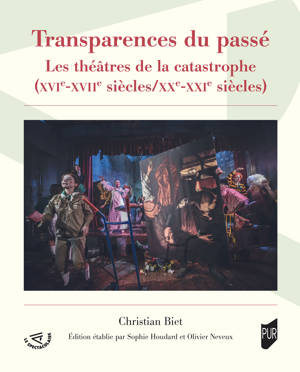
Transparences du passé Les théâtres de la catastrophe (XVIe-XVIIe siècles/XXe-XXIe siècles) (Christian Biet)
Posted: 7 Mar 2024 - 12:04

Christian Biet, Transparences du passé Les théâtres de la catastrophe (XVIe-XVIIe siècles/XXe-XXIe siècles), éd. Olivier Neveux et Sophie Houdard-Biet, Rennes, PUR, 2023.
Comment le théâtre a-t-il fait en France après les guerres de Religion qui ont ensanglanté le XVIe siècle? Comment s’est-il emparé de la violence inscrite dans la mémoire du chaos juste passé? Par quels effets frappants saisit-il le public ? Par quels détours le raisonne-t-il ?

Massacres, guerres civiles anglaises, premiers génocides indiens, débuts de l’esclavage : la première modernité a consacré une part importante de son théâtre à représenter ces moments d’une extrême violence. La tragédie cherche alors des causes au chaos et des formes pour leurs mises en scène. Qu’elle en rejoue l’événement violent dans les pièces d’actualité ou qu’elle choisisse de le figurer dans des fictions lointaines, elle réfléchit une Histoire dont l’origine est le sang.

Christian Biet a défendu ce théâtre contre une histoire littéraire trop souvent oublieuse et cantonnée à la tragédie régulière classique. Il l’a édité, commenté, fait jouer. Dans cet ouvrage crucial, fruit de vingt années de recherche, il montre à partir de cas et de pièces, l’actualité de ce corpus pour un public du XXIe siècle. Car ce théâtre fonctionne pour nous à la manière d’un miroir sans tain, les revenants des catastrophes lointaines révèlent comme en transparence notre temps contemporain de l’après-catastrophe.

Avec le soutien du labex Les passés dans le présent ANR-11-LABX-0026-01, de l’Unité de recherche HAR (Histoire des arts et des représentations), de l’université Paris Nanterre, et de l’UMR 5317 – IHRIM (Institut d’histoire des représentations et des idées dans les modernités).

Plus d'informations ici.

Œuvres complètes. Tome IX B 1757-1758, éd. Berchtold (Jacques), Jacob (François), Martin (Christophe), Séité (Yannick)
Posted: 7 Mar 2024 - 11:59

Œuvres complètes. Tome IX B 1757-1758, éd. Berchtold (Jacques), Jacob (François), Martin (Christophe), Séité (Yannick), Paris, Classiques Garnier, 2024.
Dans cette période critique, Rousseau compose, traduit, donne un nouvel élan à sa pensée : dans la Lettre à D’Alembert, il prend congé du monde parisien ; dans des textes longtemps inédits, il s’explique sur le lien social, le devoir moral et, en marge d’Helvétius, sur la marche de l’esprit humain. Ce volume propose un établissement renouvelé de la plupart des textes présentés grâce à la mobilisation de nouvelles sources manuscrites, au réexamen de plusieurs autres déjà connues, et à l’adoption de principes d’édition adaptés au statut de chacun d’entre eux.

Plus d'informations ici.


Théâtre des provinces au xviie siècle Une anthologie, éd. Louvat (Bénédicte), Pasquier (Pierre)
Posted: 7 Mar 2024 - 11:55

Théâtre des provinces au xviie siècle. Une anthologie, éd. Bénédicte Louvat et Pierre Pasquier, Paris, Classiques Garnier, 2024.
La présente anthologie donne à lire un échantillon de la production théâtrale des provinces françaises du xviie siècle en rassemblant sept pièces (trois tragédies, une tragi-comédie, deux comédies et un mystère), écrites en français ou en langue régionale et dont la composition couvre tout le siècle.

Plus d'incormations ici.

Albineana Cahiers d’Aubigné 2023, n° 35 Migrations et identités dans l’Europe humaniste (XVIe-XVIIe siècles)
Posted: 7 Mar 2024 - 11:52

Albineana Cahiers d’Aubigné  2023, n° 35 Migrations et identités dans l’Europe humaniste (XVIe-XVIIe siècles)

More info here.

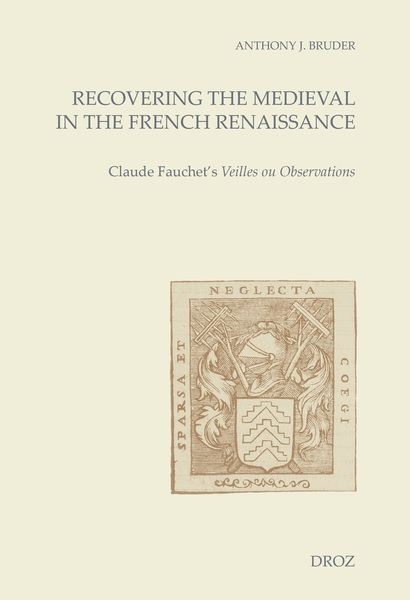
Recovering the Medieval in the French Renaissance (Anthony J. BRUDER)
Posted: 7 Mar 2024 - 11:49

Anthony J. BRUDER, Recovering the Medieval in the French Renaissance. Recovering the Medieval in the French Renaissance: Claude Fauchet's Veilles ou Observations, Genève, Droz, 2024.

Focusing on a little studied miscellany by Claude Fauchet (1530-1602), this book reveals the role of the medieval in crafting an image of French modernity during the Renaissance. Designed to confront the Pléiade with the rich legacy of medieval French, the Veilles argued that an illustrious vernacular had to be rooted in native traditions, richer by far than generally credited. From meter in the twelfth-century Roman d’Alexandre to the emendation of Philippe de Commynes’s Mémoires, and from dueling etiquette to the tomb of Jean de Meun, Fauchet’s observations even reach into his present moment, with essays on Lemaire de Belges, Marot, and Ronsard. Here is an echo of a very different French Renaissance, in which the Burghers of Calais are more important than Francion, and a knowledge of Old French more desirable than classical erudition. Furthermore, as a response to rupture and loss, the Veilles are perhaps the earliest snapshot of a primary stage in the reception of medieval French literature.

Abordant un recueil peu étudié de Claude Fauchet (1530-1602), ce livre révèle le rôle du médiéval dans la construction d’une image de la modernité française à la Renaissance. Conçues pour confronter la Pléiade au riche héritage de la France médiévale, les Veilles soutenaient qu’une illustre langue vernaculaire devait être enracinée dans les traditions autochtones, bien plus riches qu’on ne le pense généralement. De la métrique du Roman d’Alexandre à l’©mendation des Mémoires de Philippe de Commynes, et des règles du duel à la tombe de Jean de Meun, les observations de Fauchet portent aussi sur son époque, avec des essais sur Lemaire de Belges, Marot et Ronsard. Émerge alors l’écho d'une Renaisdance française très différente, dans laquelle les bourgeois de Calais sont plus importants que Francion, et la connaissance de l'ancien français plus souhaitable que l'érudition classique. Comme une réponse à la rupture et à la perte, les Veilles sont peut-être le tout premier instantané d'une étape fondamentale dans la réception de la littérature française médiévale.

Plus d'informations ici.

Conferences and Colloquia

Corneille : la parole et les vers
Posted: 14 Apr 2017 - 13:13

Colloque festival

Rouen, les 31 mai, 1er et 2 juin 2017


Rencontre internationale organisée par le CÉRÉdI (Rouen)avec la participation du Mouvement Corneille-Centre international Pierre Corneille, de l’IRET (Paris III-Sorbonne Nouvelle) et de l’IRCL (Montpellier III).

Comité scientifique : Gilles Declercq (Sorbonne Nouvelle-Paris III), Myriam Dufour-Maître (Rouen-Normandie), Julia Gros de Gasquet(Sorbonne Nouvelle-Paris III), Bénédicte Louvat-Molozay (Paul Valéry-Montpellier III), Florence Naugrette (Paris Sorbonne), Guillaume Peureux (Paris Ouest-Nanterre), Liliane Picciola (Paris Ouest-Nanterre), Stella Spriet (Saskatchewan, Canada), Jean-Yves Vialleton (Grenoble-Alpes).

Rouen, les 31 mai, 1er et 2 juin 2017


« Pourquoi et de quelles façons les vers d’un Corneille sont, en tant que vers, dramatiques ? », s’interrogeait Pierre Larthomas dans Le Langage dramatique (1972), mais cette question est demeurée peu traitée. Le colloque se donne donc pour projet d’examiner la relation entre discours et vers dans l’œuvre de Corneille. Il peut certes paraître périlleux d’entreprendre de distinguer la « force des pensées » de la « force des vers » (Jean-Marie Villégier), tant le théâtre de Corneille donne le sentiment d’une fusion parfaite des axes de la dramaticité et de la poéticité, tout particulièrement réalisée et durablement imprimée dans les mémoires par la frappe de la sentence dans le moule de l’alexandrin. Mais dans ce creuset de la forme-sens, peut-on repérer des signes de dialectique voire de tension entre la linéarité et le retour, entre d’une part la dynamique discursive et son allure spécifique, et d’autre part les effets propres à la versification ? Le colloque envisage la question du côté du poète, du comédien, du spectateur et du critique. Trois master classes, un concert, une projection de mises en scène et une représentation théâtrale sont l’occasion d’expérimenter la réalisation dramatique, poétique et lyrique du vers cornélien.

Programme


Mercredi 31 mai


Matin

Mont-Saint-Aignan, Maison de l’Université, place Émile Blondel, salle de conférences


9h – Accueil des participants

9h15 – Ouverture du colloque


Horizons du vers cornélien

Présidente : Michèle Rosellini


9h30

Gilles Declercq (Sorbonne Nouvelle-Paris III) : « La sentence : enjeux d’une forme-sens »

10h

Ludivine Rey (Paris Sorbonne) : « La génétique du vers cornélien »

10h30

Bénédicte Louvat-Molozay (Paul Valéry-Montpellier III) : « Le vers cornélien selon Corneille : parcours des paratextes »

Discussion et pause

11h20

Liliane Picciola (Paris Ouest-Nanterre) : « Des vers espagnols aux vers cornéliens : hypothèses sur l’intention des réécritures »

11h50

Jean-Marc Civardi (Versailles-St Quentin-en-Yvelines) : « Corneille poète néo-latin »

12h20

Hélène Merlin-Kajman (Sorbonne Nouvelle-Paris III) : « Le vers cornélien : réflexions sur un saisissement »

Discussion


Après-midi

Mont Saint-Aignan, UFR des Lettres, bâtiment A, amphi Axelrad


Vers lyrique, vers dramatique (1)

Président : Jean-Yves Vialleton

14h 15

Benoît de Cornulier (Nantes) : « Aspects de versification lyrique dans le théâtre de Corneille »

14h45

François Regnault (Paris) : « Corneille pourrait-il dire comme Alberto Caeiro, cet hétéronyme de Fernando Pessoa : “J’écris la prose de mes vers” ? »

Discussion


15h30-17h30

Master classe

Brigitte Jaques-Wajeman (metteure en scène), Bertrand Suarez-Pazos (comédien), François Regnault (Paris) : « Je veux la liberté dans le milieu des “vers” »


Jeudi 1er juin

Mont Saint-Aignan, Maison de l’Université, place Émile Blondel, salle divisible nord


Vers lyrique, vers dramatique (2)

Président : François Regnault

9h30

Marc Douguet (Paris Sorbonne) « La récurrence des motifs rimiques et syntaxiques dans le vers cornélien »

10h

Françoise Poulet (Bordeaux Montaigne) : « Phrase, mètre et conversation dans les comédies de Corneille »

10h 30

Jean-Yves Vialleton (Grenoble-Alpes) : « “Ils ne sont pas venus, nos deux rois ?” (Attila, v. 1) : l’enjambement à la césure dans le théâtre de Corneille et ses valeurs stylistiques »

11h

Claire Fourquet-Gracieux (UPEC-Paris XII) : « “Je n’ai pas cru à propos que l’homme parlât le même langage que Dieu”. Un vers dévot cornélien ? »

11h 45 :

Le Mouvement Corneille : présentation des activités de l’association


Parole, ethos et vers

Président : Gilles Declercq


14h

Jean de Guardia (UPEC-Paris XII) : « Combien de vers pour convaincre ? Ornement et dramaticité chez Corneille »

14h30

Jérôme Lecompte (Paris III-Sorbonne Nouvelle) : « Formes de l’ethos héroïque »

15h

Cécilia Laurin (Sorbonne Nouvelle-Paris III) : « “Connais-moi tout entière” : parole apocalyptique et dramaturgie cornélienne »

Discussion et pause

16h

Michèle Rosellini (ENS Lyon) : « Du duo au duel : structure versifiée de l’ironie dans le dialogue des amants cornéliens »

16h30

Fabien CavaillÉ(Caen-Normandie) : « Le pouvoir de parler, l’occasion de se taire : usages des interruptions de vers dans quelques tragédies de Corneille (Cinna, Héraclius, Suréna) »

17h

Myriam Dufour-Maître (Rouen-Normandie) : « Allures du vers et obscurcissement du discours : le “style tardif” de Corneille »

Discussion


19h Mont Saint-Aignan, UFR des Lettres, bâtiment A, amphi Axelrad

Pierre Corneille, Pulchérie, comédie héroïque (1673), par la Compagnie des Lunes errantes (entrée libre)

Pulchérie, impératrice d’Orient Anne-Laure Dechambre

Martian, vieux sénateur Christophe Querry

Léon, amant de PulchérieLionel Brun

Aspar, amant d’IrèneRomaric Olarte

Irène, sœur de Léon Anne-Céline Trambouze

Justine, fille de MartianCécilia Roumi


Vendredi 2 juin


Mont Saint-Aignan, Maison de l’Université, place Émile Blondel, salle divisible nord


Genres dramatiques et vers

Président : Jean de Guardia

9h30

Sylvain Garnier (Paris-Sorbonne) : « La comédie cornélienne et l’élaboration du vers dramatique classique »

10h

Stella Spriet (Saskatchewan, Canada) : « Le vers cornélien dans les pièces à machines »

Discussion et pause

11h

Projection : « Les Corneille »

Montage des mises en scène de Corneille par Brigitte Jaques-Wajeman


En disant, en chantant le vers

Présidente : Liliane Picciola

Mont Saint-Aignan, Maison de l’Université place Émile Blondel

Salles divisibles nord et sud


13h30

Deux master classes simultanées : « Pour une déclamation historiquement informée de l’alexandrin de Corneille »


1)    salle divisible nord

Olivier Bettens (chercheur indépendant)

Et

2) salle divisible sud

Pierre-Alain Clerc (Haute École de Musique de Genève)


15h40

Mont Saint-Aignan, UFR des Lettres bâtiment A, amphi Axelrad

Communication en musique, avec

Sarah Nancy (Sorbonne Nouvelle-Paris III), voix, et Florian Carré, clavecin : « Parole, vers, musique. Le cas des stances du Cid de Charpentier. »

Discussion

16h45

Liliane Picciola et Bénédicte Louvat-Molozay : conclusions du colloque

17hfin du colloque

Entrée libre au colloque, au spectacle et aux master classes, dans la limite des places disponibles


Organisation : myriam.dufour-maitre@univ-rouen.fr

Femmes face à l’absence de l’Antiquité à l’époque contemporaine : terre, mer, outre-mer (Europe-Amérique du Nord)
Posted: 14 Apr 2017 - 12:58

Rochefort (11-13 mai 2016)

Jeudi 11 mai 2017

 8h30-12h30

Accueil des participants

Introduction scientifique – Emmanuelle Charpentier (Université Toulouse-Jean Jaurès-Framespa) et Benoit Grenier (Université de Sherbrooke, Québec-CIEQ)

 Subir l’absence ?

« Pénélope face à la toile, une femme d’action ? », Pauline Schmitt Pantel (Université Paris 1 Panthéon Sorbonne-Anhima)

« Une Pénélope marseillaise : Mercédès dans Le Comte de Monte-Cristo », Tiphaine Martin (Université de Toulon-Babel)

« Du portrait au sentiment de l’existence. Figures féminines de l’attente dans la peinture occidentale », Maurice Daumas (Université de Pau-ITEM)

« L’alliance, l’ancre et la plume : lien conjugal et économie de l’absence chez les femmes d’officiers de marine (milieu XIXe siècle-milieu XXe siècle) », Thomas Vaisset (Service Historique de la Défense) et Jean de Préneuf (Université Lille III-IRHiS)

« « Quand vous lirés ce livre avec papa, vous saurés ce que c’est » : la responsabilité éducative ad interim au miroir de la correspondance de la famille Glayre (1798-1804) », Sylvie Moret Petrini (Université de Lausanne, Suisse)

14h30-17h30

« Guerre, absence et neurasthénie : l’agentivité perdue de Blanche Lacoste Landry et la mobilisation de ses proches », Sophie Doucet (Université du Québec à Montréal)

« Trois femmes face à l’absence dans la France de l’Occupation : le témoignage des écrits personnels », Jacques Cantier (Université Toulouse-Jean Jaurès-Framespa)

« « Depuis que je te connais, je t’ai toujours attendu » . Nanou face aux absences de Jacques (France, 1954-1957) », Raphaëlle Branche (Université de Rouen-GRHIS)

« Absence sans conscience n’est que ruine des couples. Les Marseillaises et la vie conjugale au XVIIIesiècle », Christophe Régina (ESPE Midi-Pyrénées-Framespa)

« Mais comment peut-on être la femme de Proudhon ? Euphrasie Piégard (1822-1900) face à l’emprisonnement, l’exil et les opinions politiques de son mari », Olivier Chaibi (ESPE de Créteil-IDHES)


Vendredi 12 mai 2017

 Stratégies de (sur)vie face à l’absence

 9h-12h30

 « Une économie de l’absence des hommes. Femmes, pluriactivité et marché dans l’Europe alpine à l’époque moderne », Anne Montenach (Université de Provence-TELEMME)

 « Le travail des femmes dans les Alpes suisses : de la solitude à l’indépendance », Marie-France Vouilloz-Burnier (Historienne indépendante)

 « Entre le mythe et l’oubli : les femmes charlevoisiennes face aux départs périodiques des hommes, 1930-1970 », Marie-Pier Bouchard (Université Laval, Québec)

 « Femmes d’officiers militaires suisses : répartition des tâches et stratégies féminines dans un contexte d’absence masculine, XVIIe-XIXe siècles », Jasmina Cornut (Université de Lausanne, Suisse)

 « Les procuratrices à Montréal (1740-1770) : contextes familiaux et administration des biens », Jonathan Fortin (Université de Sherbrooke, Québec)

 « Les femmes délaissées par leur mari et la justice civile de Montréal (1795-1830) : pouvoirs, propriété, agentivité », Jean-Philippe Garneau (Université du Québec à Montréal)

14h30-17h30

 « Épouses et servantes au Canada sous le régime français : une autonomie contrainte et contraignante », Arnaud Bessière (Université Laurentienne, Québec)

 « La trajectoire d’Éléonore Pagé (1795-1860) dans la vallée laurentienne du Canada : analyse des limites d’un espace d’autonomie féminin », Jean-René Thuot (Université du Québec à Rimouski)

 « Between loneliness and protagonism : women in the universe of crime in Northern Portugal in the 1800s », Alexandra Esteves (Universidade Católica Portuguesa, Portugal)

 « Femmes, famille et exploitation agricole dans un pays d’émigration : la Galice Sud-Ouest (XVIIIe-XIXesiècles) », Camilo  Fernandez Cortizo (Universidade Santiago de Compostela, Espagne)

 « Femmes de marin dans le Finistère Sud  : absence des hommes et empowerment des femmes, une perspective anthropologique », Corinne Fortier (Collège de France-LAS)


Samedi 13 mai 2017

 Absence et agentivité des femmes

 9h-12h30

 « Les Femmes-chevaliers dans la vallée du Pô à la Renaissance », David Salomoni (Università degli Studi Roma Tre, Italie et CIHAM)

 « Pouvoir au féminin : itinéraire épistolaire d’une noble provençale au XVIIIe siècle », Camille Caparos(Université de Provence-TELEMME)

 « « La conduite scandaleuse qu’a suivie pendans son absence la ditte Dame » : les mariages interethniques pendant l’exil des officiers canadiens après la guerre de Sept Ans (1760-1800) », Karine Pépin (Université de Sherbrooke, Québec)

 « À Rome en absence des hommes : rôle social et possibilité d’action des matronae », Novella Lapini(Università degli Studi di Firenze, Italie)

 « Représenter la majesté royale et veiller sur les sujets en l’absence du roi  : les rôles dévolus à Blanche d’Anjou, reine d’Aragon de 1295 à 1310 », Alexandra Beauchamp (Université de Limoges-CRIHAM)

 « Épouses de défenseurs de la patrie ou d’ennemis de la nation : absences des hommes et stratégies de survie sous la Révolution française dans la France de l’Ouest (1789-1801) », Solenn Mabo (Université Rennes 2-CERHIO)

14h30-16h30

 « Subir l’absence, réagir face à l’absence : Marie-Madeleine de Castille épouse Fouquet, une veuve civile ? », Pauline Ferrier-Viaud (Université Paris 4-Centre Roland Mousnier)

 « Les liens conjugaux et familiaux à l’épreuve de l’emprisonnement en France (années 1910-1939) », ElsaGénard (Université Paris 1 Panthéon Sorbonne-Centre d’histoire du XIXe siècle)

 « Femmes de marins pêcheurs rochelais, de l’isolement à l’action collective – 1985-2015 », Henri Moulinier(Université de La Rochelle-CHRIA)

 Conclusions du colloque


https://femmes-abs-2017.sciencesconf.org/resource/page/id/6

Écrits pour le mouvement, écrits en mouvement Formes, emplois et évolutions du livret de ballet de la Renaissance à nos jours
Posted: 5 Apr 2017 - 15:16

20-22 avril 2017

Paris, Maison de la Recherche de Paris-Sorbonne

6 rue Serpente, Paris 6e, salles 35 et 40

8H30 Accueil

Axe 2 : La danse moderne : étiolement du livret et du ballet

Modératrice : Céline TORRENT (Université Sorbonne Nouvelle / Labex OBVIL)

9H Julia BÜHRLE (Oxford University)

Danser Shakespeare aux XVIIIe et XIXe siècles

9H30 Sylvie JACQ-MIOCHE (École de danse de l’Opéra National de Paris)

Le ballet blanc et ses avatars néoclassiques : effacement ou disparition de la narration ?

Discussion

Pause

Axe 3 : Retour en scène et métamorphoses du livret à la fin du XXe siècle

M odératrice : Delphine VERNOZY (Université Paris-Sorbonne / Labex OBVIL)

10H30 ValenBna KARAMPAGIA (Sorbonne Nouvelle et Nice Sophia Antipolis, CTEL)

L'adaptaBon chorégraphique : un renouvellement du statut du livret (le livret de

Barbe-bleue par Pina Bausch)

11H Anne PELLUS (Université Toulouse II – Jean Jaurès)

MusicalisaBon du texte et disséminaBon du sens dans Turba de la Compagnie Maguy

Marin

11H30 Camille DESMAREST (compagnie Au fil de soi) et Captain SIMARD

adaptaBon de La Cafeère de Théophile GauBer

Discussion

13H-14H30 Déjeuner

Axe 4 : Le livret dans tous ses états: étoilement d’un genre entre livrets d’écrivain, de peintre

ou de musicien

Modératrice : Marie CLEREN (Université Paris-Sorbonne)

14H30 Jean GUIZERIX (chorégraphe, danseur étoile de l'Opéra National de Paris)

sur le livret de ballet La Conjuraon de René Char

Discussion

Pause

15H30 Jean-François MUNNIER (directeur du fesBval Concordan(s)e )

16H Ingrid THOBOIS (écrivain) et Gilles VÉRIÈPE (chorégraphe)

L’architecture du hasard

17H Conclusion et échanges


COLLOQUE INTERNATIONAL « THEATRE ET SCANDALE »
Posted: 21 Feb 2017 - 19:21

Paris, 9-11 mars 2017


(Université Paris-Sorbonne, Labex OBVIL-CRLC ; Université de Chicago ; Priteps ; ED III)

Organisation : B. Filippi, F. Lecercle, L. Norman, C. Thouret


N.B. Pour les auditeurs, la journée du 9 mars à l’Odéon est accessible uniquement sur inscription (gratuite) en écrivant à les.bibliotheques@theatre-odeon.fr.

Pour celle du 10 mars, au Chicago Center, il n’est pas nécessaire de s’inscrire.

Pour celle du 11 mars, à la Maison de la Recherche, il faut, à cause du plan Vigipirate, envoyer son nom 48 heures à l’avance à francois.lecercle@wanadoo.fr


JEUDI 9 MARS, Théâtre de l’Odéon :

Place de l’Odéon, 75006 Paris


10h45 : Accueil des participants

11h : Accueil des participants : Stéphane BRAUNSCHWEIG (directeur du Théâtre de l’Odéon),

11 h15 Ouverture : Bruna FILIPPI (Lumsa, Rome), François LECERCLE (Paris-Sorbonne), Larry NORMAN (Université de Chicago), Clotilde THOURET (Paris-Sorbonne)

11h30 : « Scandales à l’Odéon : un demi-siècle après Les Paravents »


11h45-13h : Session 1 : La mécanique du scandale hier et aujourd’hui

Présidence : Robert Morrissey

Hélène MERLIN-KAJMAN (Sorbonne Nouvelle) : « Qu'est-ce qu'un scandale (au théâtre) ? Le cas des querelles théâtrales au XVIIe siècle. »

Florence MARCH (Université de Montpellier) : « Scandale en Avignon : enjeux, nature et fonction. »


13 h : déjeuner


14h -15h45 : Session 2 : Défrayer la chronique

Présidence : Françoise Decroisette

Logan CONNORS (Université de Miami) : « Le rôle du scandale dans la carrière d’un auteur dramatique au XVIIIe s. »

Florence NAUGRETTE (Paris-Sorbonne) : « Hugo le scandaleux. »

Alain VIALA (Oxford, All Souls) : « Actrices galantes : de la cristallisation d'un stéréotype au temps du romantisme. »


15h45-16h15: Pause 


16h15-18h :  Session 3 : L’implication du public

Présidence : Christian Biet

Marielle SILHOUETTE (Paris-Ouest La Défense) « Les Tisserands de Gerhart Hauptmann de 1894 à nos jours : réflexions sur une pièce scandaleuse. »

Mara FAZIO (Université de Rome La Sapienza) : « Le Vicaire (Der Stellvertreter) de Rolf Hochhuth, 1963-1966 : scandale à Berlin, Paris, Rome. »

Guillaume NAVAUD (Paris-Sorbonne) : « Le spectateur perturbateur : une figure idéologique et dramaturgique. »


VENDREDI 10 MARS : University of Chicago Center in Paris.

6 rue Thomas Mann, 75013 Paris


10h00 – 11h15 :  Session 4 : Scandale et anecdotes

Présidence : Larry Norman

Jan LAZARDZIG (Université d’Amsterdam) : « Historiographies of Scandal: Histories of Theater Censorship and the use of Anecdotes and Documents (c. 1900-1920). »

Anne TEULADE (Université de Nantes) : « Scandale et fantasme dans les anecodtes de la controverse espagnole du XVIIe siècle. »


11h15-11h45 : pause


11h45-13h : Session 5 : Scandales shakespeariens

Présidence : Line Cottegnies

Ellen MACKAY (Indiana University, USA) : « The Scandal of Women’s Flesh: Anti-theatricalism and Intertheatricality in the French Scene of Henry V. »

Laurence MARIE (New-York) « Othello ou les scandales en série : Hambourg (1776), Paris (1792), Londres (1814) et Paris (1822). »


13 h. Déjeuner


14h-15h45 : Session 6 : Scandale ou pas ?

Présidence : Pierre Frantz

Enrica ZANIN (Université de Strasbourg) : « Quand le scandale ne fait pas scandale : enquête sur les scandales ratés et non advenus, au XVIIe siècle et de nos jours. »

Camilla CEDERNA (Université de Lille III) : « La fermeture de la Comédie-Italienne de Paris (1697), entre satire et transgression: vrai ou faux scandale ? »

Zoé SCHWEITZER (Université de Saint-Etienne) : « La scène cannibale de Blasted à Thyestes : le scandaleux fait-il scandale ? »


15h45-16h15 : pause


16h15-18h : Session 7 : Scandale et politique (1)

Présidence : Sophie Marchand

Bruna FILIPPI (Université Lumsa, Rome) : « La politisation du scandale : la destruction du Tordinona (Rome, 1691). »

Anne WAGNIART (Université d’Artois) : « L'Urania (1666) de Johann Christian Hallmann: le scandale à l'origine de l'éclatement de l'école théâtrale silésienne. »

Elsa JAUBERT (Université de Caen) : « De la polémique au scandale : le théâtre et l'émergence de l'espace public en Allemagne dans la seconde moitié du XVIIIe siècle. »


SAMEDI 11 MARS : Maison de la Recherche de Paris-Sorbonne,

28 rue Serpente, 75006 Paris


9h30 – 11h15 :  Session 8 : Scandale et politique (2)

Présidence : Elisabeth Angel-Perez

Lucie COMPARINI (Paris-Sorbonne) : « Goldoni adapté pendant la Révolution : Paméla ou la vertu récompensée par François de Neufchâteau, un scandale paradoxal. »

Karl ZIEGER (Lille) : « Reigen (La Ronde) d’A. Schnitzler : chronique d'un scandale… politique. »

Tancredi GUSMAN (Università Statale di Milano) : « Entre liberté d’expression et devoirs de la représentation : Le Galilée de Strehler et la fonction publique du théâtre. »


11h15-11h45 : pause 


11h45-13h : Session 9 : Scénographie du scandale

Présidence : Bruna Filippi

Hirotaka OGURA (Tokyo, Université Sophia) « Scandale et théâtre nô. »

Sylvie ARLAUD (Paris-Sorbonne) : « Scénographes du scandale : la représentation en question, de Heiner Müller à Frank Castorf et Hans Neuenfels. »


13h : Déjeuner


14h-15h15 : Session 10 : Figures scandaleuses

Présidence : Andrea Fabiano

Marta MARCHETTI (Università de Rome La Sapienza) : « La théâtralité scandaleuse de Carmelo Bene au Teatro Laboratorio de Rome (1961-1963). »

Gerardo GUCCINI (Université de Bologne) : « Lo scandalo come fatalità e strumento. Appunti sulla vita e sull'opera di Pier Paolo Pasolini. »


15h15-15h45 : pause


15h45-17h : Session 11 : Figures scandaleuses (2)

Présidence : Marthe Segrestin

Robert HENKE (Washington University, St Louis, MO) : « Histrionic Blasphemy: Dario Fo's Mistero Buffo and the Catholic Church. »

Judith SARFATI-LANTER (Paris-Sorbonne) : « ‘Pays de la musique et des chevaux blancs’ : Elfriede Jelinek, Thomas Bernhard et le public autrichien. »

17h : Conclusion : B. Filippi, F. Lecercle, L. Norman, C. Thouret


17h30 : clôture du colloque

Représentations négatives de la femme au pouvoir
Posted: 21 Feb 2017 - 11:18

JOURNÉE D’ÉTUDE 

Vendredi 3 mars 2017 

Université de Bretagne Occidentale 

Faculté des Lettres & Sciences Humanines, Salle C219 

 Organisée par Agnès Cousson, Elizabeth Mullen 

Séance FEMMES MYTHIQUES, DE L’ANTIQUITÉ AU XVIIIe SIÈCLE 

Présidente de séance : Agnès Cousson 

9 h 20 : Anne Debrosse  (Saint-Cyr, Université Paris Sorbonne) : 

« Circé et la Biche. Des femmes contre Ulysse dans le dialogue sério-comique de Giambattista Gelli (1549) » 

9 h 45 : Lorna David (Université Bordeaux Montaigne) : 

« Reine idéale, amante passionnée : la chute de Didon dans le Roman d’Enéas » 

10 h 10 : Charlotte Trinquet du Lys (University of Central Florida, USA) : 

« Bonnes/mauvaises fées dans leur contexte socio-historique : l’exemple de Maléfique et de Mother Gothel » 

Discussion 

PAUSE SALLE C 206 

11 h 05 : Marie Saint Martin (Université Paris Sorbonne) : 

« Une mère au pouvoir : aspects éthiques des réécritures d’Agamemnon en France, XVIe-XVIIIe siècles » 

11 h 30 : Anaïs Guittonnny (Université de Limerick) : 

« L’amazone dans les utopies gynocentrées de la deuxième moitié du XVIIIe siècle en France : discréditer un mythe »