



Announce

Calls for Papers and Contributions

Replaying the Francophone Early Modern in the Twenty-First Century
Posted: Thursday, April 1, 2021 - 09:51

Call for Papers

L’Esprit Créateur 62.2 (Summer 2022)


Replaying the Francophone Early Modern in the Twenty-First Century


Guest Editors: Annelle Curulla (Scripps College) and Michael Meere (Wesleyan University)


If the past is never really passed, then how is this contemporary moment remaking our understanding of the early modern francophone world (1500-1800)? This issue uses the concept of the “replay” as a way to examine the reframing, redescription, and reimagining of the past through performance (broadly conceived as performing arts, commemorative practices, reenactments, games, etc.). What are the limits of re-presentation through performance? What are some possibilities of resistance? Adopting a global perspective, we invite contributions from scholars and practitioners often separated by disciplinary, historical, or geographic boundaries, and whose work explicitly engages with theater history, theatricality, and current theoretical discussions concerning theater and performance studies. 


Please send proposals of 300-400 words in English or French to Annelle Curulla acurulla@scrippscollege.edu and Michael Meere mmeere@wesleyan.edu by June 1, 2021. Articles (max. 6000 words including notes) due November 1, 2021.


Appel à contributions

L’Esprit Créateur 62.2 (été 2022)


Rejouer la première modernité francophone au XXIe siècle


Éds. Annelle Curulla (Scripps College) et Michael Meere (Wesleyan University)


Si le passé n’est jamais vraiment passé, comment ce moment contemporain refait-il notre compréhension du monde francophone de la première modernité (1500-1800) ? Ce numéro propose le concept du « rejeu » afin d’examiner le recadrage, la redescription et la réimagination du passé par la performance (au sens large, comprenant les arts du spectacle, les pratiques commémoratives, les reconstitutions, les jeux, etc.). Quelles sont les limites de la re-présentation à travers la performance ? Quelles sont les possibilités de résistance ? Adoptant une perspective mondiale, nous invitons des contributions des chercheur·euses et des professionnel·les du spectacle, souvent séparé·es par des frontières disciplinaires, historiques ou géographiques, dont la recherche porte sur l’histoire du théâtre, la théâtralité et de la théorie contemporaine concernant les études de théâtre et de performance. 


Les propositions d’article (300-400 mots, en français ou en anglais) doivent être envoyées à Annelle Curulla acurulla@scrippscollege.edu et Michael Meere mmeere@wesleyan.edu avant le 1er juin 2021. Les articles retenus (max. 36000 signes, espaces et notes compris, en français ou en anglais) sont à envoyer pour le 1er novembre 2021.
Appel à communication : « Le génie à l’épreuve du genre »
Posted: Tuesday, March 23, 2021 - 19:55

« Le génie à l’épreuve du genre »

Au cours de la première journée du Laboratoire Junior FIGÉE, consacrée à la définition des différentes acceptions du terme « génie » dans les discours savants et théoriques des XVIIe et XVIIIe siècles, est apparue comme une nécessité l’approche du « génie » au prisme du genre.


En effet, si rien ne permet a priori d’affirmer que le génie soit exclusivement masculin, il convient de remarquer dans les textes de l’époque une écrasante majorité d’occurrences décrivant des hommes glorifiés pour leur perception du « génie » poétique de la langue ou de considérations sur le génie de telle ou telle profession exclusivement masculine.

Du génie d’abord perçu collectivement au génie de plus en plus individualisé – philosophique, poétique ou même scientifique – les textes paraissent ainsi résister à une inclusion des femmes d’Ancien Régime qui se retrouveraient reléguées hors de toute génialité. Pourtant, si l’on s’en tient à l’identification du génie particulier avec un « démon » telle qu’elle était si courante à la Renaissance, n’est-il pas encore possible de trouver au XVIIe siècle ne seraient-ce que les traces d’un « mauvais génie » féminin dans les nombreux récits de possessions et d’exorcismes ? À une période où les chasses aux sorcières font encore rage, où les sages-femmes sont progressivement inféodées aux médecins, où les épistolières doivent se ranger aux règles du bon goût et de la pudeur telles que définies par des auteurs de traités de civilité, est-il possible de déceler quelque part dans les textes d’Ancien Régime une description du génie qui ne soit pas en fait exclusivement masculine ? Au XVIIIe siècle, Diderot lui-même ne considérait-il pas, suivant en cela Aristote et Galien, que les femmes pussent transmettre du génie à leurs enfants sans en être elles-mêmes pourvues ? En faisant des femmes des êtres « mutilés et imparfaits » par rapport aux hommes, la tradition scolastique a-t-elle également amputé les femmes de toute possibilité d’être géniales ? Toutes ces questions sont autant d’invitations à explorer, sous l’angle de la notion de génie, des textes écrits non seulement sur les femmes, souvent pour des femmes, et – pourquoi pas même ? – par des femmes.


Il est possible de définir cinq pistes autour desquelles organiser cette journée d’étude. Devant le constat que l’histoire socio-culturelle et littéraire survalorise les écrits des hommes au détriment de ceux des femmes, sans doute n’est-il pas si paradoxal de repartir de considérations écrites par des hommes, sur des femmes, mais à destination d’autres hommes – ce qui constituerait une sorte d’entre-soi masculin – afin d’essayer d’identifier, dans les blancs de ces discours ou même en creux sous les préjugés souvent misogynes, un génie proprement féminin.

Une deuxième approche consisterait à explorer la littérature masculine directement à destination des femmes afin de tenter d’y déceler les contours d’un génie qui leur serait imposé de l’extérieur. Jacques Du Bosc publie par exemple en 1632 un traité à la postérité exceptionnelle, L’Honnête femme, suivi d’une multitude de déclinaisons et rééditions comme La Femme héroïque ou les héroïnes comparées avec les héros en toutes sortes de vertus. Jusqu’où est-il possible d’y voir un effort normatif d’édification d’un génie féminin ?

Cette dichotomie du « génie » se heurte toutefois à une troisième conception, qui suppose au contraire l’universalité de la notion. À l’opposé de la cour et de Du Bosc, Descartes affirme que la pensée n’est pas liée aux idiosyncrasies du corps et résume son projet dans le Discours de la méthode, « un livre, où [il a] voulu que les femmes même pussent entendre quelque chose ». Est-il dès lors possible d’affirmer que le génie n’est pas l’apanage du seul genre masculin et que lecogito puisse suffire pour penser la possibilité même d’un génie partagé, affranchi de la barrière des corps, des sexes, des genres ? S’appuyant en particulier sur Poullain de la Barre, Elsa Dorlin n’hésite pas à répondre à l’affirmative. Pourtant, cette question déchire les cartésiens : Malebranche, Poullain de la Barre ou encore Spinoza y apportent des réponses radicalement opposées.

Quatrièmement, la littérature à destination des femmes ne se limitant pas aux écrits d’homme, il convient d’envisager à part entière les œuvres de femmes philosophes, autrices ou artistes de la période, pour voir dans quelle mesure elles ont elles-mêmes pu proposer des réflexions sur la notion de génie et des exemples dont elles ne soient pas exclues. Il s’agira alors de désinvisibiliser ces conceptions issues de femmes de lettres afin d’enrichir tant et plus les différentes acceptions du génie évoquées lors de la précédente journée du laboratoire.

Enfin, une cinquième approche consisterait à analyser rétrospectivement la question du génie à partir du moment où, au XVIIIe, il s’individualise. En effet, quelles femmes des XVIIe et XVIIIesiècles seraient à présent considérées comme géniales ? Naturellement douées pour tel ou tel art, telle ou telle science ? Capables de produire des réalisations sublimes ? Sont-elles des individus d’exception, selon des conceptions plus tardives du génie ? Ces femmes de génie, injustement méconnues, méritent sans doute aujourd’hui d’être considérées comme telles et de sortir de l’ombre. Il devient dès lors possible de repenser les possibles figures de « génies » au féminin, depuis la sage-femme Louise Bourgeois jusqu’aux plus communément admises femmes de sciences comme les célèbres Christine de Suède et Émilie du Châtelet qui, suscitant souvent la jalousie, ont su imposer leur indiscutable génie aux yeux de leurs condisciples masculins.

La journée d’étude est prévue en vidéo-conférence le mercredi 9 juin 2021. Les propositions de communication, rédigées en français ou en anglais et d’une longueur maximale de 500 mots, sont à faire parvenir avant le 19 avril 2021 à l’adresse figee@ens-lyon.fr.

Molière on stage - International Conference
Posted: Wednesday, March 10, 2021 - 08:36

Molière on stage - International Conference

Lessons in Interpretation 


The Maison Française, Oxford, June 27-28, 2022 
Avignon, July 11-12 2022 
  
Organized to mark the occasion of the 400th anniversary of Molière’s birth, this joint conference and festival seeks to re-examine his plays, through the prism of modern and contemporary (20th-21st century) productions. The aim of the conference will be to examine the ways in which the great directors of the 20th century such as Baty, Jouvet or Planchon have shaped our understanding of these plays, as well as to understand how the stage can in itself serve as an instrument of knowledge of Molière’s work. How does the director, in staging the text, reveal new dramaturgical functions and mechanisms, which would go unnoticed without the crucible of the stage? 
 Direction is a hermeneutic device by vocation, one that reveals latent meaning – conscious or otherwise – in the dramatic text. But it is also a heuristic device: the great series of incarnations that embodied Molière’s characters (Jouvet’s austere and grandiose Don Juan, Richard Fontana’s feverish and seductive Tartuffe directed by Vitez, the adolescent Agnès played by Isabelle Adjani directed by Roussillon) allowed for an awareness of the plays’ multiple potentialities. Similarly, certain observations on the dramatic structure can only be made upon the passage to the stage (the pacing of the acts, the importance of scene transitions, the structuring of the declamation for the voice, writing conceived entirely according to breath, etc.). Having established themselves as authorities in their own right in the artistic process as of the end of the 19th century, directors have opened new avenues for the continuation of Molière’s legacy and the understanding of his work, which hitherto largely borrowed tools from historical and literary analysis. 
 This conference will adopt a global perspective on the staging of Molière’s plays for live theatre, with a particular emphasis on francophone theatre, where Molière has been the object of numerous adaptations and hybridizations, as well as on theatre in other languages and cultures (English, Spanish, and Asian languages...), where Molière’s legacy is continually renewed through the act of translation. 
  
 
Organizing Committee 
Gilles Declercq, Université Sorbonne-Nouvelle, IRET 
Jean de Guardia, Université Grenoble-Alpes, Litt&Arts 
Sylvie Chalaye, Université Sorbonne-Nouvelle, IRET 
Céline Candiard, Université Lumière Lyon II, IHRIM 
Tristan Alonge, Maison Française d’Oxford (CNRS), Université de la Réunion 
Stella Spriet, University of Saskatchewan, Canada 
 
 
Scientific Committee 
Jean-Marie Apostolidès 
Georges Banu 
Jan Clarke 
Marco Consolini  
Sylvaine Guyot 
Tiphaine Karsenti  
Mario Longtin 
Pierre Longuenesse  
Bénédicte Louvat 
Daniel Mesguich 
Catherine Naugrette 
Florence Naugrette  
Wes Williams 

Transcription collaborative – Correspondances familières aux XVIIe et XVIIIe siècles
Posted: Monday, February 1, 2021 - 09:19

Correspondances familières aux XVIIe et XVIIIe siècles

Les Correspondances familières aux XVIIe et XVIIIe siècles est un projet hébergé sur la plateforme TACT, plateforme de transcription et d’annotation collaborative de corpus textuels, hébergée par Huma-Num et développée conjointement par des ingénieurs du laboratoire Litt&Arts (Université Grenoble-Alpes) dans le cadre du projet Démarre SHS !.

Le projet Correspondances familières aux XVIIe et XVIIIe siècles vous propose de participer à la transcription de lettres de personnalités et de manuels épistolographiques du XVIIe et XVIIIe siècle, dans lesquelles vous pourrez découvrir un lexique, une orthographe, ou encore des pratiques sociologiques singulières à cette période. À ce jour sont ouverts à la transcription 3 ouvrages épistolographiques du XVIIe siècle, vous trouverez la suite peu à peu au cours des prochains mois.

Ce projet entre dans le travail de recherche doctorale d'Iris Fabry sous la direction de Julie Sorba (LIDILEM) et Cécile Lignereux (Litt&Arts), pour le laboratoire LIDILEM et financé par l’Université Grenoble Alpes.

Pour en savoir plus, rendez-vous sur la plateforme TACT à l’adresse suivante : https://tact.demarre-shs.fr/project/30

Calls for Papers from 17th-Century French Forum for MLA Washington, DC 2022 
Posted: Sunday, January 24, 2021 - 21:47

How the French 17th Century Invented (or Not)... 

What ideas, practices, forms, or genres can be ascribed to 17th-century France and what should be reconsidered in light of a different temporality or geographic origin? Send 300-word proposals to harrisod@grinnell.edu by 1 March 2021.  


Restarts in 17th-Century France  

Instances of “starting over” in 17-century French literature, art, philosophy, culture, and politics, and the rhetorical or performative gestures of beginning again. Send 300-word proposals to erwelch@email.unc.edu by 1 March 2021.  


Francophonie and the Early Modern: Intertextual Connections 

Ways 20th/21st-century Francophone authors engage with early modern literary works or colonial histories; anti-racist/decolonial approaches to researching and teaching early modern texts.  

Collaborative, non-guaranteed roundtable organized by Francophone and 17th-Century Forums.  

Send 300-word proposals to ajosephg@umich.edu and awilliar@mailbox.sc.edu by 15 March 2021.  


The Political Ends of Early Modernity  

How have early modern texts, images, and ideas been used to promote or justify contemporary political discourses and actions, such as white supremacy or imperialism? Non-guaranteed roundtable. Send 300-word proposals to anna.rosensweig@rochester.edu by 1 March 2021. 

Jobs

Assistant Professor of French (tenure-track) at Cedarville University
Posted 20 Jan 2022 - 14:35

The Cedarville University Department of English, Literature, and Modern Languages invites applications for a tenure-track eligible Assistant Professor of French. Our supportive and motivated department places a high priority on our Christian identity, integrity, collegiality, and rigor in the classroom.

The faculty member will be responsible for teaching all courses included in the French minor, from the elementary to intermediate level, including upper-level courses in the language. Additional courses will include linguistics courses required by the Linguistics program according to professor qualifications.

Additional expectations include academic advising, professional development, scholarly activity in the field, university service, and a formal paper on Biblical integration of faith, learning, and teaching. The teaching load is twenty-four semester hours per year (two semesters).

This position is subject to the University's verification of credentials along with other information required by law and Cedarville University policies, including the successful completion of a background check. Applications will be accepted until the position is filled. This position is pending budget approval.

Position Requirements:

Preferred applicants will possess a completed doctorate (Ph.D.) in French or a related field by August 2022. Applicants nearing completion (ABD) may be considered.

Strong interpersonal skills and the ability to work as a team member

Excellent written and oral communication skills

Documented successful teaching experience at the undergraduate level

Committed to biblical integration in and out of the classroom

Qualified applicant must be a born-again Christian with a personal commitment to Jesus Christ

Qualified applicant must agree with and be willing to abide by Cedarville University's Doctrinal Statement, Community Covenant, and General Work Place Standards.

Contact Information:

For consideration, an employment application must be completed on our online application website, including completion of a doctrinal questionnaire, submission of unofficial transcript copies, and a CV. All official inquiries should be directed to Jennifer Cochran (jcochran@cedarville.edu), Director of Academic Human Resource Services. 

Cedarville University is an Equal Opportunity Employer

Assistant Professor of French (tenure-track) at Longwood University
Posted 20 Jan 2022 - 14:33

The Department of English and Modern Languages invites applications for a full-time, tenure-track position in French, to begin August 2022. Terminal degree required. Applicants should possess an earned doctorate in French or a related field (PhD or EdD; ABD will be considered).  The area and time period of specialization is open. Applicants should demonstrate experience with communicative language teaching, evidence of scholarly activity or scholarly potential, and a commitment to undergraduate teaching.

The successful candidate will embrace the opportunity to work closely with students and contribute to the life of the department, which offers a bachelor’s degree and teaching licensure in modern languages with concentrations in various languages, including French. Professional responsibilities include teaching 12 credit hours per semester of undergraduate courses, including French language courses at all levels as well as French and Francophone literature and culture courses. The department expects candidates to have an active research agenda in French, and supports the scholarship of all full-time instructors. In addition to effective teaching, scholarship, and service, duties may include program assessment and advising of students. There are opportunities for program, curriculum, and course development within the University’s Civitae Core Curriculum and the major. The normal teaching load is 12 credits per semester with a class size of 18-25 students. 

In addition to the primary responsibility of teaching, faculty are also expected to advise students effectively, to make service contributions, and to engage in scholarship and professional activity, including undergraduate research. 

Requirements:

Terminal degree required. Ph.D. in French or related field preferred; (ABD candidates must have an expected completion date by August 2022 for preferred consideration). Candidates with demonstrated college teaching ability preferred. A demonstrated commitment and ability to work with a diverse group of students, faculty, staff, and constituents in support of the university mission is required.

Review of applications will begin immediately and continue until the position is filled.   To apply for this position, qualified applicants must complete the online information section and questions, and please attach (where it says Resume) a letter of application, curriculum vitae, unofficial graduate transcripts, statement of teaching interests and philosophy that includes how the candidate serves diverse populations in the classroom, and names and contact details of three references. Link to apply:  https://longwood.interviewexchange.com/jobofferdetails.jsp?JOBID=141286.   

Foreign Language Faculty (Tenure-track) at Alderson Broaddus University
Posted 20 Jan 2022 - 14:30

Alderson Broaddus University seeks applications for a full-time nine-month, tenure track faculty position in Foreign Languages beginning August 15, 2022. The successful candidate will be expected to teach one or more modern foreign languages (i.e. Spanish, French, etc) to students with different levels of language fluency. A typical teaching load consists of four (4) three credit courses each semester. The successful candidate will be able to offer programming to bring a level of multicultural understanding and awareness to the campus. Other responsibilities include student advising, participating in student recruitment and retention activities, and committee obligations within the College of Humanities, Education, and Social Sciences as well as the university as a whole. Opportunities exist to develop and teach summer courses. Rank and salary are commensurate with experience and educational qualifications.

Qualifications for position: Applicant should hold an earned Doctorate in the assigned foreign language or in a closely related field with at least 18 graduate credit hours in the assigned foreign language. Candidates with a master’s degree in the assigned language or in a foreign language education, plus teaching experience will be considered. The applicant should demonstrate evidence of successful college-level teaching, should possess good communication skills, and demonstrate the ability to work collegially with other higher education faculty within the College of Humanities, Education, and Social Sciences and across the institution.

The Dean of the College of Humanities, Education & Social Sciences and the Provost/Executive Vice President for Academic Affairs provide supervision of this position.

Submit cover letter, curriculum vitae and reference list in one pdf packet to HR@ab.edu.

Alderson Broaddus University is a health-related and professional educational institution firmly rooted in the liberal arts. Alderson Broaddus University is located in Philippi, WV, and is affiliated with the American Baptist Churches, USA, and the West Virginia Baptist Convention.

Director of the Weinberg College Language Resource Center at Northwestern University
Posted 10 Nov 2021 - 11:54

The Weinberg College of Arts and Sciences at Northwestern University invites applications for the position of Professor of Instruction (highest rank for non-tenure eligible, teaching-track faculty) and inaugural Director of the Weinberg College Language Resource Center. This is a renewable, full-time appointment to begin September 1, 2022. The successful candidate will be appointed as Professor of Instruction in one of the Weinberg College Language Departments or Programs and will serve for a renewable 3-year term as the inaugural director of the Weinberg College Language Resource Center. Candidates must have a Ph.D. and a minimum of 12 years of experience teaching a language and/or linguistics at the university level as well as native or near-native command of a language other than English, and a professional-level of proficiency in English. We are particularly interested in candidates with expertise in second language acquisition and pedagogy including a deep familiarity with current theories and methods of instruction, assessment, and technologies devoted to language acquisition and cultural learning at all levels (beginner to advanced) and for a wide range of languages (both commonly and less-commonly taught). Success in this position requires aptitude and experience in administration and program development in higher education, as well as strong communication skills across university community (students, faculty, staff, and administrators).

Applications will be accepted until the position is filled. For fullest consideration, applications should be submitted online at by January 10, 2022.  Applications should consist of a cover letter, CV, a statement of teaching philosophy, student course evaluations, three contacts for letters of recommendation (at least one of which must address excellence in teaching), and a statement addressing past and/or potential contributions to enhancing diversity, equity, and/or inclusion through teaching, administration, and/or research. For further information, contact César Braga-Pinto (c-braga-pinto@northwestern.edu)

Director of the Weinberg College Language Resource Center at Northwestern University
Posted 10 Nov 2021 - 11:54

The Weinberg College of Arts and Sciences at Northwestern University invites applications for the position of Professor of Instruction (highest rank for non-tenure eligible, teaching-track faculty) and inaugural Director of the Weinberg College Language Resource Center. This is a renewable, full-time appointment to begin September 1, 2022. The successful candidate will be appointed as Professor of Instruction in one of the Weinberg College Language Departments or Programs and will serve for a renewable 3-year term as the inaugural director of the Weinberg College Language Resource Center. Candidates must have a Ph.D. and a minimum of 12 years of experience teaching a language and/or linguistics at the university level as well as native or near-native command of a language other than English, and a professional-level of proficiency in English. We are particularly interested in candidates with expertise in second language acquisition and pedagogy including a deep familiarity with current theories and methods of instruction, assessment, and technologies devoted to language acquisition and cultural learning at all levels (beginner to advanced) and for a wide range of languages (both commonly and less-commonly taught). Success in this position requires aptitude and experience in administration and program development in higher education, as well as strong communication skills across university community (students, faculty, staff, and administrators).

Applications will be accepted until the position is filled. For fullest consideration, applications should be submitted online at by January 10, 2022.  Applications should consist of a cover letter, CV, a statement of teaching philosophy, student course evaluations, three contacts for letters of recommendation (at least one of which must address excellence in teaching), and a statement addressing past and/or potential contributions to enhancing diversity, equity, and/or inclusion through teaching, administration, and/or research. For further information, contact César Braga-Pinto (c-braga-pinto@northwestern.edu)

New Publications

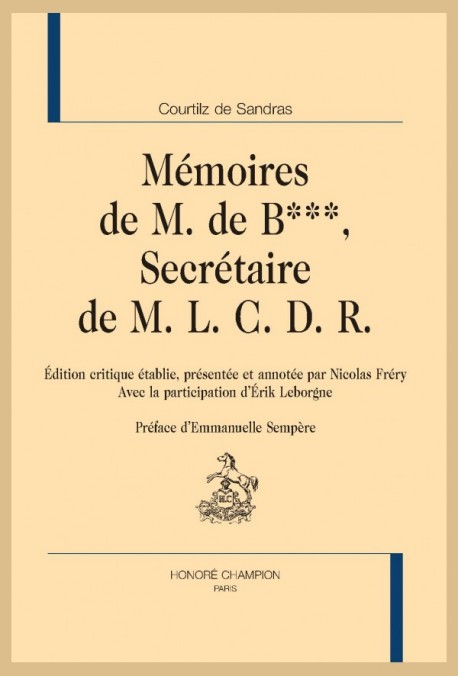
Courtilz De Sandras, Mémoires de M. de B***, secrétaire de m. L. C. D. R., éd. Nicolas Fréry
Posted: 6 Mar 2025 - 09:18

Courtilz De Sandras, Mémoires de M. de B***, secrétaire de M. L. C. D. R., éd. Nicolas Fréry, avec la participation d'Erik Leborgne, préface d'Emmanuelle Sempère, Paris, H. Champion, 2025.
Onze ans après ses Mémoires de d’Artagnan, auxquels Dumas a offert une éclatante postérité littéraire, Courtilz de Sandras (1644-1712), écrivain prolifique et clandestin aujourd’hui reconnu comme un pionnier du roman à la première personne, fait paraître ses derniers mémoires apocryphes : les Mémoires de B***. Cet ouvrage hybride associe, selon la formule dont Courtilz est l’inventeur, le plaisir du romanesque – attaque de carrosse, enrôlement par des corsaires, récit d’une jeune Grecque qui se venge dans le sang de son amant – et l’examen sans complaisance d’une période politiquement troublée, marquée par la figure toute-puissante de Richelieu. Dans une société où l’on est ce que l’on naît, Courtilz donne la parole à un narrateur anonyme qu’un drame originaire, dont se souviendra Marivaux au seuil de La Vie de Marianne, condamne à ignorer son ascendance en dépit de son sentiment d’élection aristocratique. L’infructueuse quête d’identité de B*** aboutit, à mesure qu’il devient le serviteur dévoué de Richelieu, à une dissolution de l’individualité dans le fracas de l’histoire.

Plus d'informations ici.

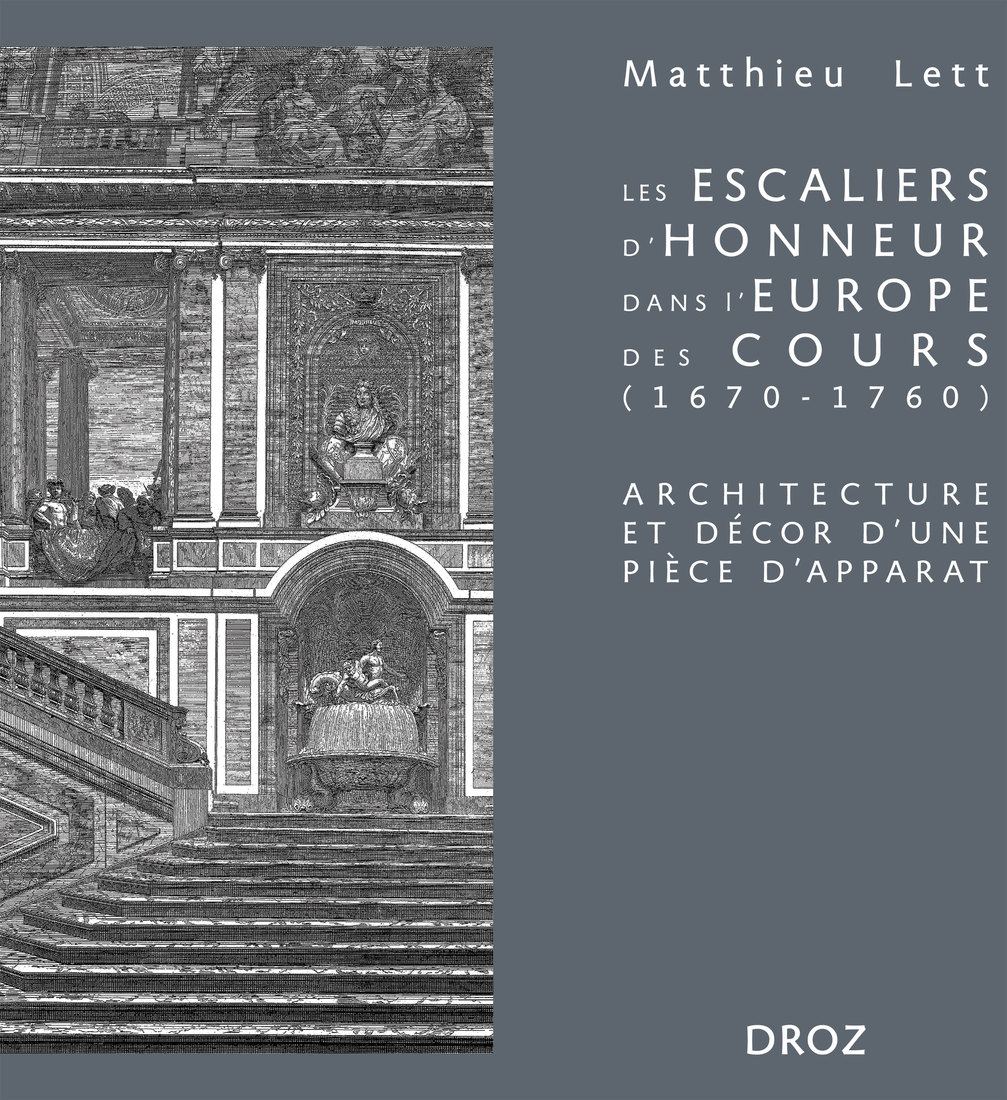
Les escaliers d'honneur dans l'Europe des cours (1670-1760). Architecture et décor d'une pièce d'apparat - Matthieu Lett
Posted: 6 Mar 2025 - 09:13

Matthieu Lett, Les escaliers d'honneur dans l'Europe des cours (1670-1760). Architecture et décor d'une pièce d'apparat, Genève, Droz, 2023.
Entre les années 1670 et 1760, les grands escaliers d’honneurs devinrent un espace d’apparat privilégié au sein des résidences princières européennes. Ils incarnaient à la fois le rang et les ambitions de leurs commanditaires. De Versailles à Caserta, de nombreux chantiers furent entrepris, dans un contexte diplomatique marqué par les rééquilibres politiques entraînés par la montée en puissance de la France de Louis XIV puis les guerres de succession d’Espagne (1701-1713), de Pologne (1733-1738) et d’Autriche (1740-1748). À partir d’un corpus original d’une trentaine d’escaliers bâtis pour des princes souverains en Espagne, en Grande-Bretagne, en Italie, en France et surtout dans le Saint-Empire romain germanique, cet ouvrage vise à mieux comprendre les contraintes et les enjeux qui ont présidé à leur production, en se fondant sur des sources en partie inédites. Pour la première fois, l’escalier est abordé tant sur le plan de l’architecture que du décor dans une perspective européenne qui donne un éclairage nouveau sur la compétition somptuaire entre les cours à l’époque moderne.

Plus d'informations ici.

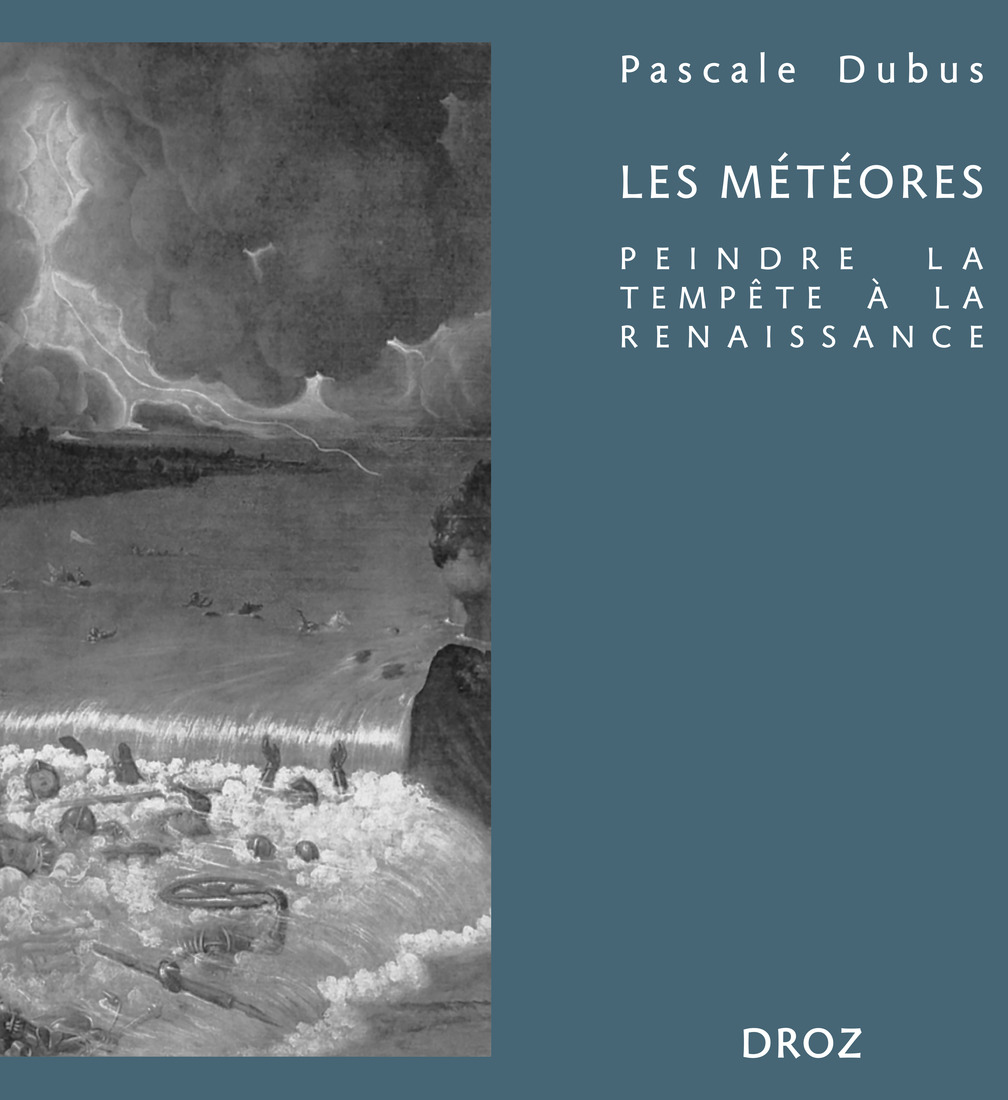
Les Météores. Peindre la tempête à la Renaissance - Pascale Dubus
Posted: 6 Mar 2025 - 09:09

Pascale Dubus, Les météores Peindre la tempête à la Renaissance, Genève Droz, 2025.
Comment peindre la tempête, l’éclair ou l’arc-en-ciel ? Léonard de Vinci, Giorgione et leurs contemporains de la Renaissance étaient fascinés par cette question. Pensés comme ce qui se laisse difficilement représenter, les météores, terme qui désignait alors les phénomènes climatiques, posaient aux peintres et aux théoriciens de la peinture le problème des limites de la mimèsis. Loin d’être seulement le fruit de leur curiosité « naturaliste », les météores sont chargés par les peintres de la Renaissance de significations diverses qui accentuent la puissance expressive de leurs peintures et enrichissent les histoires qu’ils dépeignent. Ce sont les hypothèses originales qui guident le dernier livre de Pascale Dubus, publié à titre posthume et fruit d’une longue recherche. Alors que le changement climatique est une question brûlante d’actualité, ce livre offre un point de vue singulier sur l’origine de notre fascination mêlée d’effroi pour ces passions du temps qui échappent au pouvoir humain.

Plus d'informations ici.

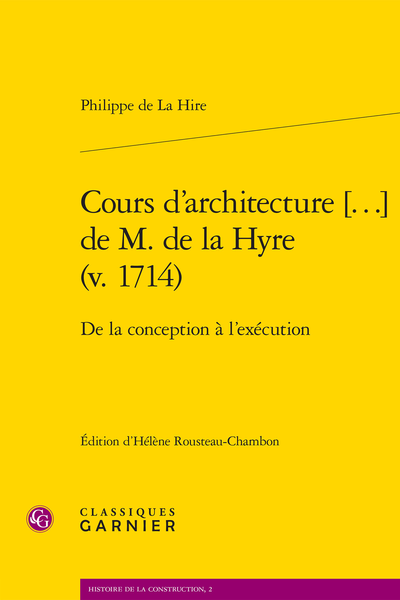
Cours d'architecture […] de M. de la Hyre (v. 1714), éd. Hélène Rousteau-Chambon
Posted: 6 Mar 2025 - 09:05

Philippe de La Hire, Cours d'architecture […] de M. de la Hyre (v. 1714). De la conception à l’exécution, éd. Hélène Rousteau-Chambon, Paris, Classiques Garnier, 2025.
Le Cours d’architecture dispensé par Philippe de La Hire au début du xviiie siècle, et demeuré à l’état de manuscrit, est le premier manuel français d’architecture. La construction y occupe une place centrale. Ce texte innovant fait l’objet ici de sa première analyse critique générale.

Plus d"informations ici.

Maxime Boyko, Représenter le roi au sortir du xvie siècle France et Angleterre en quête d'un art diplomatique (1610-1642)
Posted: 6 Mar 2025 - 09:01

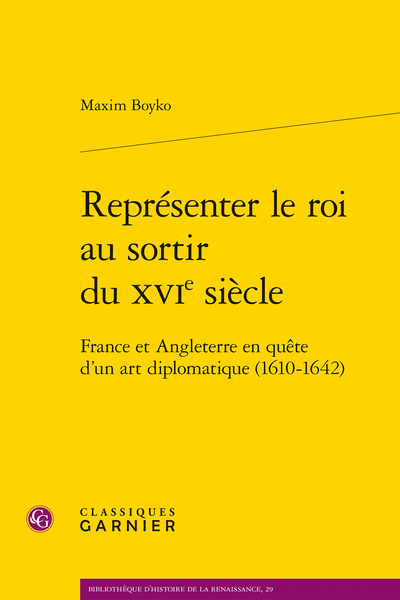
Maxime Boyko, Représenter le roi au sortir du xvie siècle France et Angleterre en quête d'un art diplomatique (1610-1642), Paris, Classiques Garnier, 2025.

L'ouvrage réexamine les relations franco-anglaises en 1610-1642 par l’analyse du fonctionnement de l’appareil diplomatique des deux royaumes. L’objectif de cette étude est de comprendre la manière dont l’état des structures administratives et la sociologie des acteurs ont pesé sur le cours des événements politiques.

Plus d"informations ici.

Conferences and Colloquia

Upcoming on Zoom: What's Wrong with the Renaissance – Curriculum, Colonialism, and English?
Posted: 1 Sep 2020 - 14:37

When: Thursday, 1 October 2020 5:00 p.m. (GMT)

Where:Zoom Hosted by the Centre for Renaissance and Early Modern Studies and the Department of English and Related Literature, University of York United Kingdom

Contact:Kevin Killeen crems-enquiries@york.ac.uk

A round-zoom-table discussion with: Shani Bans, Issa Islam, Farah Karim-Cooper, Wendy Lennon, Subha Mukherji

The prolonged surge of the Black Lives Matter movement since 2013 has led, latterly, to a great deal of conspicuous hand-wringing in universities, museums and the arts. Will it make any difference? How will it change the academy as a whole and how does it need to change a field such as Renaissance Literature and its allied disciplines? Do we remain, as a discipline, impervious to how few BIPOC scholars come through to MA and PhDs in the Renaissance? Does Renaissance scholarship still act as though its task is high connoisseurship of books? Is the early modern curriculum — with its violence, nationalism, religious bigotry and congenital misogyny — too staid and pretty? Does the discipline, still fastidious and imperious, show a disdain for translated (non-classical) literature in teaching very consciously to avoid dealing with non-European cultures? Given the realities of education in the UK, can we separate the dearth of black scholars from the dearth of working class scholars? Does the fact that 'post-colonial criticism' fits awkwardly onto pre-colonial (or early colonial) times serve as a get-out clause to avoid confronting our literature through a difficult lens? Are we poorly served if we have to understand pre-modern race primarily through Shakespeare? Why is the discipline so white and what can we do about it?

Bringing together five scholars at different career stages, this round-table will ask what's wrong with the Renaissance, as a literary discipline (and as a concept), addressing the curriculum, race and the realities of the academy for black scholars.

Sponsored by the Society for Renaissance Studies Hosted by the Centre for Renaissance and Early Modern Studies and the Department of English and Related Literature, University of York.

All Welcome. Please register in advance via Eventbrite. The Zoom log-in details will be sent to delegates before the event. When joining please mute your microphone upon entry, but you’re more than welcome to keep your camera on.

https://www.york.ac.uk/english/news-events/events/2020/renaissance/

Email: crems-enquiries@york.ac.uk

Attribution du Prix XVIIe Siècle 2019
Posted: 19 Aug 2020 - 00:35

Le Prix XVIIe siècle 2019 de la Société d’Etude du XVIIe siècle a été attribué le 30 juin 2020 à Yann Rodier pour Les Raisons de la Haine. Histoire d'une passion dans la France du premier XVIIe siècle (1610-1659), Champ Vallon, « Époques », 2019.

Le Prix sera remis à M. Rodier le vendredi 30 octobre 2020 à 16h à l’Institut historique allemand (Hôtel Duret de Chevry), 8 Rue du Parc Royal, 75003 Paris.

 Présentation de l’ouvrage sur le site de l’éditeur :

http://www.champ-vallon.com/yann-rodier-les-raisons-de-la-haine/

*

Depuis 1984, la Société d’Etude du XVIIe siècle (http://www.17esiecle.fr/) décerne, chaque année, un Prix XVIIe siècle assorti d’une somme de 2000 euros. Ayant pour but d’encourager la diffusion d’un savoir rigoureux auprès du plus large public, ce Prix récompense, sans exclusive de discipline, un ouvrage traitant du XVIIe siècle, paru l’année précédente.

Lauréats précédents :

2018 – Dictionnaire des Pays Bas au Siècle d’Or dirigé par Catherine Secrétan et Willem Frijhoff, Paris, CNRS Editions, 2018.

2017 – François Friche, Entre Terre et Ciel. Romans comiques et mystère de l’Incarnation (1620-1660), Paris, Hermann, 2017.

2016 – Ariane James-Sarazin, Hyacinthe Rigaud. Le catalogue raisonné, Dijon, Editions Faton, 2016.

2015 (deux lauréats) – Aude Volpilhac, « Le secret de bien lire ». Lecture et herméneutique de soi en France au XVIIe siècle, Paris, Honoré Champion, 2015

– Yannick Nexon, Le chancelier Séguier (1588-1672), ministre, dévot et mécène au Grand Siècle, Paris, Champ Vallon, 2015.

2014 – Nathalie Lecomte, Entre cours et jardins d’illusions. Le ballet en Europe (1515-1715), Paris, Centre National de la Danse, 2014.

2013 – Sophie Vergnes, Les Frondeuses : une révolte au féminin (1643-1661), Seyssel, Champ Vallon, 2013.

2012 – Isabelle Landy, Entre Philologie et linguistique : approches de la langue classique, Paris, Garnier, 2012.

2011 – Bartholomé Benassar, Vélasquez, Paris, De Fallois, 2011.

2010 – Gilles Siouffi, Le Génie de la langue française. Études sur les structures imaginaires de la description linguistique à l’Âge classique, Paris, Honoré Champion, 2010.

2020 Virtual Meeting of International Salesian Scholars Seminar (October 22, 23, 24)
Posted: 14 Aug 2020 - 14:59

Via Suzanne Toczyski:

As you may be aware, many professional/scholarly associations, societies, and working groups, are foregoing in person meetings in the coming months, due to health and safety issues precipitated by the COVID-19 pandemic, as well as the accompanying financial crisis, with many colleges/universities having eliminated travel funding.

With these factors in mind, we propose a virtual meeting, via ZOOM, of the 2020 International Salesian Scholars Seminar. Given this format, we would forego this year having the customary discussion of the research papers prepared in advance by Seminar participants, and focus exclusively on the plenary seminar, “Performative Transformation: The Praxis of the Heart. Franciscan Echoes in Francis de Sales,” which will be led by Mary Elizabeth Ingham, C.S.J. (Ph.D., University of Fribourg, Switzerland).  Since the Seminar is already on our calendars, Dr. Ingham’s seminar would be scheduled for three-hour segments on Thursday, October 22, Friday, October 23, and Saturday, October 24, from 1:00 to 4:00 p.m., Eastern Daylight Time (10:00 a.m. – 1:00 p.m., Pacific Daylight Time).

As disappointing as it is for us not to gather in person, at the same time this format may make it possible for more scholars to participate. In addition to colleagues in the U.S. and Europe, several of Wendy’s doctoral students in French spirituality from the Oblate School of Theology in San Antonio, TX, may also join us.

Specializing in the Franciscan Intellectual Tradition and Duns Scotus, Dr. Ingham is Professor of Philosophical Theology at the Franciscan School of Theology, Oceanside, CA, and Professor Emerita and Distinguished Scholar in Residence at Loyola Marymount University. The central lens for Dr. Ingham’s seminar will be the performative, i.e., the transformative, dimension of spiritual living. This lens will be unpacked through the following themes: (1) moral artistry (Vive Jésus!)—Duns Scotus; (2) particularity and beauty (unity in diversity)—Bonaventure and Scotus; and (3) the two wills: an exchange of hearts (cor ad cor loquitur)—Duns Scotus.

We welcome your comments or observations. Closer to the time for the Seminar, we will need you to register to participate for the duration of each session. (ZOOM is not live streaming, so popping in and out is not an option.)  Likewise, we will also provide instructions about the process for the seminar sessions, as well as the set up that you will need, e.g., camera, audio, etc.

Rev. Joseph F. Chorpenning, O.S.F.S., S.T.L., Ph.D. Editorial Director Saint Joseph's University Press 5600 City Avenue Philadelphia, PA  19131-1395 U.S.A.

E-mail: jchorpen@sju.edu Tel. 610/660-1214 Fax: 610/660-3412 Website: www.sjupress.com

Please contact Rev. Chorpenning if you wish to receive the invitation to register, or if you wish to see Dr. Ingham's CV.

Joint Society for French Historical Studies Conference and George Rudé Seminar in French History and Civilisation
Posted: 4 Jun 2020 - 10:05

5 July to 31 July 202

While we are very sad not to be welcoming you in Auckland, this virtual conference promises to be an exciting event that will help us all to learn about conferencing in a new way.  So please find attached the programme for the virtual conference France and Beyond. All events are open without any need to “register.”  All the recorded keynotes, webinars and panels will be available as issues of the H-France Salon to be watched after the event.  Links for the live sessions will also be distributed on H-France in the week preceding the event. 

There will be four types of session, Keynotes, Webinars, Salons, and Panels, and these will be clearly identified with instructions on the H-France site in July.  The general principle is that Keynotes and Webinars are recorded, Salons are not, and Panels are pre-recorded.  There are some panels where the discussion session is open and not recorded so that people at ease asking questions. If you want to participate in sessions that are live and not recorded, you will have to log in at the particular time (e.g. Panels 6, Ideas of the French Revolution, 10 Women Writers, 22 Publishing French and Francophone History & 33, Grad Stories).

Editor of French History and Civilization (the Rudé Seminar proceedings), Dr Briony Neilson, (brionyneilson@gmail.com) welcomes submissions from now of written articles for French History and Civilization that is published on H-France in a peer-reviewed on-line format.  Please note that in addition to all conference participants, submissions are warmly invited from anyone whose proposal was accepted for the Auckland conference but who could not participate in the virtual event.  

All this information (plus updated versions of the programme as the links come ready) will be found at the following address hosted on the Massey University website:

https://www.massey.ac.nz/massey/learning/departments/school-of-humanities/events/france-and-beyond/france-and-beyond_home.cfm

The Conference address for the H-France Salon can be found at:

https://h-france.net/h-france-salon-volume-12-2020/rude-sfhs-virtual-conference/

For any additional information don’t hesitate to email any one of the Auckland Team.

Kirsty     K.Carpenter@massey.ac.nz

Tracy      t.adams@auckland.ac.nz

Joe         j.zizek@auckland.ac.nz


CAHSA Online Speaker Series
Posted: 28 May 2020 - 18:47

Dear colleagues,

As part of its online lecture series, the Collectif d’Anthropologie et d’Histoire du Spirituel et des Affects (CAHSA) is pleased to present a talk by Dr. Leslie Tuttle, Associate Professor of History (Louisiana State University, Bâton-Rouge). Her current research focuses on the changing perceptions of dreams in seventeenth and eighteenth-century France and the French diaspora. The talk (in English) will last 30-40 minutes, followed by 20-30 minutes for discussion (in French and English).

CAHSA Online Speaker Series

Presents

Dr. Leslie Tuttle Louisiana State University

11 June 2020 

11h CT

(9h PT/ 10h MT / 12h ET / 18h CET)

Via Zoom

Free for CAHSA members.

Become a CAHSA member at http://www.cahsanet.org to participate ($15 CAD/year)

RSVP to groupecahsa@gmail.com for the Zoom link for the lecture

“The Etiquette of Dreaming: Night Visions and Discernment in Seventeenth Century Spirituality”

Most cultures throughout history have accepted dreams as a potential way to communicate with invisible or supernatural realms. As heirs to multiple methods for interpreting dreams drawn from both learned and popular sources, early modern Europeans fit this global pattern. However, in the wake of the Reformations, talking about one’s dreams fell under renewed scrutiny. This presentation will sample seventeenth-century religious texts including penitentials, spiritual manuals, hagiography and the Jesuit Relations to trace changing protocols governing when it was acceptable to relate a dream, to whom, and for what purpose.


*** *** *** *** *** *** *** *** *** ***


Chers et chères collègues,

Dans le cadre de sa série de conférences en ligne, le Collectif d’Anthropologie et d’Histoire du Spirituel et des Affects (CAHSA) a le plaisir de proposer une conférence du Dr. Leslie Tuttle, professeure associée au département d’histoire de Louisiana State University (Bâton-Rouge), spécialiste des pratiques magiques, de la sorcellerie et des superstitions dans l’Europe moderne. La conférence (en anglais) durera 30-40 minutes, suivie par 20-30 minutes de discussion (en anglais et français).

Les E-conférences du CAHSA

Présentent

Dr. Leslie Tuttle Louisiana State University

11 June 2020 

11h heure normale du Centre

(9h heure normale du Pacifique / 10h heure normale des Rocheuses / 12h heure normale de l’Est / 18h heure Française)

Via Zoom

La participation est gratuite pour les membres du CAHSA. Veuillez nous écrire à groupecahsa@gmail.com pour obtenir le lien Zoom qui vous permettra de participer à la conférence. Vous pouvez adhérer au CAHSA à www.cahsanet.org($15 CAD/an, payable en ligne)

“The Etiquette of Dreaming: Night Visions and Discernment in Seventeenth Century Spirituality”

Most cultures throughout history have accepted dreams as a potential way to communicate with invisible or supernatural realms. As heirs to multiple methods for interpreting dreams drawn from both learned and popular sources, early modern Europeans fit this global pattern. However, in the wake of the Reformations, talking about one’s dreams fell under renewed scrutiny. This presentation will sample seventeenth-century religious texts including penitentials, spiritual manuals, hagiography and the Jesuit Relations to trace changing protocols governing when it was acceptable to relate a dream, to whom, and for what purpose.

Member News Briefs

Bernard J. Bourque, University of New England (Australia)
University of New England (Australia)

Congratulations to Bernard J. Bourque for his book: All the Abbé’s Women. Power and Misogyny in Seventeenth-Century France, through the Writings of Abbé d’Aubignac (Tübingen: Narr Verlag, 2015). [ISBN: 978-3-8233-6974-5]


Post date: 11 years 2 weeks ago
Book Review on Tuomas Tikanoja, Transgressing Boundaries: Worldly Conversation, Politeness and Sociability in Ancien Régime France, 1660-1789.
Boston University

H-FranceReview Vol. 15 (May 2015), No. 72


Tuomas Tikanoja, Transgressing Boundaries: Worldly Conversation, Politeness and Sociability in Ancien Régime France, 1660-1789. Helsinki: Tuomas Tikanoja, 2013. 277 pp. Notes, bibliography, index. ISBN 978-952-93-2685-3.


Review by Elizabeth C. Goldsmith, Boston University:

http://www.h-france.net/vol15reviews/vol15no72goldsmith.pdf

 
Post date: 11 years 3 weeks ago
Chris Semk, on Nicholas Hammond and Michael Moriarty, eds., Evocations of Eloquence: Rhetoric, Literature and Religion in Early Modern France
Yale University

H-France Review Vol. 15 (June 2015), No. 79


Nicholas Hammond and Michael Moriarty, eds., Evocations of Eloquence: Rhetoric, Literature and Religion in Early Modern France. Berlin: Peter Lang, 2012. viii + 364 pp. Notes and index. $73.95 U.S. (pb). ISBN 978-0343-0849-6 


Review by Christopher Semk, Yale University.

Post date: 11 years 3 weeks ago
Nick Page on Anna Arzoumanov, Pour lire les clefs de l’Ancien Régime. Anatomie d’un protocole interprétatif
UC Berkeley

H-France Review Vol. 15 (June 2015), No. 82


Anna Arzoumanov, Pour lire les clefs de l’Ancien Régime. Anatomie d’un protocole interprétatif. Paris, Classiques Garnier, 2013. 533 pp. Notes, annex, bibliography, and indexes. 73 € (cl). ISBN 978-2-8124-1426-8; 48 € (p). ISBN 978-2-8124-1425-1


Review by Nicholas D. Paige, University of California, Berkeley:

http://www.h-france.net/vol15reviews/vol15no82paige.pdf

 
Post date: 11 years 3 weeks ago
Journée d'étude

Journée d'étude organisée par Sara Harvey à laquelle vous êtes conviés:

Chers & chères collègues, Je me permets de vous contacter pour vous annoncer la tenue d'un colloque que j'organise à Montréal afin d'égayer le mois de juin à venir et dont vous trouverez le programme en suivant ce lien : https://cas.hypotheses.org/files/2015/05/Critique_au_present_Programme.pdf Cette manifestation vise à poursuivre par un travail collectif une partie des hypothèses issues d'un projet de recherche postdoctoral que j'ai mené sur l'émergence de la critique dans la presse périodique littéraire au XVIIe siècle. Elle permettra également, je l'espère, d'établir un dialogue avec la communauté des chercheurs en réfléchissant aux problématiques qui entourent la critique au présent, qu'elle soit académique, professionnelle ou amateure. Ce colloque se déroulera du 17 au 19 juin prochains à Montréal (Institut de tourisme et d’hôtellerie du Québec, métro Sherbrooke). Il portera plus précisément sur l’observation de discours critiques en langue française ayant accompagné la publication initiale de productions artistiques et intellectuelles de l’époque moderne. Et, il interrogera les pratiques de ces discours à la faveur d’une réflexion sur la situation actuelle de l’activité critique, alors même qu’elle est confrontée à une transformation majeure imposée par le Web en tant que nouvel espace de diffusion et de médiatisation. Si vous souhaitez vous joindre au banquet du 17 juin et au cocktail du 19, qui se tiendront également à l’ITHQ, veuillez en informer Isabelle Lachance (isabelle.lachance1@uqtr.ca), membre du comité organisateur, d’ici le mercredi 10 juin prochain. Enfin, n’hésitez pas à distribuer cette annonce auprès de vos étudiants de 2e et 3e cycles ainsi que des stagiaires postdoctoraux susceptibles d’être intéressés par l’événement. En espérant vous rencontrer très prochainement. Bien cordialement, Sara Harvey


Post date: 11 years 1 month ago