Announce

Calls for Papers and Contributions

CfP / Appel à communication : 40th Annual SE-17 Conference (abstracts by 31 July)
Posted: Wednesday, June 9, 2021 - 12:24

{Link to the CfP / Appel on the EMF Site}

40ème Congrès international annuel de la Société d’études pluridisciplinaires du dix-septième siècle français

40th Annual International Conference of the Society for Interdisciplinary French Seventeenth-Century Studies 

SE17

14-15 Oct. & 22-23 Oct. 2021 (Congrès Virtuel / Virtual Conference)

Le Grand siècle en mouvement : négociations, circulations, dynamiques

The Grand Siècle in Movement: Negotiations, Circulations, Dynamics

Organisatrices / Organizers:

Anne Duprat (Université de Picardie-Jules Verne / Institut Universitaire de France)

Charlotte Trinquet du Lys (University of Central Florida)

Aux Etats-Unis comme en France, nombreux ont été les appels à une réinvention du « monde de demain », fondée sur une meilleure compréhension des lignes de fracture mais aussi des forces dynamiques à l’œuvre dans la structuration de ce monde, dans la façon dont il se pense et se représente dans ses différentes composantes. Fortement marquée par la mémoire des guerres civiles et des guerres de religion, parcourue de tensions culturelles, sociales et symboliques constantes, ébranlée par la transformation irrévocable de son rapport au monde au seuil du XVIIIe siècle, et par la déportation et l’esclavagisme des Africains et la colonisation des peuples autochtones en Amérique du nord, la France du Grand Siècle apparaît aujourd’hui bien loin de la  construction culturelle monumentale qu’avait élaborée pour elle l’historiographie classique au XIXe siècle. De même, la richesse de ses productions culturelles, leur fluidité formelle, leur forte dimension intermédiale et leur complexité sémantique et intellectuelle ont débordé sans cesse les tentatives de cartographie systématique qu’a pu en faire pendant les trente dernières années la critique littéraire et historiographique.

C’est à l’exploration de cette exceptionnelle diversité et de cette mobilité des formes inventées et des gestes accomplis par les auteurs·trices, et par tous les acteurs·trices engagé·e·s dans la création au XVIIe, ainsi qu’à la mise en évidence des échos que ces productions peuvent susciter aujourd’hui dans une conversation mondiale marquée par la dynamique et la nécessité des réinventions, que le congrès 2021 de la SE17 invite les chercheurs et chercheuses de toutes disciplines. Il s’agira de creuser les failles qui parcourent la construction de l’Etat-nation et la mobilité des groupes qui le constituent, telles qu’elles se manifestent dans et par ses productions culturelles et sociales durant le XVIIe siècle français (1595-1715). On pourra ainsi faire émerger la puissance créative, symbolique et esthétique des mouvements et des aspirations qui les animent, l’efficacité des négociations ponctuelles sans cesse renouvelées auxquelles ils ont donné lieu ou qui les ont inspirés — mais aussi les échecs auxquels certaines de ces tentatives ont abouti — enfin des dynamiques d’adaptation et de réinvention de soi et de l’autre qui ont marqué cette construction, et peuvent éveiller aujourd’hui des échos dans un monde aux formes politiques, scientifiques et médiatiques en pleine mutation.

Nous proposons comme point de départ trois axes par lesquels aborder ce Grand siècle en mouvement : négociations, circulations et dynamiques. A partir des propositions que nous recevrons, nous ferons un regroupement en 6 séances, en plus de la séance pédagogique habituelle. Le programme sera divisé en deux fois deux jours de conférence virtuelle, sur les dates suivantes : 14-15 octobre et 22-23 octobre 2021.

***

In the United States as in France, many calls have been made for a reinvention of the “world of tomorrow,” based on a better understanding of rupture points but also of the dynamic forces at work in the structuring of this world, in the way in which it thinks and represents itself in its different components. Strongly marked by the memory of civil and religious wars, characterized by constant cultural, social and symbolic tensions, shaken by the irrevocable transformation of its relationship to the world on the threshold of the 18th century, and by the deportation and enslavement of Africans and the colonization of indigenous peoples in North America, Grand Siècle France today appears far removed from the cultural monument 19th-century classical historiography constructed and celebrated. Likewise, the richness of its cultural productions, their formal fluidity, their strong intermedial dimension and their semantic and intellectual complexities constantly exceeded literary and historiographic criticism’s attempts over the past thirty years to create a systematic cartography. 

The 2021 Annual Conference of the SE17 invites researchers from all disciplines to explore the exceptional diversity and mobility of the forms invented and actions taken by the authors and actors engaged in the creation in the XVIIth century, by highlighting the echoes that these productions generate today amidst a global conversation marked by a dynamic and necessity for reinvention. We hope to examine the flaws inherent in the construction of the nation-state and the mobility of the groups that constitute it, as they are manifested in and by the cultural and social productions of the French 17th century (1595-1715). We will thus be able to bring out the creative, symbolic and aesthetic power of the movements and aspirations that drove them, the effectiveness of the endlessly renewed negotiations to which they gave rise or that inspired them—but also the failures of some of these attempts—finally, the dynamics of adaptation and reinvention of self and other that marked this construction, and find echos in a world whose political, scientific and media forms are in full mutation.

We propose as a starting point three axes by which to approach this Grand Siècle in motion: negotiations, circulation and dynamics. We will group the proposals we receive into 6 sessions, in addition to the usual session on teaching the seventeenth century. The virtual conference will take place over two two-day sessions: Oct. 14-15 and Oct. 22-23, 2021.


Axe 1. Négociations : l'individu et le collectif

Axis 1. Negotiations: The Individual and the Collective

 - Violence interpersonnelle et violence politique dans la France d’Ancien Régime : police et politique ; la Fronde et le complot ; évolutions des mises en spectacle (théâtre, ballet, représentations curiales, peinture, musique), du langage (histoire symbolique du « sang », du « fer ») et des rhétoriques de la violence sur le long XVIIe siècle.

Interpersonal and political violence in Ancien Régime France: Police and Politics; the Fronde and conspiracy; changes in performance genres (theater, ballet, curial representations, painting, music), in language (the symbolic history of “blood”, of “iron”) and the rhetoric of violence in the long 17th century.

- Personne/personnel/personnage : constructions fictionnelles et littéraires du moi, héroïque ou non, dans la France baroque et classique ; simulation, dissimulation et évolution des représentations littéraires de soi en collectivité.

Person / personal / character: fictional and literary constructions of the self, heroic or not, in baroque and classical France; simulation, concealment and evolution of literary representations of self in relationship to the collective.

-  De l’écrivain·e à l’auteur·trice : genre littéraire et gender, stratégies de légitimation et fabrique de l'autorité dans le champ littéraire.

From writer to author: literary genre and gender, legitimation strategies and the creation of authority in the literary field.

-  Le long XVIIe siècle et l’héritage des guerres de religion : techniques de la conciliation (civile, politique, confessionnelle, curiale…), de la médiation (sociale, morale, psychologique) et de la réparation.

The long 17th century and the legacy of the religious wars: techniques of reconciliation (civil, political, confessional, curial, etc.), of mediation (social, moral, psychological) and of reparation.


Axe 2. Circulations : métamorphoses de l’espace au 17e siècle

Axis 2. Circulations: metamorphoses of space in the 17th century

- Epistémologie des réseaux : construction de la connaissance, circulation de l’information et de la propagande à distance (sociétés de correspondance, salons, journaux, historiographie).

Network epistemology: construction of knowledge, circulation of information and long-distance propaganda (correspondence companies, salons, newspapers, historiography).

- Islam, judaïsme et chrétienté au XVIIe siècle en Europe : repenser la visibilité ethnique des groupes religieux et leur exemplarité culturelle, morale et théologique (Juifs, Arabes, Maures, Morisques, Sarrasins, Turcs…), en France et/ou dans d’autres pays (Espagne, Angleterre, Hollande).

Islam, Judaism and Christianity in the 17th century in Europe: rethinking the ethnic visibility of religious groups and their cultural, moral and theological exemplarity (Jews, Arabs, Moors, Moriscos, Saracens, Turks, etc.), in France and / or in others country (Spain, England, Holland).

- Inclusions/exclusions : espaces, identités et politiques en mutation, en France et dans les colonies amérindiennes et antillaises.

Inclusions / exclusions: spaces, identities and changing policies, in France and in the North American and Caribbean colonies.

- Structures symboliques et représentationnelles des différents colonialismes et anticolonialismes français d’Ancien Régime (discours, représentations, logiques économiques et scientifiques).

Symbolic and representational structures of the various French colonialisms and anti-colonialisms of the Ancien Régime (discourse, representations, economic and scientific logic).


Axe 3. Dynamiques : l’innovation au XVIIe siècle et ses ré/adaptations contemporaines

Axis 3. Dynamics: innovation in the 17th century and its contemporary re / adaptations

- Langue, parole, écriture : mutations littéraires de l’oralité sous Louis XIV et leurs réinterprétations contemporaines

Language, speech, writing: literary mutations in orality and their contemporary reinterpretations under Louis XIV’s reign

- Fluidité des identités sexuelles et sociales au XVIIe siècle et dynamique de leurs réécritures récentes (féminisme et préciosité, gender fluidity et poésie libertine baroque, non binarisme…) 

Fluidity of sexual and social identities in the 17th century and the dynamics of their recent rewritings (feminism and preciousness, gender fluidity and baroque libertine poetry, non-binarism, etc.)

- Métamorphoses du conte (1665-1730) : l'invention du conte oriental; écritures féminines et innovation formelle; nouvelle psychocritique du conte

Metamorphoses of the fairy tale (1665-1730): the invention of the oriental tale; women’s writing and formal innovation; new psychocriticism of fairy tales

- Mutation des genres littéraires : la trans- et l'intermédialité baroque et classique face à l’intermédialité contemporaine (littérature/cinéma/séries/BD/ jeux vidéo/ etc.)

Mutation of literary genres: baroque and classical trans- and intermediality versus contemporary intermediality (literature / cinema / series / comics / video games / etc.)

- Le XVIIe siècle comme thème dans la création esthétique contemporaine : interpréter et réinterpréter les formes anciennes (stylisme, mode, architecture, musique, spectacle, etc.)

The 17th century as a theme in contemporary aesthetic creation: interpreting and reinterpreting old forms (styling, fashion, architecture, music, spectacle, etc.)

 - L’étrangeté classique : exotisme et défamiliarisation

Classical strangeness: exoticism and defamiliarization

Date limite du 31 juillet 2021 à envoyer à : se172021conf@gmail.com

  • Envois de propositions de 250 mots (inclure l’axe qui vous intéresse, ou spécifier séance pédagogique)
  • Demandes de présidence de séance (inclure l’axe qui vous intéresse)
  • Demandes de participation aux ateliers de travaux en cours (proposition pas nécessaire, mais merci d’envoyer le titre de votre travail en cours)
  • Idées et propositions pour les autres séances (groupes de lectures, projets asynchrones)


Deadline of July 31, 2021 to be sent to: se172021conf@gmail.com

  • 250-word abstracts (include the axis that interests you, or specify teaching session) 
  • Interest in chairing a panel (please include the axis that interests you)
  • Interest in participating in work in progress workshops (no abstract needed, just title of work in progress)
  • Ideas and proposal for the other sessions (reading groups, asynchronous projects)

***

Séances basées sur les axes proposés / Sessions based on the proposed axes

Au lieu de séances traditionnelles avec interventions de 20 minutes, nous proposons de suivre le modèle instauré l’an dernier de tables rondes et forums (75 minutes par table ronde, consistant de présentations de 5-10 minutes sur les thèmes proposés, suivies de discussion avec l’audience). Nous proposons de suivre aussi ce modèle pour la séance pédagogique.

Instead of traditional sessions with 20-minute interventions, we propose to follow the model established last year of round tables and forums (75 minutes per round table, consisting of 5-10-minute presentations on the proposed themes. We propose to also follow this model for the pedagogy session (s).

Séance(s) Pédagogique(s) / Teaching Session(s)

Comme toujours, la SE17 est fière de programmer une ou plusieurs séance(s) sur la pédagogie et l’enseignement du 17e siècle pour le 40e congrès annuel. La séance est libre et toutes les idées sur la pédagogie et l’enseignement du 17e sont les bienvenues. Cette année nous nous proposons aussi d’ouvrir les propositions pédagogiques basées aussi sur les trois axes du congrès : négociations, circulations et dynamiques.

As always, SE17 is proud to offer one or more sessions on teaching the 17th century at our 40th Annual Conference. All ideas on pedagogy and teaching of the 17th-century are welcome at this session. This year we also propose opening the session(s) to proposals based on the three axes of the conference: negotiations, movements, and dynamics.

Ateliers de travaux en cours / Work in progress Workshops

Ces séances closes consistent en présentations rapides de 5 minutes suivies d’une discussion de groupe portant sur un travail en cours. Tous les participants auront fait circuler leur travail en cours (pas plus de 30 pages) et auront lu le travail en cours des autres avant la séance. Ces ateliers sont indépendants des séances au format table ronde, et sont réservés aux personnes qui veulent présenter et faire évaluer leurs travaux en cours. Les participants pourront aussi présenter une communication à une autre séance ou la présider.  Les ateliers seront programmés par les participants en dehors des heures du congrès.

These closed sessions consist of 5-minute flash presentations followed by feedback and intensive group discussion. Participants agree to circulate their work in progress of no more than 30 pages and to read the work in progress of the other participants in advance of the session. These workshops are independent of the roundtable format sessions and are reserved for people who want to present and have their work in progress evaluated. Participants may also present or preside over one other session at the conference. Workshops will be scheduled by participants outside of regular conference hours.

Autres séances / Other sessions

Les présidentes du congrès organiseront également des Groupes de Lectures, des présentations Flash sur le travail en cours des groupes de lectures du 39ème congrès, et des projets asynchrones. Nous vous invitons à envoyer vos idées et propositions pour ces séances.

The conference presidents will also be organizing reading groups, flash presentations from last year's reading groups, and asynchronous projects and welcome ideas for these sessions.

Molière par la scène - Molière on stage
Posted: Wednesday, May 12, 2021 - 11:57

Appel à communications pour le colloque-festival international


Molière par la scène - Leçons de l’interprétation

(English version below)


A la Maison Française d’Oxford, les 27 et 28 juin 2022

En Avignon, les 11 et 12 juillet 2022


Organisé à l’occasion du quadricentenaire de la naissance de Molière, ce colloque-festival se propose d’examiner à nouveaux frais son théâtre, par le prisme de la mise en scène moderne et contemporaine (XXe-XXIe s.). Il s’agira d’une part de mesurer ce que notre regard sur ce théâtre doit aux grands metteurs en scène du XXe siècle comme Baty, Jouvet ou Planchon, et d’autre part de comprendre en quoi le passage par la scène peut constituer en lui-même, aujourd’hui, un instrument de connaissance du théâtre de Molière. Comment, en mettant le texte sur le plateau, le metteur en scène fait-il apparaître de nouveaux fonctionnements et mécanismes dramaturgiques, qui passaient inaperçus sans l’épreuve de la scène? 


La mise en scène est bien sûr par vocation un instrument herméneutique, qui met au jour les significations latentes – délibérées ou non – du texte de théâtre. Mais elle est aussi un instrument proprement heuristique : les grandes incarnations successives ayant donnécorps aux personnages de Molière (le Dom Juan austère et grandiose de Jouvet, le Sganarelle hâbleur et pétillant de Daniel Soranochez Vilar, le Tartuffe fiévreux et séducteur de Richard Fontana chez Vitez, l’Agnès adolescente d’Isabelle Adjani chez Roussillon, l'Orgon improbable de Bakary Sangaré chez Bozonnet, le Dom Juan joueur de Mexianu Medenou chez Julie Brochen) ont ainsi permisde prendre conscience de multiples potentialités des pièces. De même, certains constats sur la structure dramatique ne peuvent se faire que par le passage à la scène (rythme général de la composition en actes, importance des liaisons scéniques, structuration de la tirade pour la voix, écriture entièrement pensée en fonction du souffle, etc.). En s’imposant comme instances à part entière dans le processus artistique à partir de la fin du XIXe siècle, les metteurs en scène ont ainsi ouvert des voies nouvelles pour la compréhension et le rayonnement du théâtre de Molière, qui avait surtout jusqu’alors emprunté les outils de l’histoire et de l’analyse littéraire. 


Ce colloque portera un regard global sur les mises en scène de Molière dans le théâtre vivant, en faisant place notamment au théâtre francophone, où Molière fait l’objet de nombreuses adaptations et hybridations, et aux théâtres d’autres langues et cultures (anglophones, hispanophones, orientales...), où le rayonnement de Molière passe par un travail de traduction sans cesse renouvelé. Tel que l’illustrent, de manière non exclusive, les spectacles suivants: Le Misanthrope de Ivo van Hove au New-York Theater Workshop en 2007, Le Malade imaginaire de Rogério De Carvalho au Teatro Nacional São João de Porto en 2012, le Tartuffe de Denis Marleau et Stéphanie Jasmin au Théâtre National de Montréal en 2016, le Tartuffe de Christopher Hampton au Theater Royal Haymarket, London, 2018, et tout récemment la trilogie Molière in the Park (Tartuffe, Le MisanthropeL’Ecole des femmes) de Lucie Tiberghien (Brooklyn’s Prospect Park, New York, 2019-2020). 


Comité d’organisation


Gilles Declercq, Université Sorbonne-Nouvelle, IRET

Jean de Guardia, Université Grenoble-Alpes, Litt&Arts

Sylvie Chalaye, Université Sorbonne-Nouvelle, IRET

Céline Candiard, Université Lumière Lyon II, IHRIM 

Tristan Alonge, Maison Française d’Oxford (CNRS), Université de la Réunion

Stella Spriet, University of Saskatchewan, Canada


Comité scientifique


Jean-Marie Apostolidès

Axel Artheron

Georges Banu

Marcel Bozonnet

Jan Clarke

Marco Consolini 

Ludmilla Dabo

Amos Fergombé

Sylvaine Guyot

Michael Hawcroft

Tiphaine Karsenti 

Mario Longtin

Pierre Longuenesse 

Bénédicte Louvat

Daniel Mesguich

Catherine Naugrette

Florence Naugrette 

Assane Timbo

Wes Williams


Les propositions de communication sont attendues avant le 30 juin 2021 à ces adresses:


jean.deguardia@univ-grenoble-alpes.fr

celine.candiard@univ-lyon2.fr

tristan.alonge@univ-reunion.fr


Call for papers for the International Conference and Festival


Molière on stage – Lessons in Interpretation


The Maison Française, Oxford, June 27-28, 2022

Avignon, July 11-12 2022


Organized to mark the occasion of the 400th anniversary of Molière’s birth, this joint conference and festival seeks to re-examine his plays, through the prism of modern and contemporary (20th-21st century) productions. The aim of the conference will be to examine the ways in which the great directors of the 20th century such as Baty, Jouvet or Planchon have shaped our understanding of these plays, as well as to understand how the stage can in itself serve as an instrument of knowledge of Molière’s work. How does the director, in staging the text, reveal new dramaturgical functions and mechanisms, which would go unnoticed without the crucible of the stage?


 Direction is a hermeneutic device by vocation, one that reveals latent meaning – conscious or otherwise – in the dramatic text. But it is also a heuristic device: the great series of incarnations that embodied Molière’s characters (Jouvet’s austere and grandiose Don Juan, Daniel Sorano’s boastful and spirited Sganarelle by Vilar, Richard Fontana’s feverish and seductive Tartuffe directed by Vitez, the adolescent Agnès played by Isabelle Adjani directed by Roussillon, Bakary Sangaré’s improbable Orgon by Bozonnet, MexianuMedenou’s playful Dom Juan by Julie Brochen) allowed for an awareness of the plays’ multiple potentialities. Similarly, certain observations on the dramatic structure can only be made upon the passage to the stage (the pacing of the acts, the importance of scene transitions, the structuring of the declamation for the voice, writing conceived entirely according to breath, etc.). Having established themselves as authorities in their own right in the artistic process as of the end of the 19th century, directors have opened new avenues for the continuation of Molière’s legacy and the understanding of his work, which hitherto largely borrowed tools from historical and literary analysis.


This conference will adopt a global perspective on the staging of Molière’s plays for live theatre, with a particular emphasis on francophone theatre, where Molière has been the object of numerous adaptations and hybridizations, as well as on theatre in other languages and cultures (English, Spanish, and Asian languages...), where Molière’s legacy is continually renewed through the act of translation.

For instance: The Misanthrope by Ivo van Hove, New-York Theater Workshop, 2007 ; The Imaginary Invalid by Rogério De Carvalho, Teatro Nacional São João de Porto, 2012 ; Tartuffe by Denis Marleau and Stéphanie Jasmin, Théâtre National de Montréal, 2016, Tartuffe by Christopher Hampton, Theater Royal Haymarket, London, 2018, and lately Molière in the Park trilogy (Tartuffe, The MisanthropeThe School for Wives) by Lucie Tiberghien (Brooklyn’s Prospect Park, New York, 2019-2020).


Organizing Committee


Gilles Declercq, Université Sorbonne-Nouvelle, IRET

Jean de Guardia, Université Grenoble-Alpes, Litt&Arts

Sylvie Chalaye, Université Sorbonne-Nouvelle, IRET

Céline Candiard, Université Lumière Lyon II, IHRIM 

Tristan Alonge, Maison Française d’Oxford (CNRS), Université de la Réunion

Stella Spriet, University of Saskatchewan, Canada


Scientific Committee


Jean-Marie Apostolidès

Axel Artheron

Georges Banu

Marcel Bozonnet

Jan Clarke

Marco Consolini 

Ludmilla Dabo

Amos Fergombé

Sylvaine Guyot

Michael Hawcroft

Tiphaine Karsenti 

Mario Longtin

Pierre Longuenesse 

Bénédicte Louvat

Daniel Mesguich

Catherine Naugrette

Florence Naugrette 

Assane Timbo

Wes Williams


Proposals for papers can be sent to these addresses before June 30, 2021:


jean.deguardia@univ-grenoble-alpes.fr

celine.candiard@univ-lyon2.fr

tristan.alonge@univ-reunion.fr


Du « théâtre de société » avant 1700 ?
Posted: Wednesday, May 5, 2021 - 10:50

Du « théâtre de société » avant 1700 ?

journée d’étude organisée par Dominique Quéro (Université de Reims Champagne-Ardenne, CRIMEL), Valentina Ponzetto et Jennifer Ruimi (FNS, Université de Lausanne), le vendredi 24 septembre 2021 à Reims en présentiel (si possible) et par visioconférence.

Peut-on parler de « théâtre de société » avant 1700, et sous quelles formes se manifeste alors ce phénomène qui connaît son plein essor à partir des années 1750 et perdure au(x) siècle(s) suivant(s) ? 

Objet de maints ouvrages au tournant des 19e et 20e siècles, les théâtres de société suscitent depuis 25 ans un regain d’intérêt de la part des dix-huitièmistes, dont David Trott, créateur du site « Théâtres de société : rayonnement du répertoire français entre 1700 et 1799 », et Marie-Emmanuelle Plagnol-Diéval, à qui l’on doit l’étude de référence sur Le théâtre de société, un autre théâtre ? (2003) et un colloque sur Les théâtres de société au XVIIIe siècle (2005) organisé avec Dominique Quéro. Si Jean-Claude Yon et Nathalie Gonidec ont enchaîné par un colloque sur Le théâtre de société au XIXe siècle(2008, publ. 2012), la poursuite en aval des investigations sur ce phénomène est encore au cœur du projet FNS dirigé par Valentina Ponzetto à l’Université de Lausanne depuis 2016, « Théâtres de société. Entre Lumières et Second Empire », projet dans le cadre duquel elle a, en collaboration avec Jennifer Ruimi, organisé plusieurs rencontres sur « La scène des théâtres de société », « Genres et esthétique des théâtres de société (18e-19e siècles) », « Théâtre de société et société : quelles interactions ? », un tout dernier colloque se proposant d’aller « Du théâtre de société aux théâtres amateurs » (22-23 avril 2021) autour de la « Permanence de pratiques (18e-21e siècles) ».  

S’interroger sur la continuité des phénomènes considérés incite à élargir plus encore l’empan chronologique des investigations sur le sujet pour se pencher également sur la période antérieure à 1700. Si l’on a pu montrer que, dès la première moitié du 18e siècle, même avant la première vague de théâtromanie des années 1730, les spectacles de société n’étaient pas rares, pourquoi ne pas tenter de remonter aux sources de telles pratiques au 17e voire au 16e siècle ? On trouve en effet, tant dans les mémoires, correspondances ou gazettes, que  dans des œuvres de fiction ou des pièces de théâtre, bien des mentions, plus ou moins précises, de représentations de (ou en) société. Non sans liens avec le théâtre de cour, tout comme avec le théâtre de collège ou d'éducation, ces spectacles – en France et à l’étranger – témoignent d’échanges entre public et privé, professionnels et amateurs, l'importance des femmes dans les réseaux de sociabilité ayant sans doute favorisé cette pratique du théâtre (comme en témoigne par exemple la marquise de Rambouillet ou la duchesse du Maine). Or peu d’études spécifiques ont été consacrées au phénomène, brièvement abordé par Pierre Mélèse dans un chapitre sur « Les représentations privées » (Le théâtre et le public à Paris sous Louis XIV, 1934) ou ponctuellement étudié en détail par Denis Lopez (« Le théâtre à l’hôtel de Rambouillet », 2006).

Il s’agira donc, lors de cette journée d’étude susceptible d’être prolongée par d’autres rencontres, de dresser un état des lieux sur la question : 

-  en proposant un début d’inventaire des spectacles de/en société avant 1700 et en réfléchissant à la pertinence même de la notion de « théâtre de société » appliquée aux phénomènes considérés ;

- en explorant les liens entre théâtres publics et théâtres privés, entre acteurs professionnels et amateurs ;

- en soulignant plus particulièrement le rôle joué par les femmes dans l’essor de ce phénomène de société.    

Les propositions de communications, accompagnées d’une courte notice bio-bibliographique, seront à envoyer conjointement avant le 10 juillet 2021 à :

Valentina Ponzetto valentina.ponzetto@unil.ch

Dominique Quéro dominique.quero@univ-reims.fr

Jennifer Ruimi jennifer.ruimi@unil.ch

Écrire l’histoire du harcèlement sexuel sur la longue durée
Posted: Wednesday, April 21, 2021 - 10:15

Appel à communications.

Écrire l’histoire du harcèlement sexuel sur la longue durée : nommer, dénoncer, représenter, mettre en image ou en musique.

Colloque Projet AVISA. 9-10 Décembre 2021.


 Ce colloque entre dans le projet AVISA co-dirigé par Armel Dubois-Nayt de l’université de Versailles-Saint-Quentin (DYPAC) et Réjane Vallée de l’université d’Évry Val d’Essonne (Centre Pierre Naville en collaboration avec le SLAM) avec le soutien de la Maison des Sciences de l’Homme Paris-Saclay et le parrainage de la SIEFAR et de la SAGEF. Ce projet entend ouvrir le chantier de l’historicisation sur la longue période du phénomène social qualifié aujourd’hui de harcèlement sexuel en mobilisant la littérature, l’histoire, le cinéma, les arts. L'appel à communication est à retrouver sur le site https://avisa.huma-num.fr/s/avisa/media/50

Les propositions de communication (environ 250 mots) devront être envoyées, accompagnées d’une courte notice bio-bibliographique, pour le 15 juin 2021 aux adresses suivantes : armel.dubois-nayt@uvsq.fr  et rejane.vallee@univ-evry.fr.

Si les conditions sanitaires l’exigent, le colloque se tiendra les 9 et 10 décembre 2021 dans un format hybridé en présentiel à Versailles et à Évry et en distanciel afin de pouvoir accueillir tous les participant·es.


Call for Papers.

Writing the long-term history of sexual harassment: naming, denouncing, representing, picturing and putting to music.

Avisa project conference 9-10 December 2021.

This conference is part of the AVISA project co-directed by Armel Dubois-Nayt from the University of Versailles-Saint-Quentin (DYPAC) and Réjane Vallée from the University of Évry Val d’Essonne (Centre Pierre Naville in partnership with the SLAM research centre) and funded by the MSH-Paris-Saclay with the sponsorship of SIEFAR and SAGEF. This project aims at laying the foundations of the historicization of the social phenomenon known today as sexual harassment by recovering its historical occurrences but also turning to its representations in literature, the visual and performing arts as well as the cinema. Call for papers : https://avisa.huma-num.fr/s/avisa/media/50

Please submit an abstract (no longer that 250 words) and short CV to armel.dubois-nayt@uvsq.fr  and rejane.vallee@univ-evry.fr by June 15th 2021.

The conference will take place on 9 and 10 December 2021 in Evry and Versailles. The format will depend on sanitary conditions and might be held as a hybrid conference offering onsite and virtual sessions to accomodate all participants.

Les poètes et la langue française de Malherbe à Boileau (Reguig & Peureux)
Posted: Monday, April 5, 2021 - 10:11

Les poètes et la langue française de Malherbe à Boileau

Colloque international organisé à la Chaise-Dieu (?), les 9 et 10 juin 2022 par Guillaume Peureux (CSLF, Université Paris Nanterre) et Delphine Reguig (IHRIM, Université Jean Monnet – Saint-Étienne)

Au tournant des XVI e et XVII e siècles on peut observer une rupture dans le rapport des poètes à la langue : alors que des poètes et des théoriciens de la poésie, comme Du Bellay ou Ronsard revendiquaient au XVI e siècle l’enrichissement de la langue par la poésie, des auteurs commencent à inverser les positions à l’orée du XVII e siècle ; avec Malherbe ou Deimier, il est désormais question de régler la poésie en fonction de l’usage, selon un principe qui semble s’être largement imposé et avoir été peu discuté au cours des décennies suivantes. Ce qui pourrait passer pour une facilité – écrire comme on parle – relève pourtant du défi. Comment ce défi est-il relevé, de Malherbe qui, méprisant l’activité des poètes et les poètes eux-mêmes, aurait prétendu vouloir être compris des « crocheteurs du port au foin » (Racan, Vie de Malherbe), à Boileau, qui fait quant à lui de la clarté malherbienne la condition de la noblesse de la poésie ? Ces deux auteurs emblématiques témoignent à eux seuls d’une variété d’interprétations de la soumission de la poésie à la parole d’usage. Dans l’histoire, l’argument a encouragé la description d’une crise de la poésie une fois détournée de son illustration traditionnelle d’une mythique « langue des dieux ». Une telle description s’est durablement appuyée sur la représentation figée d’un « cartésianisme » linguistique qui aurait « coupé la gorge à la poésie 1 ». En ce qu’elle a historiquement permis de poser la question de la survie de la poésie, l’interrogation engage des enjeux fondamentaux à l’égard de la nature et des fonctions de la poésie à cette époque. Une telle représentation est également indissociable d’un sentiment sans doute factice d’unité des théories et des pratiques, sentiment que la tradition désigne sous la catégorie de « classicisme » : à ce titre, elle se propose comme un outil d’interrogation particulièrement efficace des catégories de clarté, de netteté, de transparence dont la teneur spécifiquement poétique mérite d’être interrogée.

Plusieurs axes de réflexion peuvent ainsi être explorés :

1. Autour de la réforme malherbienne Que révèle ce rapport à la poésie du statut et des fonctions de la poésie ? Dans quels principes et quels présupposés s’origine-t-il ? Comme expliquer l’adhésion apparemment massive aux exigences malherbiennes ? Aborde-t-on la langue théâtrale ou la prose littéraire avec les mêmes critères que la poésie lyrique ? Peut-on identifier la présence de la problématique de la langue d’usage ou de conceptions pré-malherbiennes au XVI e siècle ? Des locuteurs étrangers ont-ils témoigné d’une spécificité de la poésie en langue française ? Peut-on identifier le moment où ce type de préoccupation cesse d’être formulé ? Y a-t-il une poésie, des genres ou des formes qui seraient plus que d’autres appropriés à la réalisation de ce projet ? Est-ce par exemple le cas de la poésie de circonstance, qui serait, plus que toute autre poésie, destinée à une communication immédiate ? La conformité à la langue d’usage serait-elle un moyen de réintégrer le poète dans la cité ? de lui donner un statut et une légitimité politique ? La poésie aurait-elle un rôle à jouer dans l’unification et la valorisation de la langue française garante de l’unité du royaume de France ? Quelle axiologie relie finalement évaluation de la langue et valeur du travail poétique ? Avec quelle productivité normative ?

2. Parler de la poésie au XVII e siècle De nombreux critiques, experts en poésie, commentateurs, formulent des exigences de « clarté », font de l’intelligibilité immédiate du poème une nécessité et le critère premier de la réussite poétique. On pourra chercher à examiner dans les pratiques (écriture poétique, commentaires, réécritures, discours 

théoriques…) les formes prises par cette doxa et son élaboration au fil du siècle selon une périodisation à déterminer. On pourra également se demander quels outils (dictionnaires, grammaires…) les poètes, les théoriciens, les critiques, etc. utilisent pour légitimer cette entreprise et y conformer le processus d’écriture. Quelle place prend la langue dans les discours des poètes et des théoriciens sur la poésie ? Comment s’articulent vraiment poésie, discours sur la poésie et, par exemple, discours de grammairiens ? Quelle forme prend cette articulation dans le genre des arts poétiques ? Quelle conséquence a-t-elle sur le discours concernant les figures ? On pourra aussi s’intéresser à la manière dont ceux qui ne se retrouvent pas dans la position malherbienne ou bolévienne parlent de poésie, depuis Marie de Gournay, Mathurin Régnier ou Théophile de Viau, en passant par les burlesques par exemple. L’enjeu est de mettre à jour d’autres rapports à la langue, d’autres discours sur la poésie dont la différence éclaire d’elle-même la subtilité de l’articulation des représentations de la poésie et de la langue comme matériau et comme médium propre à la poésie. On cherchera à savoir notamment si la diversité de ces articulations est liée à des fonctions particulières qui seraient affectées à la poésie par certains auteurs, dans le cas de la poésie de circonstance par exemple. On pourra également se demander quelles sont les implications idéologiques — notamment politiques — du discours sur la clarté et si ces implications induisent une différence éventuelle entre théorie et pratique de la poésie. Dans ce cadre, on pourra encore interroger la fonction et la réalité éventuelles de la censure sur les textes des poètes.

3. La poésie en question Enfin, si le rapport à la langue a été décisif pour penser la poésie à une certaine époque, on pourra se demander, symétriquement, jusqu’où il est possible de saisir la langue d’usage en lisant des vers de l’époque. Comment identifier des discours ou des pratiques d’écriture divergents par rapport à l’usage ? et comment saisir cet écart par rapport à une norme qui nous échappe forcément puisque ses seuls témoins sont des acteurs impliqués dans des jeux d’autorité et de pouvoir ? Il s’agira de comprendre dans quelle mesure ce rapport à la langue d’usage, langue de chacun, est un enjeu dans les conflits esthétiques de l’époque. On cherchera à savoir si cette position a pu avoir des conséquences sur la versification et sur la langue des vers, c’est-à-dire l’ensemble des codes et propriétés de la langue dans les vers. Et, dans l’affirmative éventuelle, on devra se demander si un tel effet remet en cause la spécificité de la langue dans les vers et si des auteurs ont pu promouvoir une inventivité linguistique hors de l’usage. Il s’agira de mettre en perspective l’identification de la langue poétique à la notion d’écart et sa situation par nature hors du cadre commun, notamment en exposant comment se négocient ces « écarts », par les auteurs, les lecteurs, etc. et comment se dit cette tension dans les textes et dans leurs commentaires.

Les propositions de communication privilégieront les approches transversales par rapport aux démarches monographiques. Elles seront accompagnées d’une présentation succincte et sont à adresser conjointement à Guillaume Peureux (guillaume.peureux@parisnanterre.fr) et à Delphine Reguig (delphine.reguig@univ-st-etienne.fr) avant le 15 septembre 2021.

Comité scientifique :

Wendy Ayres-Bennett (University of Cambridge) Claire Badiou-Monferran (Université Paris 3 – Sorbonne Nouvelle) François Cornilliat (Rutgers University) Federico Corradi (Université L’Orientale Naples) Claudine Nédelec (Université d’Artois) Guillaume Peureux (Université Paris Nanterre) Anne-Pascale Pouey-Mounou (Sorbonne Université) Delphine Reguig (Université Jean Monnet – Saint-Étienne) Gilles Siouffi (Sorbonne Université)

Jobs

Associate/Full Professor and Department Chair for Languages, Literatures & Cultures at Appalachian State University
Posted 22 Feb 2022 - 14:08

Tenure Status
Tenure Track with Administrative Duties

Provide Rank: Associate or Full Professor

Position Number: 046401

Department: Languages, Literatures & Cultures - 250250

Minimum Qualifications

Earned doctorate in one of the areas instructed in the department or in a closely-related field.

Native or near-native proficiency in English and another language.

Proven ability to work productively with a diverse group of faculty and students.

Previous administrative skills and experience in a higher education context.

Teaching experience in an area relevant to the department.

Evidence of a solid record in research, scholarly or creative activities.

Areas of Interest (No Minimum Level Required)

Vision for support of all departmental programs and their continued growth.

Evidence of successful collaboration with faculty or programs outside the department. 

Potential to manage enrollment, scheduling, and staffing to support program quality. 

Familiarity with policies pertaining to student privacy, students and faculty with disabilities, and international travel/teaching/research. 

Commitment to supporting and promoting research, scholarly, and creative endeavors by faculty and students. 

Experience in community and alumni outreach and commitment to cultivating a stronger relationship between our department and the community at large.

License/Certification Required

N/A


Description of the Department or Unit

The Department of Languages, Literatures, and Cultures is home to a diverse faculty. The department offers a variety of courses in language, culture, literature, and linguistics; these courses support General Education as well as the department's programs, which include Bachelor's degrees in East Asian Languages and Cultures, French and Francophone Studies, German, Spanish and Hispanic Studies, and initial licensure programs for K-12 French and Spanish teachers. The department also offers minors in Arabic, Chinese, French, German, Japanese, Russian, Spanish, and TESL/Applied Linguistics, two years of instruction in Latin and Portuguese, and graduate programs in French and Spanish K-12 and College Teaching. 

The department collaborates with the Honors College, the International Business program, the Reich College of Education, and the interdisciplinary Global Studies program within the College of Arts and Sciences. The department also works closely with Appalachian's Office of International Education and Development, offering short-term faculty-led programs abroad and a large number of semester- and year-long exchange programs.


Essential Duties and Responsibilities

Provide vision and day-to-day leadership in a multi-language department for a diverse faculty and student body. 

Teach in one of the areas instructed in the department. 

Advise students and mentor faculty. 

Maintain an agenda of scholarly or creative activity. 

Represent the department within the university and to outside constituencies.

Type of Position: Full Time Position

Appointment Type: 1.0

Number Of Months Per Year: 12

Physical Demands of Position

Typical physical demands of professional position at the university.


Description of University

Appalachian State University, in North Carolina's Blue Ridge Mountains, prepares students to lead purposeful lives as global citizens who understand and engage their responsibilities in creating a sustainable future for all. The transformational Appalachian experience promotes a spirit of inclusion that brings people together in inspiring ways to acquire and create knowledge, to grow holistically, to act with passion and determination, and embrace diversity and difference. As one of 17 campuses in the University of North Carolina system, Appalachian enrolls about 20,000 students, has a low student-to-faculty ratio and offers more than 150 undergraduate and graduate majors.


Posting Date: 11/18/2021

Open Until Filled: Yes

Evaluation of Applications Begins
01/12/2022

Proposed Date of Hire: 07/01/2022

Suggested Salary Range: Salary is competitive and commensurate with qualifications and experience.

Special Instructions to Applicants

A complete application includes:
1. Letter of Interest describing your experience, qualifications, commitment to diversity, and interest in the position. 
2. Curriculum Vitae
3. Vision Statement: Short (maximum 2 page) statement describing the candidate's vision for a multi-language and multicultural department within the university.

Contact Information for three references will be requested from candidates who advance to the next level.


Disability Accommodation Information

Individuals with disabilities may request accommodations in the application process by contacting Maranda Maxey, ADA/504 Coordinator, at 828-262-3056 or maxeymr@appstate.edu.


AA/EEO Statement

Appalachian State University is an Affirmative Action/Equal Opportunity Employer. The University does not discriminate in access to its educational programs and activities, or with respect to hiring or the terms and conditions of employment, on the basis of race, color, national origin, religion, sex, gender identity and expression, political affiliation, age, disability, veteran status, genetic information or sexual orientation.


 | 
 Director of Human Resources/EEO Officer
 Office of Human Resources
 330 University Hall Dr.
 Boone, NC  28608
 (828) 262-3187
 | 
 Director of Title IX Compliance/Title IX Coordinator
 Office of Title IX Compliance
 123 I.G. Greer Hall
 Boone, NC  28608
 (828) 262-2144
 | 
 ADA/504 Coordinator & Office of Disability Resources Director
 Office of Disability Resources
 224 Joyce Lawrence Lane/Suite 112 Anne Belk Hall
 Boone, NC  28608
 (828) 262-3056


Diversity and Inclusion at Appalachian

We at Appalachian State University are committed to diversity, equity, and inclusive excellence both locally and globally.
 
 
We understand that the successful implementation of diversity, equity, and inclusive excellence is the responsibility of the entire university community, including alumni and official university governing bodies. A diverse campus community supports an influx of broad and distinct ideas that increase learning opportunities and strengthen the impact of our community as we work collectively to achieve a just experience for all.
 
 
We actively encourage, support, and promote a global mindset and an equitable environment where all will know that they belong and are safe to express their culture, identity, values, ideas, opinions, and creativity. We are committed to creating a culture of equity opportunity for all, one that has an expectation of fairness, justice, and equity-minded practice at all levels of the university community.


Background Check Statement

Any offer of employment to a successful candidate will be conditioned upon the University's receipt of a satisfactory criminal background report.


Eligibility for Employment

Proper documentation of identity and eligibility for employment will be required before the hiring process can be completed.


Search Chair Name
Benji Souza

Search Chair Email
souzabj@appstate.edu

Quick Link
https://appstate.peopleadmin.com/postings/30809

Posting Number
FA00192P

Appalachian State University is an Affirmative Action/Equal Opportunity Employer. The University does not discriminate in access to its educational programs and activities, or with respect to hiring or the terms and conditions of employment, on the basis of race, color, national origin, religion, sex, gender identity and expression, political affiliation, age, disability, veteran status, genetic information or sexual orientation.

Lecturer in French (2 positions) at the University of New Hampshire
Posted 22 Feb 2022 - 14:06

The Department of Languages, Literatures, and Cultures invites applications for a lecturer faculty position to begin January 2022 for the spring 2022 semester and the upcoming academic year (2022-2023) with possibility of renewal based on performance and program need. We seek a dynamic teacher with an open area of specialization in French language, literatures, and cultures. The teaching load is six courses per year. The person hired for this position will teach a range of French language, literature, and culture courses in our friendly and supportive department. 

Additional Job Information

UNH is a federal contractor within the meaning of the Executive Order on Ensuring Adequate COVID Safety Protocols for Federal Contractors. This position may require that you be vaccinated against COVID-19 in the future, unless you apply for and receive a religious or medical exemption.

Posting Number: PF0559FY22

Acceptable Minimum Qualifications

Qualifications for the position include a Ph.D. in hand or completed by the time of 
appointment in French literature, linguistics, or cultural studies (or a closely related field). We especially invite applications from members of historically underrepresented 
 groups, and we invite all applicants to note in their cover letter any 
specific knowledge, skills, and experience related to working in diverse educational 
 environments.

Additional Preferred Qualifications

Please submit the following via https://jobs.usnh.edu: 
1) Cover letter
2) Curriculum vitae
3) Contact information for three references to provide confidential letters of

recommendation, with at least one letter addressing the candidate's teaching

experience. Your references will be contacted immediately following the submission of your application.


Review of applications will be ongoing until the position is filled. We will conduct interviews via video conference.

Salary Information

Salary is complemented by a comprehensive benefits package which includes medical, dental, retirement, tuition, and paid time off.

Faculty Information: Number of Years (list number of years below)

If Renewable or Number of years, please specify: Spring 2022 start with renewable term

If TERM position with benefits, indicate projected end date: 05/19/2023

This position is responsible for the supervision of: Does not supervise

Special Requirements: A background check will be required as a condition of employment.

Special Instructions to Applicants

INTERFOLIO USERS: If using Interfolio to submit letters of reference, please follow the special instructions at this link: https://pa-hrsuite-production.s3.amazonaws.com/2729/docs/126635.p df.

Instructions for reference providers can be access at: https://support.interfolio.com/m/296 00/l/266335-submit-a-letter-of-recommendation-to-interfolio.

Institution Information

The University of New Hampshire is an R1 Carnegie classification research institution providing comprehensive, high-quality undergraduate and graduate programs of distinction. UNH is located in Durham on a 188-acre campus, 60 miles north of Boston and 8 miles from the Atlantic coast and is convenient to New Hampshire's lakes and mountains. There is a student enrollment of 13,000 students, with a full-time faculty of over 600, offering 90 undergraduate and more than 70 graduate programs. The University actively promotes a dynamic learning environment in which qualified individuals of differing perspectives, life experiences, and cultural backgrounds pursue academic goals with mutual respect and shared inquiry.
 

The UNH Diversity Resource Guide with information and programming available in the seacoast area, New Hampshire, and the region can be found here: https://www.unh.edu/hr/diversity-resource-guide

The University System of New Hampshire is an Equal Opportunity/Equal Access/Affirmative Action employer. The University System is committed to creating an environment that values and supports diversity and inclusiveness across our campus communities and encourages applications from qualified individuals who will help us achieve this mission. The University System prohibits discrimination on the basis of race, color, religion, sex, age, national origin, sexual orientation, gender identity or expression, disability, veteran status, or marital status. Application by members of all underrepresented groups is encouraged. Hiring is contingent upon eligibility to work in the U.S.

One-Year Visiting Assistant Professor in French, 2022-23 Academic Year at Scripps College
Posted 22 Feb 2022 - 14:03

Scripps College, a women's liberal arts college with a strong interdisciplinary tradition, invites applications for a one-year, full-time, position in French at the Visiting Assistant Professor level.  Courses to be taught will include elementary and intermediate French language courses, and possibly an upper-division French course.  The teaching load will be five courses for the year as well as advising on senior theses.  Ph.D. preferred; ABD considered.  Candidates must have experience in teaching French at all levels.

Review of applications will begin on March 21, 2022 and continue until position is filled.  Candidates should submit the following materials online at https://theclaremontcolleges.wd1.mywo rkdayjobs.com/en-US/SCR_Careers_Faculty/job/Balch-Hall/Visiting-Assistant-Professor-of-French_REQ-4141: a letter of application, CV, writing sample, diversity statement, course evaluations, and three letters of reference.

For matters other than the submission of material, contact France Lemoine, Chair, French Department at flemoine@scrippscollege.edu.

Scripps College is one of the seven members of The Claremont Colleges cluster located 35 miles east of Los Angeles. In keeping with its ongoing commitment to build and support a diverse and equitable academic community, Scripps College actively encourages applications from women and members of historically underrepresented groups. Preference will be given to applicants committed to improving higher education for underrepresented students.

Open Rank Teaching Professor at Northeaster University (Boston)
Posted 22 Feb 2022 - 14:00

The World Languages Center (https://www.northeastern.edu/cssh/wlc/) in the College of Social Sciences and Humanities at Northeastern University seeks applications for an open rank Teaching Professor of French.

Duties include a teaching load of 3 courses per semester, customized language instruction offerings, and ongoing curricular and pedagogical innovation. Professional development and service are also expected. This is a non-tenure track, renewable position with full benefits, with an expected start date of Fall 2022.

This position will support the University's commitment to innovation in teaching as well as the World Languages Center's vision of developing students' intercultural communicative competence. Candidates should have demonstrated commitment to fostering diverse and inclusive environments as well as to promoting experiential learning, which are central to a Northeastern University education.

Qualifications:

A Master's degree in French applied linguistics, second language acquisition, pedagogy or a related field is required by the appointment start date. Candidates with a Ph.D. and strong scholarly background in the above fields are encouraged to apply. The successful applicant should be well prepared to teach French as a foreign language to students from diverse backgrounds, have experience teaching French in remote and/or online formats, and possess native or near native proficiency in French. Additional training in cultural studies or film studies is an asset.

Documents to Submit:

Applicants should submit a cover letter, a CV, a teaching statement, a model syllabus, complete sets of recent student evaluations, and be prepared to provide the names of three references.

To apply, please go to http://www.northeastern.edu/cssh/faculty-positions and click on the link for full-time positions or full-time interdisciplinary positions or if viewing this description on the Northeastern University website, click "Apply to this job." Please address inquiries about the position to Boris Rasting-Sera, b.rastingsera@northeastern.edu. Review of applications will begin February 9, 2022 and will continue until the position is filled.

Position Type

Academic

Additional Information

Northeastern University is an equal opportunity employer, seeking to recruit and support a broadly diverse community of faculty and staff. Northeastern values and celebrates diversity in all its forms and strives to foster an inclusive culture built on respect that affirms inter-group relations and builds cohesion.

All qualified applicants are encouraged to apply and will receive consideration for employment without regard to race, religion, color, national origin, age, sex, sexual orientation, disability status, or any other characteristic protected by applicable law.

To learn more about Northeastern University's commitment and support of diversity and inclusion, please see www.northeastern.edu/diversity.

To apply, visit https://northeastern.wd1.myworkdayjobs.com/en-US/careers/job/Boston-MA-Main-Campus/Open-Ra... 

Northeastern is an Equal Opportunity/ Affirmative Action, Title IX educational institution and employer. Minorities, women, and persons with disabilities are strongly encouraged to apply.

Visiting Assistant Professor of French at Auburn University
Posted 22 Feb 2022 - 13:57

The Department of World Languages, Literatures, and Cultures at Auburn University invites applications for a Visiting Assistant Professor in French for a one-year appointment, for academic year 2022-2023.  

This is a full time nine-month, non-tenure-eligible position. Teaching load is 3/3 per academic year primarily at the introductory and intermediate levels. Opportunities may be available, as needed, to teach upper-level French content courses. This position may be renewed for a second year based on the needs of the French section. 

Minimum Qualifications

Required qualifications: Applicants for this position must have a Ph.D. at time of appointment in French or French linguistics/applied linguistics. The area of specialization within French studies is open. ABDs will also be considered but must have Ph.D. in hand by start date. (ABDs selected for an interview must provide evidence of potential to complete degree by time of appointment, August 16, 2022.) Native or near-native fluency in French and English is also required, as is documented college-level teaching experience and positive teaching evaluations. Familiarity with current language pedagogy and the ACTFL Guidelines as well as experience in innovative course curricula are highly desirable. Candidates must be willing to participate in extra-curricular activities to help promote enrollment in the Department's French Major and Minor programs.

The candidate selected for this position must meet eligibility requirements to work in the United States at the time the appointment is scheduled to begin and continue working legally for the proposed term of employment. The candidate must be able to communicate fluently in French and English. For further information about Auburn University and our department visit: https://www.cla.auburn.edu/world-languages/ 

Special Instructions to Applicants

To apply for this position: https://aufacultypositions.peopleadmin.com/27440. Applicants will be required to attach cover letter, curriculum vitae, statement of teaching philosophy, recent teaching evaluations, and names and email addresses of three references who will be contacted for letters.

Review of applications will begin February 20, 2022 and continue until the position is filled.

"Auburn University is understanding of and sensitive to the family needs of faculty, including dual-career couples." http://www.auburn.edu/academic/provost/facultyjobs/

EEO Statement

AUBURN UNIVERSITY IS AN AFFIRMATIVE ACTION/EQUAL OPPORTUNITY EMPLOYER. It is our policy to provide equal employment opportunities for all individuals without regard to race, sex, religion, color, national origin, age, disability, protected veteran status, genetic information, sexual orientation, gender identity, or any other classification protected by applicable law.

Open Until Filled

Yes

References required for this position?

Yes

If yes, minimum number requested

3

Auburn University is an affirmative action equal opportunity employer and equal opportunity educational institution.

New Publications

Magie naturelle et libre pensée. Étude d'une relation ambivalente (XVIe-XVIIe siècles) - Adrien Mangili
Posted: 6 Mar 2025 - 09:51

Adrien Mangili, Magie naturelle et libre pensée. Étude d'une relation ambivalente (XVIe-XVIIe siècles), Genève, Droz, 2025.
La pensée magique aurait-elle fertilisé en profondeur l’athéisme moderne ? Adrien Mangili explore la façon dont les libres penseurs, tels Gabriel Naudé et Charles Sorel, ont utilisé la magie naturelle pour contester les dogmes religieux, mais aussi pour explorer les secrets les plus occultes du monde physique. En examinant cette relation complexe, l'ouvrage démontre que la rigueur scientifique et la subversion religieuse ont pu coexister avec une conception magique de la nature. La magie naturelle, loin d’être une simple superstition, devient un outil puissant pour remettre en question les certitudes établies. Cette plongée dans les textes et les idées de ces savants interroge plusieurs régimes de rationalité curieux et éclaire d’un jour nouveau les fondations de la pensée moderne.

Plus d'informations ici.

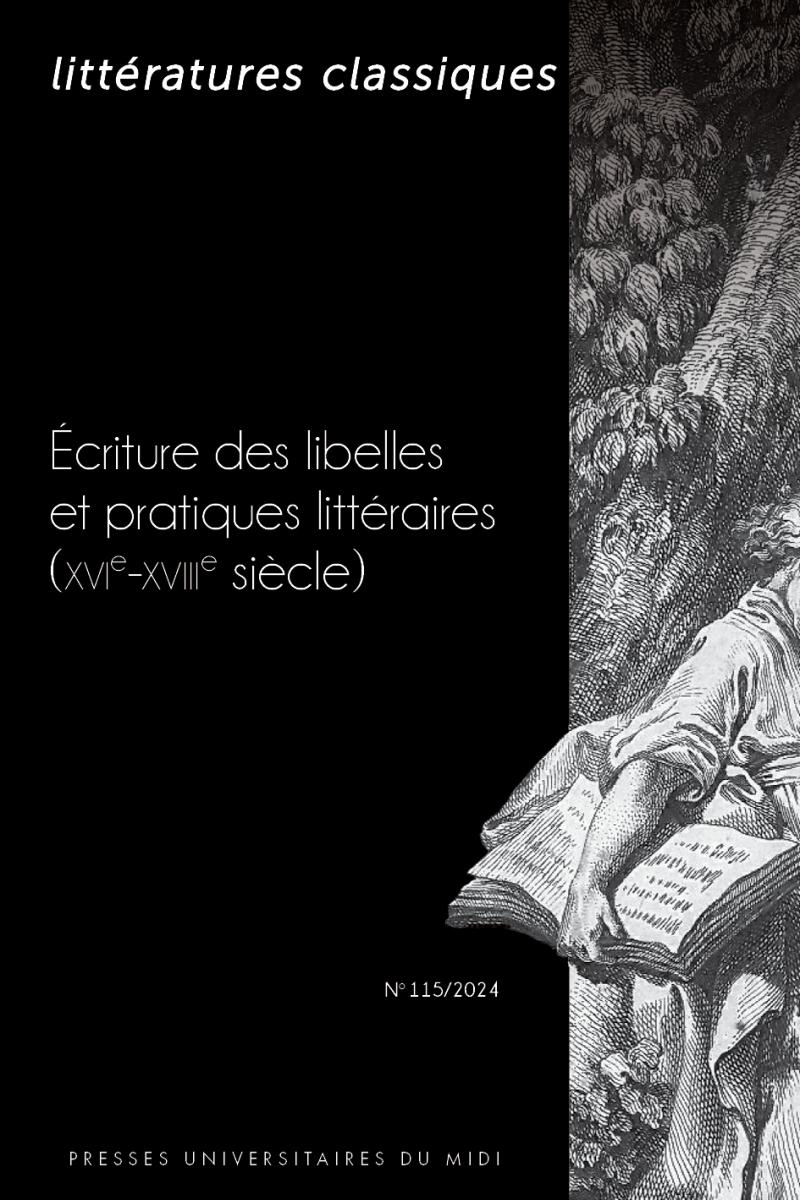
Littératures classiques, n° 115, Karine ABIVEN, Delphine AMSTUTZ, Alexandre GODERNIAUX et Adrienne PETIT (dir.), "Écriture des libelles et pratiques littéraire"
Posted: 6 Mar 2025 - 09:42

Littératures classiques, n° 115, Karine ABIVEN, Delphine AMSTUTZ, Alexandre GODERNIAUX et Adrienne PETIT (dir.), "Écriture des libelles et pratiques littéraire"


Quelles sont les relations entre l’écriture des libelles et les pratiques littéraires dans la France de la première modernité ?
Cette enquête collective explore différentes modalités de cette interaction entre littérature et communication politique du XVIe au XVIIIe siècle : propagande, performance, renouveau de la rhétorique délibérative, recours aux formes littéraires dans les débats publics. Prendre en compte la porosité entre les écritures d’intervention et les belles lettres permet de mieux étalonner le regard sur des œuvres devenues « classiques », de plonger dans un bain polémique certains textes canoniques, de restituer l’énergie rhétorique qui animait en leur temps des écrits désormais entrés au patrimoine. À l’inverse, la mise en évidence de l’inscription référentielle et de la visée polémique de certaines œuvres rapidement tombées dans l’oubli peut paradoxalement leur redonner un intérêt proprement littéraire. Il s’agit dès lors de désenclaver le territoire de la littérature moderne, pour baliser différemment ses frontières à partir de ce qui apparaît parfois trop simplement comme ses marges.


Plus d'informations ici.

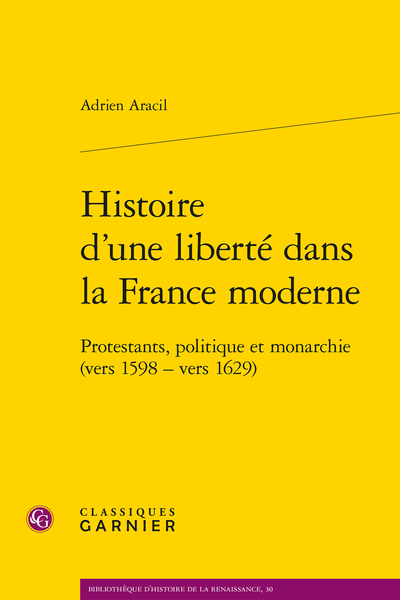
Histoire d’une liberté dans la France moderne Protestants, politique et monarchie (vers 1598 – vers 1629) - Adrien Aracil
Posted: 6 Mar 2025 - 09:37

Adrien Aracil, Histoire d’une liberté dans la France moderne Protestants, politique et monarchie (vers 1598 – vers 1629), Paris, Classiques Garnier, 2025.
Parler de liberté pour comprendre la politique d’Ancien Régime est inattendu. Comprise comme une capacité à l’action libre, la notion structure pourtant la façon dont les huguenots se sont glissés dans le cadre contraint où la monarchie française se réélabore après les guerres de Religion.

Plus d"informations ici.

Les Frères Du Bellay et l'Europe Politique et culture à la Renaissance - dir. Denis CROUZET, Rosanna GORRIS CAMOS et Loris PETRIS
Posted: 6 Mar 2025 - 09:33

Les Frères Du Bellay et l'Europe Politique et culture à la Renaissance, dir. Denis CROUZET, Rosanna GORRIS CAMOS et Loris PETRIS, Genève, Droz, 2025.
Pourquoi et comment les frères Du Bellay, notamment l’aîné Guillaume, seigneur de Langey, et Jean, le cardinal, ont-ils été appelés à jouer un rôle majeur dans l’histoire européenne, entre 1526 et 1560 ? Pour le comprendre, les contributions rassemblées dans ce volume scrutent les rythmes de leurs parcours mouvementés, les spécificités de leurs réseaux de clientèle et de sociabilité, le rôle qu’a joué l’écriture dans leur ascension, dans des perspectives économique, politique, militaire, diplomatique, culturelle et littéraire. De nombreuses sources archivistiques inconnues sont étudiées et renouvellent la compréhension d’une famille, autour d’un moment Du Bellay et d’un lieu majeur : l’Italie. « Sans fin pour France travaillant […] Son vif esprit pour François bataillant » : le mot de Peletier du Mans sur Langey vaut à coup sûr pour Guillaume et Jean, et peut-être aussi, différemment, pour Martin et René. 

Plus d"informations ici.

Antiquités, recherches et bibliothèques. La naissance de l'histoire littéraire en France dans la seconde moitié du XVIe siècle - dir. S. Geonget, S. Menegaldo et T. Uetani
Posted: 6 Mar 2025 - 09:24

Antiquités, recherches et bibliothèques. La naissance de l'histoire littéraire en France dans la seconde moitié du XVIe siècle,  dir. S. Geonget, S. Menegaldo et T. Uetani, Paris, H. Champion, 2025.

Après un demi-siècle de combat pour la langue française, la France du dernier quart du XVIe siècle voit émerger une conscience de sa littérature nationale. Ainsi s’élabore, en particulier avec les travaux de Claude Fauchet, d’Étienne Pasquier, de La Croix du Maine et de Du Verdier, un discours sur la littérature française, ses origines, son histoire et ses spécificités ; de Jean de Meun à Pierre de Ronsard, des auteurs tendent à devenir constitutifs d’un patrimoine littéraire proprement français, méritant d’être exploré, catalogué, décrit, analysé et mis à l’honneur par ces pionniers de l’histoire littéraire qui mettent à contribution sources manuscrites ou imprimées, réseaux de solidarité et modèles érudits, en France et hors de France, afin d’ériger les premiers monuments à la gloire du génie poétique français.

Plus d'informations ici.

Conferences and Colloquia

Journée d’études en ligne : "AUTOUR DU LIVRE", en l'honneur de Colette Winn
Posted: 12 Oct 2020 - 17:15

Friday, October 16, 2020 at 9 AM CDT – 4 PM PDT

Public · Hosted by French Connexions at Washington University in St Louis

Online Event

The French cultural center at Washington University in St Louis presents:

"AUTOUR DU LIVRE"

Silver Colloquium Journée d’études en l'honneur de Colette Winn

16 october 2020

Department of Romance Languages and Literatures (RLL)

Washington university in St. Louis

for contact about registration : Lionel Cuillé, lcuille@wustl.edu


Schedule (all times in CDT / GMT -5)

9:00 Welcome

9:15-10:15 Session I : Book Culture

Julie Singer, Washington University in St Louis "Enseignements à mon frère? Anne of France and the Bourbon memory of Saint Louis" (BnF MS fr. 2829)

Faith Beasley, Dartmouth College "Textes et contextes: Writing Conversation"

Anne Larsen, Hope College "Salons, Network Patronage, and the Self-Representation of French Seventeenth-Century Women of Science"


10:15-10:30 Coffee Break


10:30-11:15 Session II : Self-Fashioning Women’s Identities

Cathy Yandell, Carleton College "Reading the Bodies of Witches: The Case of Jeanne des Anges (1632-1637)"

Karen de Bruin, University of Rhode Island "Transcending the Father: Germaine de Staël and the Perfectibility of the Human Species"


11:15-11:30 Coffee Break


11:30-12:15 Session III : Poètes courtisans

François Rouget, Queen's University (Canada) "Catherine de Retz et ses admirateurs : Complément d’enquête sur Amadis Jamyn et Cholières"

Cynthia Skenazi, University of Santa Barbara "Modes d'emploi du livre: L'exemple du "Poète Courtisan" de Du Bellay"


12:15-1:30 Lunch


1:30-2:30 Session IV : Visualizing the Text

Marilynn Desmond, Binghamton University (SUNY), "Visualizing Briseida in Late Medieval Manuscript Illustration"

Harriet Stone, Washington University in St Louis " Through the Dutch Doorway to the House that Lafayette Built for the Princesse de Clèves"

Andrew Clark, Fordham University "Performing Portraits: How Women in the Ancien Régime Use Portraits to Confirm and Upend Historical Truth"


2:30-2:45 Coffee Break


2:45-3:45 Session V : Defending Women

Deborah McGrady, University of Virginia "The Return of Joan of Arc: The Slow Transformation of the Heretic into a Heroine in Sixteenth-Century France"

Tili Boon Cuillé, Washington university in St. Louis "The Scepter and the Distaff: Rousseau’s "La Reine Fantasque" as Intertext"

Fabienne Moore, University of Oregon "Re-authorizing the Social Contract: Etta Palm’s "Lettre d’une amie de la vérité" (March 1791)


4:00-5:00 Celebrating Colette

Please also visit our online companion online companion "Autour du livre": https://library.wustl.edu/spec/exhibits/ curated by Zhiyuan Meng and Julie Singer and featuring Early Modern French books from Washington University Libraries’ Special Collections.

We thank the Washington University Libraries, the Department of Romance Languages and Literatures, and the estate of Isidore and Edith Silver for their generous support.

Professor Colette Winn has taught French language and literature courses at every level. She has supervised decades of Washington University students both in St. Louis and in France, including as part of the French for the Pre-Med Program in Nice, a vibrant and successful summer program which she created in 1993 and has directed ever since. Colette was named Chevalier de l’ordre des Palmes Académiques in 1995 in recognition of her extensive contributions to French Studies. Colette has always been, and remains, an extremely dedicated teacher and mentor whose students have, year after year, course after course, séjour after séjour, benefitted from her profound commitment to their education and well-being. It is in honor of her many accomplishments and contributions that we celebrate Colette today. The organizers:

Tili Boon Cuillé, Julie Singer, Harriet Stone

* For a full list of Colette Winn's publications, see  https://rll.wustl.edu/files/rll/2019Winn.pdf

Talk: 'In a Manner that Might have No': Sexual Desire and Intellectual Disability in French Fairy Tales
Posted: 12 Oct 2020 - 17:02

Greetings! I wanted to share a talk that I am giving with the "Women, Gender and Early Modern World" research group at the Harvard Mahindra Center. 

The talk is from my second book project in progress (The Body Perfect: the Aesthetics of Ableism in the Early Modern French and Francophone World). This particular talk is titled "'In a Manner that Might have No': Sexual Desire and Intellectual Disability in French Fairy Tales" https://mahindrahumanities.fas.harvard.edu/event/manner-might-have-meant-no-sexual-desire-and-intellectual-disability-early-modern

The talk is 10/22 at 5 PM EST (4PM CST) and the zoom link will be sent upon registration. I'd love to see you there!

Warm regards, 

Jennie 

-- 

Jennifer E. Row, PhD

Assistant Professor

Department of French and Italian, University of Minnesota

Affiliate faculty, Theatre Arts & Dance

304D Folwell Hall  

2020-2022 Imagine Chair in Arts, Design, and Humanities with Tammy Berberi and Jigna Desai

Critical Disability Studies Collective co-chair 

(she/her/hers; Jennie or J.Row) 

November 2020 zoom conference, Masculinities in the Premodern World: Continuities, Change, and Contradictions
Posted: 27 Sep 2020 - 14:45

12-14 November 2020

The past twenty-five years have witnessed a bourgeoning of studies on sexuality and gender in the pre-modern world. In particular, men and masculinities have received considerable attention. Building on the theoretical perspectives provided by feminism, Foucault, and cultural studies, the study of men and masculinities is increasingly theoretically inflected and sophisticated. Studies have encompassed questions pertaining to men of various social statuses, secular and ecclesiastical, as portrayed in historical, literary, philosophical, theological, and art historical sources among others.

The conference, sponsored by the Toronto Renaissance and Reformation Colloquium (TRRC), seeks to locate the study of premodern men and masculinities in its current richness and complexity. 

REGISTER BY OCTOBER 30 AT EventBrite.

https://trrc.itergateway.org/2020_conference

Panic & Plague in 1720 & 2020: The View from Minnesota (Lecture Series)
Posted: 20 Sep 2020 - 21:40

The Center for Early Modern History invites you to join us for our fall lecture series, Panic and Plague in 1720 & 2020: The View from Minnesota. In 1720, the Mississippi Company, a project of financial speculation in the Mississippi River region, collapsed. The explosion of this financial bubble coincided and was entangled with the last mass outbreak of bubonic plague in European history in Marseilles, followed shortly thereafter by a devastating outbreak of smallpox in Boston. This series brings together scholars from across disciplines and across the globe to discuss the intercutting relationships between disease and financial disaster in the early 1720s -- reflecting on parallels in the early 2020s.

https://drive.google.com/file/d/1ZCL8ocR12e-3FCBROVSPCD9yxJwa-tea/view

Addressing Racism and Anti-Blackness in French and Francophone Studies: A Virtual Colloquium Series
Posted: 13 Sep 2020 - 17:03

SPONSORED BY THE FRENCH DEPARTMENT AT WELLESLEY COLLEGE

https://sites.google.com/wellesley.edu/addressing-antiblackness/schedule

Registration required

All talks take place from 2:30–3:45 PM EST

Speakers and dates:

Marlene L. Daut, Professor of African Diaspora Studies, University of Virginia, Thursday, September 17, 2020

Alice L. Conklin, Distinguished Professor of History, Ohio State University, Thursday, September 24, 2020

Anne Lafont, Directrice d'études, EHESS, Wednesday, September 30, 2020

Philippe Blanchet, Professeur de sociolinguistique, Université Rennes 2, Wednesday, October 7, 2020

Dorian Bell, Associate Professor of Literature and Jewish Studies, UC Santa Cruz, Thursday, November 5, 2020

Tyler Stovall, Dean of Fordham University's Graduate School of Arts and Sciences, Thursday, November 12, 2020

Crystal Fleming, Professor of Sociology, Stony Brook University, Tuesday, November 17, 2020

Please see the website for titles of talks and other details:

https://sites.google.com/wellesley.edu/addressing-antiblackness/schedule

Member News Briefs

Leanna Bridge Rezvani
M.I.T.

With thanks to Leanna Bridge Rezvani for reminding me of her pedagogical website on teaching La Princesse de Clèves, to which she has made additions since speaking about the resource at last year's SE-17 conference.

You can access the site via the following URL:

http://teachinglaprincessedecleves.com

Post date: 10 years 12 months ago
Cahiers du dix-septième (XVI, 1)

Congratulations to the authors featured in the newest volume (XVI, 1) of the Cahiers du dix-septième :

http://se17.bowdoin.edu/cahiers-dix-septieme/2015-volume-xvi-1

Table of Contents

Alison Calhoun.  Corneille’s Andromède and Opera: Practice Before Theory ..........................1

Nathalie Freidel.  La ruse du nom, machination rhétorique dans Amphitryon de Molière ...... 18

Ralph Albanese.  Ruses et stratégies discursives dans L’Ecole des Maris  ..................................35

Christophe Schuwey.  Le Mercure galant : un recueil interactif ...................................................48

Herbert Morris.   The Absent and Present Serpent in Nicolas Poussin’s Spring ...........................63

Henry Cohen.  Racine’s Esther: In Praise of Historiographers and Historians ............................77

Sylvie Romanowski.  Teaching the Seventeenth Century at the Graduate Level .........................93

BOOK REVIEWS

Braider, Christopher. The Matter of Mind: Reason and Experience in the Age of Descartes. Toronto: University of Toronto Press, 2012. ISBN 978-1-4426-4348-2. Pp. 340.   Reviewed by Ellen McClure..........................................................................109

Randall, Catharine. The Wisdom of Animals: Creatureliness in Early Modern French Spirituality.  Notre Dame, IN:  University of Notre Dame Press, 2014.  ISBN 978-0-268-04035-2. Pp. 178.   Reviewed by Jean Leclerc.................................................111

Winn, Colette H., ed. Teaching French Women Writers of the Renaissance and Reformation. New York: The Modern Language Association of America, 2011. ISBN 978-1-60329-089-0. Pp. viii & 440.  Reviewed by Kathleen Llewellyn.........................................................................113


Post date: 10 years 12 months ago
‘Dying of the Fifth Act’: Corneille's (Un)Natural Deaths, Joseph Harris
Royal Holloway, University of London

Bravo to Joseph Harris for his article in the most recent volume of French Studies:

"‘Dying of the Fifth Act’: Corneille's (Un)Natural Deaths"

French Studies (2015) 69 (3): 289-304 

http://fs.oxfordjournals.org/content/early/2015/05/19/fs.knv075.abstract

Post date: 10 years 12 months ago
Early Modern French Studies (Volume 37, Issue 1, July 2015)

Congratulations to the authors featured in the newest volume of Early Modern French Studies (Volume 37, Issue 1, July 2015).

*Please note that effective January 2015, Seventeenth-Century French Studies changed its title to Early Modern French Studies to reflect an expansion in scope.*

http://www.maneyonline.com/toc/emf/37/1

Valérie M. Dionne, “Le Sourire canin de Montaigne et de La Mothe le Vayer, ou la vertu cynique du libertin”

Michael Meere, “Theatres of Torture: Martyrs, Pagans, and the Politics of Conversion in Early Seventeenth-Century France”

Tatiana Senkevitch, “The Portrait of the King’s Minister and the State of Collaboration”

Helena Taylor, “Ovid, Galanterie, and Politics in Madame de Villedieu’s Les Exilés de la cour d’Auguste”

Jean-Alexandre Perras, “Le ‘Siècle de la frivolité’: sur l’invention d’un lieu commun au XVIIIe siècle”

Post date: 10 years 12 months ago
Papers on French Seventeenth Century Literature XLII, No. 83, 2015
Christian-Albrechts-Universität zu Kiel

Bravo à Rainer pour l'édition de son dernier numéro de PFSCL!

http://periodicals.narr.de/index.php/papers_on_french

Post date: 11 years 1 week ago