Announce

Calls for Papers and Contributions

CFP: Objects of Desire – International Conference at Lille Catholic University
Posted: Sunday, October 15, 2017 - 10:55

24-26 May 2018 ; Proposals 15 December 2017

Organisers: Lille Catholic University, Liverpool Hope University and the ENSFR (European Network for Short Fiction Research)

Call for Papers

Literature, religion and art began with objects of desire and have never abandoned the theme. From Helen of Troy and the forbidden fruit in the Garden of Eden via Novalis’s blue flower to the throne of Westeros, numerous examples spring immediately to mind, and if the ten commandments tell people not to covet anything that belongs to their neighbours, this surely implies that they are highly likely to do just that.

As the philosopher Elizabeth Anscombe defines it: “The primitive sign of wanting is trying to get,” (2000) which explains why desire provides the motive for action, in history and in literature. Every love story, but also every crime novel and every political empire starts with desire, and its object may be a person, a diamond or a continent. Although there is a certainly a difference between desiring the presence of God, desiring a million dollars and desiring a large ice cream, any and all of these may inspire the artist or the writer.

Opinions also differ on the desirability of desire. If Buddhists and Stoics tend to believe that we should seek to free ourselves from desire and Plato felt our desires should be put aside for the greater good, Freudian and Lacanian analysts encourage us to recognise our desires and many Christians, like Pascal and C.S. Lewis, have declared that “we are too easily pleased” (1941) and should desire far greater joy than we have yet known. Artists, writers and film directors still continue this debate, incarnating the good, bad and indifferent results of desire in their works.

Desire may be understood in relation to gender—do men and women long for the same things? Sexual attraction is a theme to be considered and so is the very idea of love. Carson McCullers has famously proposed a definition in “The Ballad of the Sad Café” (1943): “love is a joint experience between two persons — but the fact that it is a joint experience does not mean that it is a similar experience to the two people involved. There are the lover and the beloved, but these two come from different countries.” Exploring these countries could give way to discussions that could use, as a starting point, Judith Butler’s approach in her first published book Subjects of Desire in which she analyzes the interplay between desire and identity. Looking at desire through the prism of gender studies will also make it possible to reflect upon ideals of femininity and masculinity, but also of beauty, the way they are (re)presented in the media, in advertisements…

What does the act of desiring tell us about the object of desire? Is the one who desires truly seeking love, beauty, wealth, immortality or power in the object and if so, are they right to do so or is the object merely the attractive facade of a powerful illusion or delusion? Do objects of desire exist through necessity? How are they created? What role do advertising or video clips accompanying popular songs play in their creation? Has the way objects of desire are represented changed over the centuries? Did particular periods of history have specific ways of portraying them?

We welcome proposals in French or English that explore the relation between short fiction and desire across different periods and genres, including flash fiction, the novella and short story cycles. As a concentrated and intense form of prose writing, short fiction lends itself very well to representations of desire. As Sarah Hall says, “The form is very good at unzipping the mind’s fly” (‘Sex, Death and the Short Story’). Think of Katherine Mansfield’s “Bliss” (1918): “For the first time in her life Bertha Young desired her husband;” or of J. G. Ballard’s “The Subliminal Man” (1963), where hypnotic techniques of advertising turn the desire for consumer items into an irresistible compulsion. The short story form itself may be driven by desire as a structuring principle, the desire for instance of the reader to explore its gaps and mysteries. In Towards the End (1985), for instance, John Gerlach suggests that closure may be an object of desire. Several critics have analysed desire and its objects in the novel. Peter Brooks speaks of “a dynamics of desire animating narrative and the construal of its meanings;”(1993). René Girard’s concept of “mimetic desire” suggests that a human instinct for imitation is what drives people. Do these ideas also apply to the short story or do desire and the short story interact in a different way?

We also welcome papers from other areas of literary studies, cultural studies (including cinema and television), philosophy, psychology, theology, communication, history and history of art.

Although we expect most proposals to be individual, panel proposals of three closely related papers will also be considered.

Proposals (250-300 words) should be sent to gerald.preher@univ-catholille.fr and suzanne.bray@univ-catholille.fr by 15th December 2017.


CFP: Authority, Gender and Social Relations
Posted: Sunday, October 15, 2017 - 02:05

Durham (UK, 23-26 July 2018), proposal by 31 October 2017

Durham Early Modern Studies Conference

Durham University

For some years, Durham University has hosted a regular Seventeenth-Century Studies Conference. With the establishment of an Institute of Medieval and Early Modern Studies (IMEMS) at Durham, we are re-launching this conference with a more ambitious timeframe, taking the ‘early modern’ to cover the period 1450 to 1800. For the 2018 conference, we are focusing on the authority, gender and social relations. We conceive of these concepts in their broadest sense and take them to include (but not necessarily be restricted to) the following:

  • Gender and class: useful categories of analysis?
  • Patriarchy and the household
  • Power in the landscape
  • Resistance and rebellion
  • Clientage, subordination, reciprocity and affinities
  • Communities and neighbourhoods
  • Archaeologies of authority
  • Archaeologies of community and place
  • Gender, belief and the body
  • Elites and society
  • Architecture, art and power
  • Landscapes and social topographies
  • Literary and dramatic representations of authority and resistance
  • Occupation and social structure
  • Labour discipline
  • Slavery, serfdom and unfree labour
  • Ethnicity and national identity
  • Religious radicalisms
  • Belief and hierarchy
  • Dress, demeanour and authority
  • Experiences of inequality: clothing, housing, food and diet

Interdisciplinary approaches are welcome. We are keen to deal with transnational histories and with the history of the New World and with European relations with the rest of the globe.

We welcome proposals both for individual 20-minute papers and for panels comprising three 20-minute papers. Please send proposals for papers (300 words) or panels (3 x 300 words, with a rationale for the panel) including title and abstract(s) to: early.modern@durham.ac.uk by 31 October 2017.

The first day of the conference will be given over to papers by postgraduate students, with the support of the Durham Medieval and Early Modern Students Association (MEMSA).

Replies to all submissions will be sent no later than early 2018.

CFP: Visions and Revisions: Romance Utopias and Dystopias
Posted: Sunday, October 15, 2017 - 01:29

24th Annual Carolina Conference for Romance Studies University of North Carolina at Chapel Hill April 5-7, 2018

Visions and Revisions: Romance Utopias and Dystopias

Utopian and dystopian visions span Western intellectual history from Thomas More's coinage of the former term in 1516 to the powerful twentieth century literary dystopias that influence our understanding of the current political climate worldwide, such as Aldous Huxley's Brave New World, George Orwell's 1984, Margaret Atwood's The Handmaid's Tale, and Sheree Thomas' anthology Dark Matter.  Etymologically, utopia means "no place"--a place that does not (yet?) exist--but it is also a play on words, being close to the Greek for "good place," thus the association of utopia with an idealized society.  While the utopian genre began as a way to envision political alternatives and solutions for social and economic inequality, dystopias show the potential dangers of such experiments.

In Romance Studies, we have the opportunity to examine the development of utopia and dystopia as genres within the literary traditions of Spanish, Italian, French, and Portuguese speaking countries. We can also look at how these concepts have been transformed by decolonial and postcolonial perspectives in order to influence the political and intellectual struggles of the colonized worlds. In literature, as well as in cinema, philosophy, contemporary theory, and video games (ecc.), how do authors, filmmakers, and artists use utopias and dystopias to address, debate, and/or comment on real-world issues such as, but not limited to, nuclear warfare, neoliberalism, global climate-change, technological “progress,” and socio-economic inequalities? How are these ideas used to elucidate elements of society that might otherwise remain unnoticed, whether potential solutions to human suffering or warnings about the cataclysmic potential contained within a present that may seem innocuous on the surface? What do utopian and dystopian visions and revisions have to teach us about the intersections between art, politics, technology, and science? 

Topics of interest and approaches may include but are not limited to:

  • Animality
  • Animation
  • Apocalyptic and post-apocalyptic literature
  • Biopolitics
  • Comics
  • Colonial, decolonial, and postcolonial studies
  • Cultural studies
  • Ecocriticism
  • Enlightenment era
  • Feminism (western and non-western)
  • Film studies
  • Gender studies
  • Genre theory
  • Historical fiction
  • Middle Ages and Renaissance studies
  • Performance
  • Political science
  • Popular culture
  • Posthumanism
  • Queer theory
  • Science fiction, fantasy, and horror
  • Virtual spaces and video games
  • Visual arts
  • War

Please submit abstracts of 300 words in English to ccrs2018@gmail.com by December 18, 2017.  Presentations of no more than twenty minutes should be conducted in English in order to facilitate connections among subject areas more so than language concentration.  We also welcome proposals for language-specific roundtables in Spanish, French, Italian, or Portuguese.  Panel proposals and roundtables should include a completed form from each participant. Seeccrs.unc.edu for more information.

Please submit a single-page Word document in the following format:

Name:

Email address:

Affiliation:

Classification: (Professor, Ph.D. Student, M.A. Students, Post-doc, independent researcher, etc.)

Title:

Abstract (300 words, single-spaced):

Relevant Time Period(s) and Country(-ies):

Keywords (up to 6):

CFP: The Society for the Study of French History 2018 Annual Conference ‘Political Economy and Cultures of Inequality’
Posted: Sunday, October 15, 2017 - 01:23

University of Warwick

9-10 July 2018


Public concerns about inequality have grown in recent years. They do so at a time when historians are turning their attention increasingly to political economy. Thomas Piketty’s Le capital au XXI siècle (2013) has been especially influential in sparking debates over the history of inequality and political economy, and it is to these debates that this conference seeks to contribute. How have political and economic cultures come together to create, reinforce or contest inequality? How has inequality been conceptualised in France and the francophone world? And what impact have wealth inequalities had on politics and culture? In engaging with these themes, participants should feel free to interpret them in the broadest possible terms.


Invited speakers include:

Michael Kwass (Johns Hopkins University), Marie-Emmanuelle Chessel (Sciences Po) and Jackie Clarke (University of Glasgow). There will also be a round-table on the conference theme as well as a special panel in honour of seiziémiste Mack Holt and another in memory of Richard Bonney, a founding member of the Society and founding editor of the associated journal, French History.


In addition to the conference theme, we also invite papers or panels on any aspect of French history from the early medieval to the contemporary period and we welcome contributions that reflect the broad diversity of the history of France and its former colonial empire.  

We invite proposals for twenty-minute papers in English or in French. Panels of three papers are especially welcome, as are contributions from postgraduate students and overseas scholars. Paper proposals should comprise a title, abstract of 300 words and a one-page CV in a single pdf file. The deadline for submission of proposals is 15 December 2017. Please send these to the organising committee: Pierre Purseigle, Penny Roberts and Charles Walton: SSFH2018@warwick.ac.uk   

CFP: French Medico-Textual Cultures
Posted: Sunday, October 15, 2017 - 01:15

Queen’s University Belfast, 9–10 March 2018

Confirmed Keynote Speakers: Prof. Holly Tucker (Vanderbilt) and Dr Larry Duffy (Kent)

Deadline for proposals: Friday 24 November 2017

The aim of this conference is to consider the reciprocal influence of French and francophone medical and cultural texts in shaping popular and professional understandings of illness, disease and the patient experience. We invite proposals for papers focussing on the ways in which French cultural texts (literature, film, graphic novel, blog, documentary...) engage with developments in medical research, as well as the role played by cultural texts in representing the pathogenic origins, contagious action and lived reality of a wide range of diseases from the early-modern period to the present day.

Questions to be addressed include:

• How do medical and cultural texts develop a mutually-reinforcing understanding of illness and disease? 

• How is disease textually transmitted across genres and disciplinary boundaries?

• How do first-person narratives of illness engage with medical texts or theories, and vice-versa?

• How do cultural representations of disease influence medical and scientific concepts of health and disease, and vice-versa? 

• In what ways do cultural texts comment on the patient experience of national healthcare systems and their potential flaws? 

• How do physician-writers use cultural texts to engage the public in the work that they do? 

Proposals of c. 250 words for 20-minute papers (in French or English) that deal with any aspect of the above questions should be emailed to the conference organiser, Dr Steven Wilson (steven.wilson@qub.ac.uk), by Friday 24 November 2017.

This event is supported by the British Academy and the Modern Languages Core Disciplinary Research Group at Queen’s.

New Publications

The Dream of Absolutism: Louis XIV and the Logic of Modernity (Hall Bjørnstad)
Posted: 3 Nov 2021 - 05:10

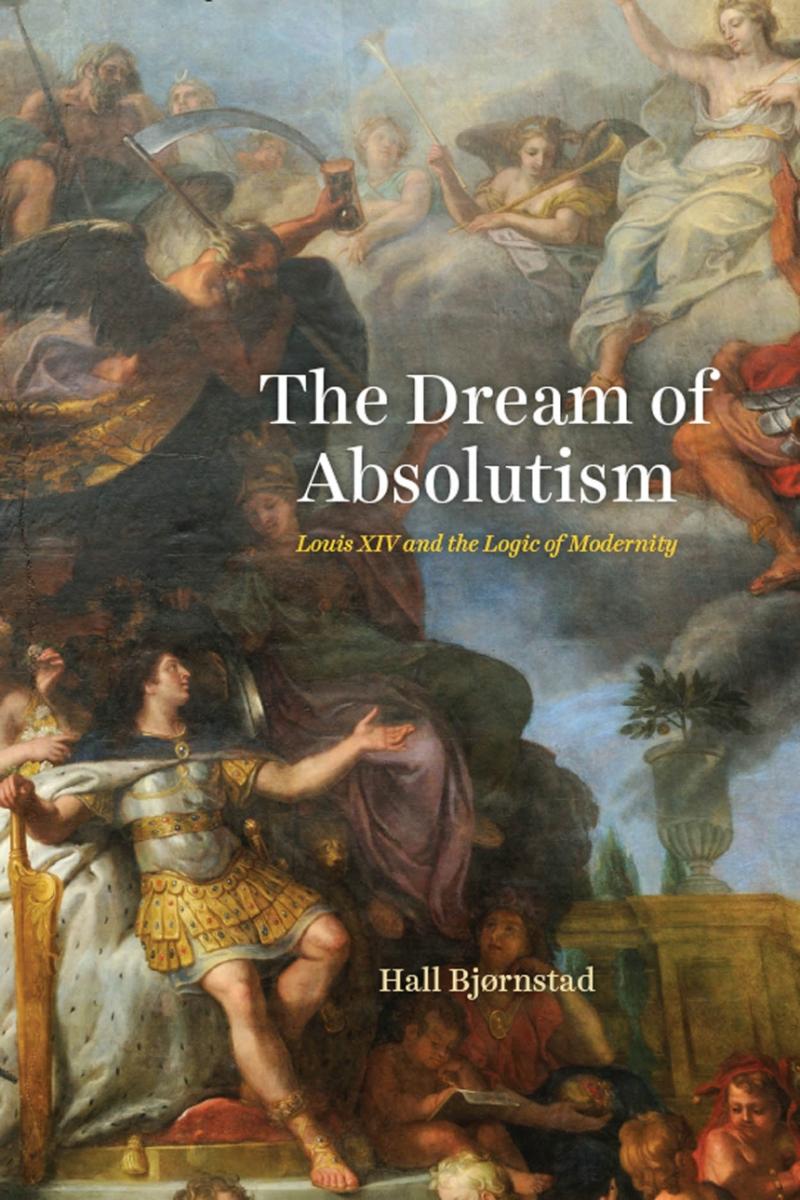
Hall Bjørnstad, The Dream of Absolutism: Louis XIV and the Logic of Modernity (University of Chicago Press, October 2021). 
What was absolutism, and how did it work? What was the function of the ostentatious display surrounding Louis XIV at Versailles? What is gained—and what is lost—by approaching such expressions of absolutism as propaganda, as present-day scholars tend to do? 

In this sweeping reconsideration of absolutist culture, Hall Bjørnstad argues that the exuberance of Louis XIV's reign was not top-down propaganda in any modern sense, but rather a dream dreamt collectively, by king, court, image-makers, and nation alike. Bjørnstad explores this dream through a sustained close analysis of a corpus of absolutist artifacts, ranging from Charles Le Brun's famous paintings in the Hall of Mirrors at Versailles via the king's secret Mémoires to two little-known particularly extravagant verbal and textual celebrations of the king. The dream of absolutism, Bjørnstad concludes, lives at the intersection of politics and aesthetics. It is the carrier of a force that emerges as a glorious image; a participatory emotional reality that requires reality to conform to it. It is a dream, finally, that still shapes our collective political imaginary today. 

For more details see: https://press.uchicago.edu/ucp/books/book/chicago/D/bo113684735.html  

248 pages | 7 color plates, 14 halftones | 6 x 9

Trois adolescents d'autrefois, Rodrigue, Agnès et Hippolyte (Patrick Dandrey)
Posted: 3 Nov 2021 - 05:06

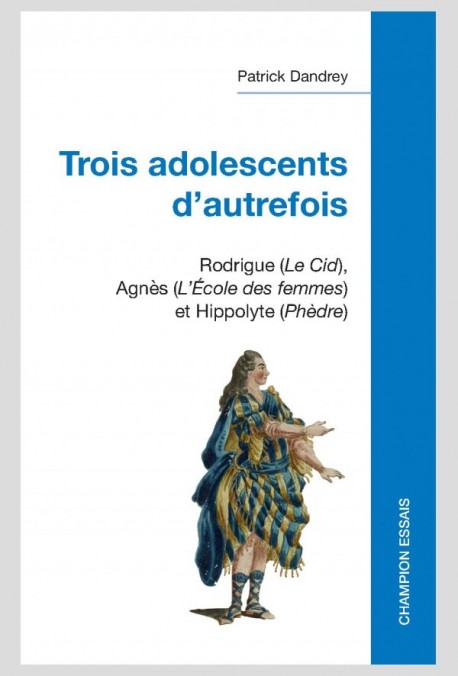
Patrick Dandrey, Trois adolescents d'autrefois, Rodrigue, Agnès et Hippolyte, Paris, Honoré Chamption, "Champion essais", 2021.
Peut-être parce qu’on s’est accoutumé à les voir incarnés à la scène par des comédiens plus âgés que leurs rôles, Rodrigue, Agnès et Hippolyte, héros de trois chefs-d’œuvre parmi les plus vivants et les plus puissants du théâtre français, se caractérisent par un trait commun qu’on a trop oublié : ce sont des adolescents. Soumis à des figures adultes dont ils subissent les injonctions contradictoires et les passions mal maîtrisées, ils sortent de l’enfance assujettie et prétendent à une reconnaissance comme sujets de plein droit, comme sujets adultes : cette transition, c’est ce que nous nommons adolescence. Mais au XVIIe siècle l’adolescence ne constitue pas une tranche de vie identifiée et autonome : on y entre et on en sort par phases décousues, par « tuilage ». L’œuvre dramatique aurait-elle donc pour tâche de combler ce vide, de dire cette béance, de revendiquer cette reconnaissance ? En relisant dans cette optique inédite ces trois pièces, on les redécouvre : toujours neuves et étonnamment méconnues.

Disponible en librairie et sur le site de l'éditeur.

Collection CHAMPION ESSAIS

Format13 X 20 CM

No dans la collection0055

Nombre de volume1

Nombre de pages204

Type de reliureBROCHÉ

Date de publication27/09/2021

ISBN9782745357427

Libertines and the Law (Adam Horsley)
Posted: 1 Nov 2021 - 13:58

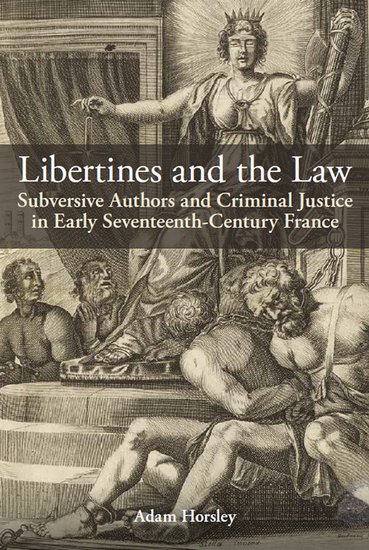
Adam Horsley, Libertines and the Law: Subversive Authors and Criminal Justice in Early Seventeenth-Century France (Oxford: Oxford University Press / British Academy Postdoctoral Fellowship Monographs, 2021), 432 pp.
Following the assassination of Henri IV in 1610, the political turbulence of Louis XIII's early reign led to renewed efforts to police the book trade during a golden age of so-called 'libertine' literature. Libertines and the Law examines the notorious trials of three subversive authors. The Italian naturalist philosopher Giulio Cesare Vanini was brutally executed for blasphemy by the Parlement de Toulouse in 1619. The Jewish convert Jean Fontanier was burned at the stake two years later in Paris for authoring a text refuting Christian teaching. Finally, the trial of the infamous poet Théophile de Viau for irreligion, obscenity, and poetic descriptions of homosexuality proved to be a landmark in French literary and social history, despite the poet eventually escaping the death penalty in 1625.

These trials are contextualised with a conceptual history of libertinism, as well as an exploration of literary censorship and the mechanics of the criminal justice system in early modern France. Drawing from legal manuals, rarely explored archival sources, newly discovered documents, and forgotten witness testimonies, Libertines and the Law provides new insights into the censorship of French literature and thought from the perspectives of both the defendants and the magistrates. Through a diverse corpus including poetry, philosophical texts, religious polemics, Jewish teachings, private memoirs, and seventeen images of the relevant trial records, it sheds new light on this crucial period in literary, legal, and intellectual history.

Table of contents.

Hardback
Published: 14 October 2021
432 Pages | 17 Illustrations
ISBN: 9780197267004

Notre Homère. stratégies d'appropriation des poèmes homériques (XVIe - XXIe siècle) (dir. C. Louette et A. Sahla)
Posted: 29 Oct 2021 - 17:11

Notre Homère. stratégies d'appropriation des poèmes homériques (XVIe - XXIe siècle), dir. Christiane Louette et Agathe Sahla, Grenoble : UGA Editions, coll. "Lire l'Antiquité", 2021.
EAN 9782377472819.

Prix : 35EUR.

Présentation :

À l’heure où traductions et adaptations d’Homère se multiplient, ce livre explore les moyens que les artistes et écrivains français ont mis en oeuvre pour faire d’Homère un auteur patrimonial. Transmission, traduction, transformation, transposition : les auteurs examinent toute forme d’appropriation créatrice qui se réalise parfois au risque d’un dévoiement ou d’un écart. Son sujet est la vulgarisation d’Homère à tous les sens du terme, du plus noble – le transfert dans la langue vulgaire – au plus péjoratif – la chute du piédestal – en passant par l’adaptation à un public pluriel : vulgariser, c’est rendre accessible au plus grand nombre. Les auteurs font le choix de considérer les diverses appropriations des textes homériques comme des enrichissements, voire des oeuvres à part entière : il ne s’agit pas seulement de traduire, mais de faire « nôtre ».

Transhistorique et pluridisciplinaire, il croise les approches d’antiquisants et de modernistes, de stylisticiens et de comparatistes, approches plurielles et multiples d’un nous collectif.

Url de référence :
https://www.uga-editions.com/menu-principal/actualites/a-paraitre/notre-homere-888920.kjsp...

Variations on the Ethics of Mourning in Modern Literature in French (dir. C. Bourne-Taylor, S.-L. Cooper)
Posted: 29 Oct 2021 - 17:09

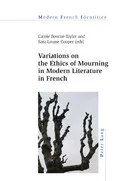
Carole Bourne-Taylor, Sara-Louise Cooper (dir.), Variations on the Ethics of Mourning in Modern Literature in French, Oxford, Peter Lang, Coll. Modern French Identities, 2021.

How does modern writing in French grapple with the present absence and absent presence of lost loved ones? How might it challenge and critique the relegation of certain deaths to the realm of the unmournable? What might this reveal about the role of the literary in the French and francophone world and shifting conceptions of the nation-state? Essays on texts from the Revolution to the present day explore these questions from a variety of perspectives, bringing out the ways in which mourning contests the boundaries between the personal and the historical, the aesthetic and the ethical, the self and the other, and ultimately reasserting its truly critical resonance.


Table of contents

Dominique Rabaté - Préface ix

Dominique Rabaté: Translation by Stephen Romer

Preface xi

Acknowledgements xv

Carole Bourne- Taylor - Introduction 1
 

Part I Unmournable Revolutions

Benjamin Thurston - Impossible Mourning: Funeral Orations for Louis XVI (1814– 1815) 57
Rachel Benoît - Unmourned Histories in Gustave Flaubert’s
L’Éducation sentimentale 85


Part II Inconsolable (Af)filiations

Jennifer Rushworth - The Rhythm of Mourning in Proust (with Barthes and Derrida) 109Henriette Korthals Altes -

Mourning their Mothers: Roland Barthes, Jacques Derrida and the Gift of Tears 129

Khalid Lyamlahy - With Barthes and Derrida in ‘the Margins of a Funereal Song’:

The Poetics of Maternal Mourning in the Work of Abdelkébir Khatibi 153

Sara- Louise Cooper - ‘Mourning the Mother, Mourning the World:
Patrick Chamoiseau’s La Matière de l’absence’ 183


Part III Poéthique: Between New Elegy and Anti- Elegy

Ariane Mildenberg - ‘The Door Pushed Back the Light’: On a Phenomenology of Mourning in Maurice Merleau-Ponty and Jacques Roubaud 205

Daisy Sainsbury - The Ends and Beginnings of Language in Valérie Rouzeau’s
Pas revoir 227

Carole Bourne- Taylor - Poethic Justice: Re- incarnations in Emmanuel Merle’s Poetry 249

Sara- Louise Cooper - Conclusion: Mourning in Motion from Ireland to the Caribbean 271
Notes on Contributors 287
Index 291

Url de référence :
https://www.peterlang.com/view/title/70482